






{{item.videoDuration}}
{{item.title}}
{{item.text}}

{{item.videoDuration}}
{{item.text}}
Special purpose acquisition companies (SPACs) raise capital through an initial public offering (IPO) for the purpose of merging with or acquiring an operating company, referred to as the “target”. For the target company, merging with or being acquired by a SPAC is an alternative path that management teams can take to access the public markets and achieve liquidity for its shareholders in lieu of executing its own traditional IPO.
The SPAC merger pathway offers several distinct advantages over a traditional IPO. These advantages include providing valuation certainty and expected ownership dilution at the onset of the “going public” journey. By comparison, the traditional IPO pathway subjects companies to market volatility and pricing uncertainty until the road-show and book-building process at the end. The SPAC merger approach also provides management teams the ability to negotiate more customized deal terms, such as minimum cash requirements as closing conditions or deal structures that link valuation and ownership dilution to post close, or post de-SPAC, performance—features that are not available in a standard IPO.
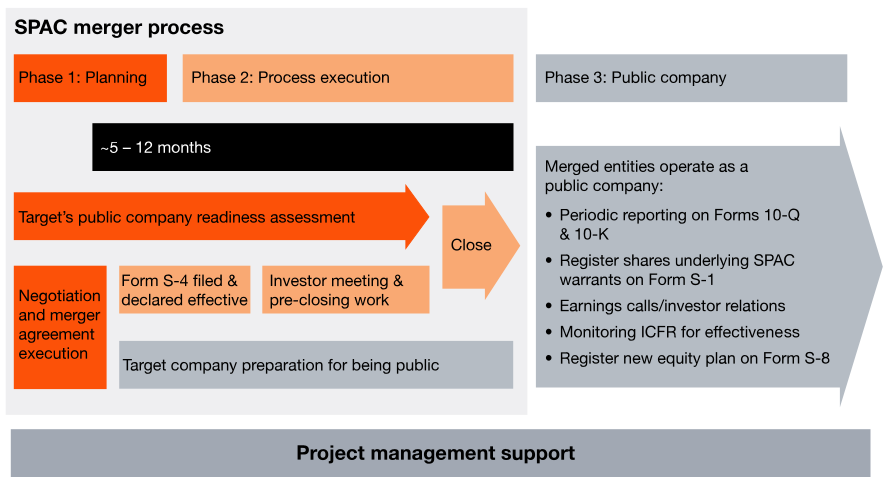
There are several challenges experienced in a SPAC merger, notably having to potentially meet an accelerated public company reporting timeline as well as navigating different legal and financial reporting requirements. The target company’s management team will need to focus on being ready to operate as a public company within three to five months of signing a letter of intent.
Explore recent market activity in our latest Capital Markets outlook
A SPAC is generally formed by an experienced management team or a sponsor with nominal invested capital, though the shares held by the sponsor typically equate to a ~20% stake in the SPAC’s capitalization, known as the “founder shares”, “sponsor shares”, or the “promote”. The remaining ~80% stake is held by public shareholders through “units” offered in the SPAC’s IPO. Traditionally, each publicly traded unit consists of a share of common stock and a fractional warrant (e.g., ½ or ⅓ of a warrant). More recently, the IPO units offered in SPAC IPOs no longer include warrants. But the units do include automatic rights to receive additional shares of common stock (e.g., ⅒ of a share) upon closing of the deal with a target company, known as the “de-SPAC”. Sponsors typically also purchase warrants or share rights.
Founder shares and public shares generally have similar voting rights, with the exception that founder shares usually have sole right to elect the SPAC directors prior to the de-SPAC. Warrant and share right holders generally do not have voting rights, and only whole warrants are exercisable and only whole share rights are settled in shares.
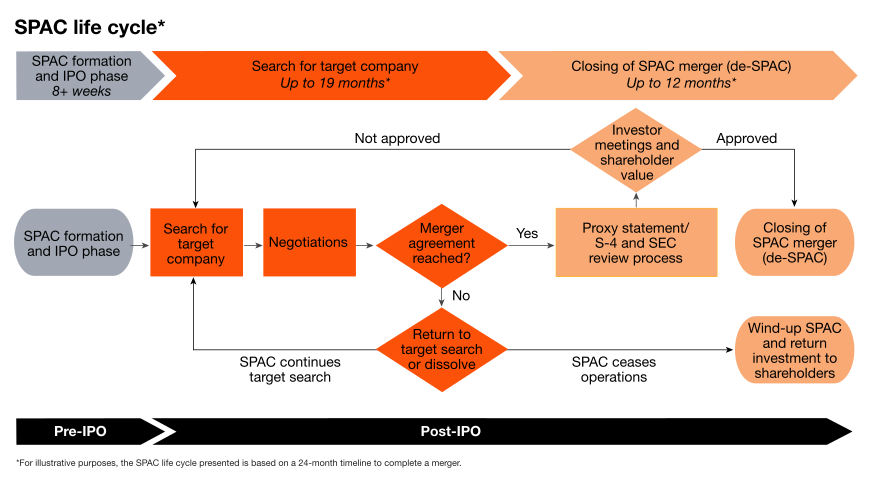
A SPAC’s IPO is typically based on an investment thesis focused on a sector and geography, such as the intent to acquire a technology company in North America, or a sponsor’s experience and background. Following the IPO, proceeds are placed into a trust account and the SPAC typically has 18-24 months to identify and complete a merger with a target company. If the SPAC does not complete a merger within that time frame, the SPAC may seek shareholder approval to extend the life of the SPAC or will be required to liquidate and return the IPO proceeds held in the trust account to the public shareholders.
Once a target company is identified and a merger is announced, the SPAC’s public shareholders will vote for or against the transaction and separately decide whether to redeem their shares or not. If the SPAC requires additional funds to complete a merger, the SPAC may issue debt or issue additional shares, such as a private investment in public equity (PIPE), as a backstop. The backstop financing is typically contemplated upfront in connection with the merger negotiations between the SPAC and the target’s management teams to ensure that a minimum amount of cash remains available post redemptions of the SPAC’s public shareholders, along with a base of committed investors who believe in the equity story of the target.
The SPAC will typically need to solicit shareholder approval for a merger and will prepare and file a proxy statement (or a joint registration and proxy statement on Form S-4 if it intends to register new securities as part of the merger). This document will contain various matters seeking shareholder approval, including a description of the proposed merger and governance matters. It will also include financial and non-financial disclosures of the target company, such as historical financial statements, management’s discussion and analysis (MD&A), pro forma financial information showing the effect of the merger, risk factors, and a description of the target’s business.
Once shareholders approve the SPAC merger and all regulatory matters have been cleared, the merger closes and the target company becomes a public entity. A Form 8-K, with information equivalent to what would be required in a Form 10 filing of the target company (commonly referred to as the Super 8-K), must be filed with the US Securities and Exchange Commission (SEC) within four business days of closing.
In recent years the SEC issued updated guidance for SPACs and de-SPAC transactions designed to enhance transparency and investor protection. The rules:
The target company will need to consider numerous cross-functional impacts for going public and being public, such as:
SPACs continue to be a path to liquidity for many companies. The SPAC merger process with a target company may be completed in as little as three to four months, which is substantially shorter than a typical traditional IPO timeline. Accordingly, a target company must accelerate public company readiness well in advance of any SPAC merger. Further, given the compressed timeline of a SPAC merger, project management is essential in order to reduce execution costs, increase project efficiencies, and provide working group participants with enhanced accountability and transparency.
Executing a SPAC merger is an alternative track to the public markets — but it comes with unique complexity. PwC helps target companies prepare for and navigate SPAC transactions with the same rigor as a traditional IPO.
Our cross-functional team of capital markets, accounting, valuation, tax, and deals specialists supports companies at every stage of their SPAC journey, including:
To create a clear path forward, you need the confidence that comes from working with a team of straight-talking advisors and actionable insights from a team of dedicated professionals. Find out how we can guide you through each step of the readiness assessment process and beyond.
{{item.text}}
{{item.text}}


