





After a year of rapid policy shifts, economic uncertainty, and operational disruption, US executives seem to have found their footing. Yet risk remains broad and persistent and, as companies converge around similar strategic responses, differentiation is becoming harder to achieve. Our April 2026 survey, Executive views on policy, risk, and growth, shows how priorities for the next 12 months vary by industry—even as investment in AI, risk management, and pursuing new growth markets are elevated across the board.
For consumer markets leaders, trade and technology are equally urgent priorities
Consumer markets (CM) executives are navigating two seismic forces, a volatile trade environment reshaping the rules of global commerce and rising AI adoption that promises to reshape those rules again. Despite these pressures, 87% say their company is stronger than two years ago.
According to PwC’s April 2026 survey, Executive views on policy, risk, and growth, adjusting trade strategy is the No. 1 action CM leaders have been taking (40%) since January 2025, with tech and AI investment close behind (34%). Looking ahead to the next 12 months, 95% plan to maintain, increase, or start new tech and AI investments.
The question isn't whether to prioritize trade or technology. It's how to move fast enough on both while managing a policy environment that seems to shift by the week. Eighty-eight percent of CM leaders have baked tariffs into their baseline forecasts—treating disruption as a new operating condition rather than an exception. And 81% say that they see disruption and volatility as opportunities for competitive advantage.
Nowhere is that confidence more earned than in supply chain resilience. Nearly seven in ten CM executives (69%) say they’re ahead of competitors on supply chain strength, and the data backs them up. Companies that adjusted channel and fulfillment strategies (34%) or reworked their merchandising, assortment, or promotional approach (22%) report improved cash flow or cost predictability at a rate of 61%, a 14-percentage-point advantage over those who didn't make comparable moves. In a margin-pressured environment, proactive go-to market calibration isn't just smart strategy. It's measurable competitive advantage.
Perhaps most surprising is that many CM leaders (57%) say that energy availability has caused them to make significant changes to their business strategy over the last six months. For an industry more accustomed to tracking foot traffic and basket size than kilowatt hours, that's a striking recalibration.
Separately, 52% of CM leaders say AI regulation is one of the top 3 factors affecting short-term strategy. But with 76% acknowledging that they're still at least 12 months from seeing AI returns beyond cost savings, the bigger opportunity—deploying AI across the value chain, finding coherence, enabling agentic commerce, meeting the next generation of shoppers where they are—remains largely ahead of them. The action portfolio CM leaders describe is unusually broad, suggesting companies are pulling every lever simultaneously rather than making concentrated wagers on any single trend. And in a world where the rules keep changing, that’s a wise posture.

Energy and industrials: From disruption to decisive action
For energy and industrials (E&I) executives, the turbulence of the past 15 months hasn’t translated into hesitation. Instead, it’s accelerated action. Nearly two in three E&I executives (66%) plan to increase or pursue new M&A opportunities or divestitures, according to our April 2026 survey, Executive views on policy, risk, and growth. In an environment defined by supply chain disruption and realignment, energy infrastructure investment, and consolidation pressure, they’re using dealmaking as a deliberate growth lever—a proactive bet on the future, not mere reaction to market conditions. A fluid policy environment and fast-shifting trade landscape have redrawn the competitive map, and they’re moving decisively to claim their position as leaders.
That dealmaking appetite is backed by a belief in technology as an offensive growth strategy. Sixty-five percent rank the speed of technology adoption and scaling as their No. 1 enabling factor for growth over the next one to two years. For E&I companies that have moved quickly, the results are already showing with improvements in strategic agility (64%), market competitiveness and the ability to enter new markets quickly (62%), and supply chain resilience (61%). As AI accelerates demand for reliable energy infrastructure and reshapes industrial operations, the companies that move fast on technology have the opportunity to gain the most ground.
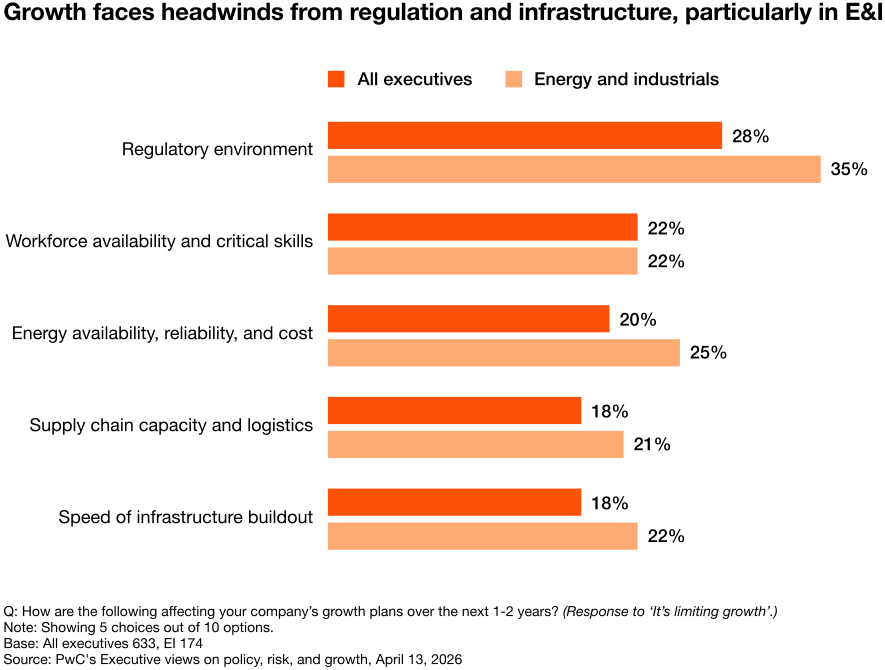
Yet E&I executives are candid about what could slow them down. More than one in three (35%) cite the regulatory environment as a key limiter to growth, more than any other sector. The current policy landscape helps illustrate why. Policy volatility, trade-driven cost inflation, and an uneven federal stance on the energy transition are creating real friction for long-term investment planning. Executives who act decisively on today's opportunities while absorbing what policy and markets throw next can be well-positioned to win.
Financial services firms keep AI at the center of strategy and investment
Across financial services (FS), firms are moving to AI execution. Institutions are focused on where AI is delivering measurable impact, how it's reshaping operating models, and what it takes to scale those outcomes across the enterprise.
According to financial services respondents in our April 2026 survey, Executive views on policy, risk, and growth, 70% are increasing or maintaining their AI/technology investment spending while a further 25% are starting new spending in that area. Furthermore, 45% rank AI and data regulations among the top three factors causing them to rethink their corporate strategy over the next one to two years, outpacing US economic policy and US antitrust policy (40% and 39%, respectively).
That emphasis on AI and data is being driven by what financial firms see happening around them as the lines between traditional FS businesses blur, creating more competition. PwC’s research shows how AI is changing the industry, forecasting that a bank’s efficiency ratio could drop 15 percentage points when AI is fully deployed. Asset managers can use AI to prepare for a future where what we call Universal Asset Access is real. Meanwhile, transformation in insurance is being driven by new information sources and analytics to price insurance coverages and protect infrastructure. And investors are driving investment as they pressure management teams to reinvent by deploying technology.
Technology is a critical lever for future viability, FS executives say in our survey. The top growth-enabling factors are the pace of AI’s return on investment (60%) and the speed of technology adoption and scaling (60%). Taking steps to transform amid an uncertain macroeconomic direction and tougher competition can pay results. FS firms that modified credit, lending, or underwriting standards, or adjusted liquidity, capital buffers, or balance sheet mix since January 2025 were more likely to report stronger results. About 70% of action-takers reported improvements in innovation speed and effectiveness than peers who took no such action (55%). And action-takers were more likely to report improvement in cost or margin performance (64% versus 48%).

Defensive moves dominate, even as healthcare sees upside in disruption
Health industry executives lean heavily on defensive actions when disruption hits. The most common C-suite response is to preserve cash or defer investment (43%), followed by protecting supply chains (38%), according to our April 2026 survey, Executive views on policy, risk, and growth.
Policy stands out as the primary force shaping these responses. US domestic and foreign policy regulation each drove significant strategic change for 59% of health industries executives, the highest across all drivers.
Tariff policies register as the top risk (65% moderate or serious), and healthcare executives are responding. Adjusting trade strategy and increased US capex/manufacturing investment are tied in our survey as the No. 1 strategic actions taken since January 2025 (38% each). Notably, 36% of these executives have already rebalanced their workforce between human roles and AI.
Health industries executives say their actions are paying off, with 62% seeing improvements in how quickly they can adjust strategy and 59% reporting better risk mitigation. Only 40% report improvements in cost and margin performance, pointing to ongoing financial pressure.
Overall, most executives say their company is stronger than it was two years ago (84%). And uncertainty is not viewed purely as a threat. Most health industries executives (86%) agree that disruption and volatility present opportunities for competitive advantage, including 43% who strongly agree. Looking ahead, trade policy and AI regulation are the top two factors causing executives to rethink their one- to two-year strategies (48% and 47% respectively).

Tech, media, and telecom move capital with confidence amid uncertainty
A year and a half into the Trump administration, technology, media, and telecommunications (TMT) executives express more confidence than other industry leaders. According to our April 2026 survey, Executive views on policy, risk, and growth, 45% of TMT executives strongly agree that their companies are in a better position than two years ago. Most (55%) say they’re ahead of competitors in access to and deployment of capital, as well as operational efficiency. That position is shaping capital allocation.
Since January 2025, 43% of TMT respondents have increased spending on technology and AI alongside expansion into new growth markets. And the payoffs are already taking shape. Seventy-one percent report improved tech adoption and scale, 72% cite faster and more effective innovation, 69% point to faster entry into new markets, and 70% report stronger competitiveness––especially those making deliberate infrastructure decisions, where 69% capture value from tax credits and incentives, a 15-percentage-point premium over peers who did not take action. These outcomes sit largely within management’s control, reinforcing continued focus on AI and innovation as core growth drivers.
Policy and risk tell a different story. Forty percent report increased engagement with policymakers and expanded proactive risk management, but results vary. Fifty-six percent report improved policy clarity while 20% say it’s too early to assess impact and another 20% report no change. Risk mitigation shows a similar pattern. Sixty-seven percent report improvement and 13% say it’s too early to tell while only 4% report worsening conditions. These areas remain less controllable, with slower and less consistent progress.
Together, these dynamics reflect pragmatic optimism. TMT leaders are capturing near-term gains where they can directly influence outcomes, particularly in AI and technology, while continuing to engage in policy and risk areas with longer timelines. The broader environment reinforces this approach. Even as organizations increase focus on AI, regulation (especially around AI and data) remains the biggest factor reshaping strategy. Regulatory complexity is constraining growth, and so are the speed of technology adoption and scaling, infrastructure buildout, and shifting customer demand.
When major external disruptions such as geopolitical tensions, policy shifts, economic volatility, or security threats occur, TMT organizations focus first on safeguarding technology, data, and networks while also advancing innovation and AI-led differentiation. The posture is clear. Strengthen resilience where outcomes are uncertain and continue allocating capital where returns are more visible.

About the survey
Between March 12 and March 20, 2026, PwC surveyed 633 US executives, including CEOs, CFOs and finance leaders, COOs and operations leaders, CIOs, CTOs, and technology leaders, risk leaders, including CROs, CAEs, and CISOs, tax leaders, and corporate board members, on business conditions, policy shifts, geopolitical risk, and growth opportunities. Respondents included executives from consumer markets (20%), energy and industrials (27%), financial services (24%), health industries (9%), and technology, media, and telecommunications (18%).


