



From shelves to systems: Why the future...

The invisible disruption
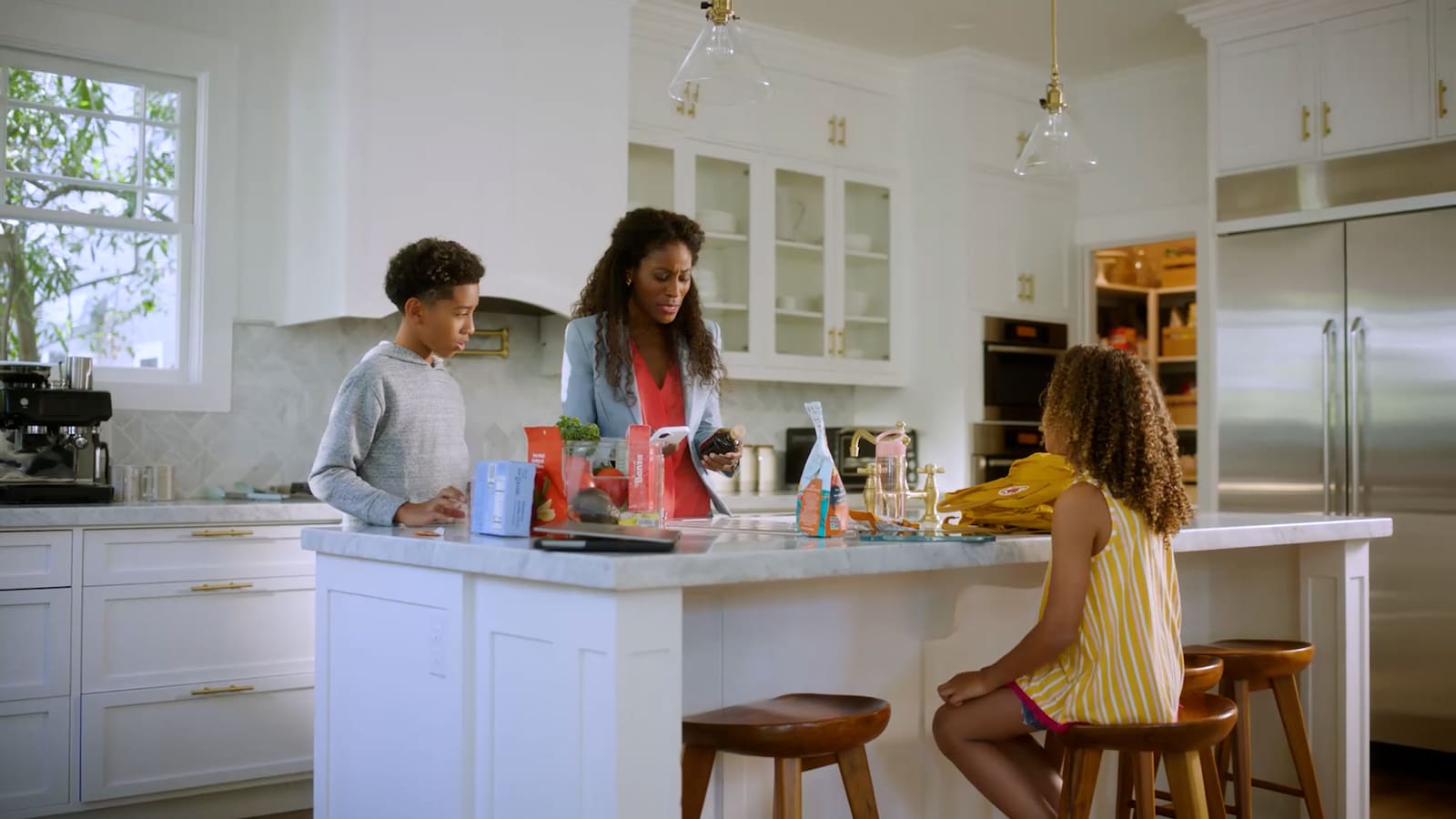
Picture this: It’s 7:42 am on a weekday morning in 2030, and the house is already in motion. Vanessa, the CFO at a commercial real estate firm, is running late. Her daughter Maya is still eating cereal. Her son Miles is bouncing a basketball by the door. “Mom, we're out of shampoo,” Maya says.
“Got it,” Vanessa replies, grabbing the lunch boxes. Without breaking stride, she speaks to her phone: “Order the usual, but less sugar in the soda. And sulfate-free shampoo for curly hair.”
Her AI assistant doesn't need clarification. It remembers who likes what. Adds in a free sample of fair-trade dark chocolate and protein bars — algorithm-approved. The groceries will beat her home. She won’t think about it again.
No list. No cart. No run to the store. Just the quiet logic of a system that knows what you need. An almost invisible shopping experience.
The future of consumer goods
What’s next: Kitchens that keep their own lists
By 2030, even Vanessa's "invisible shopping experience” could feel slow — if consumers adopt AI at speed and scale. The connected fridge won’t just track inventory; it could replenish staples like milk and vegetables, automatically aligned to household routines.
Perhaps Vanessa won’t even place an order. In the future, her AI agent will — a digital assistant, powered by GenAI, that could act on her behalf. Unlike a simple chatbot or recommendation engine, an AI agent could be designed to autonomously perceive, decide and act across the shopping journey. It might know Vanessa’s spending thresholds, her values, her tastes. If she watches a chef making miso tofu and shaved cucumber salad, the AI agent could parse the recipe and send ingredients so she can cook the dish that night. Context becomes command. Discovery blurs into fulfillment.
The most successful CPG companies won’t just respond to demand — they'll anticipate it, at the speed of life. That shift is already underway: PwC’s 2025 Future of Consumer Shopping Survey finds that millennials expect their technology use to rise significantly over the next five years.
For business leaders, it's important to remember that the most significant consumer disruptions don’t happen in boardrooms. They start in kitchens like Vanessa’s, in the micro-moments between packing lunches and finding car keys. Just consider what has already happened with the unprecedented velocity of AI, the rising adoption of GLP1s and the Make America Healthy Again (MAHA) movement. These aren’t short-term trends — they're signals that consumer behavior is being reprogrammed.
While today’s market brings affordability pressures, private label gains and operational constraints, those very challenges make it more urgent to begin building the capabilities needed for what’s next. In tomorrow’s world, where everyone has their own personal AI assistant, the companies that reset for consumer intimacy and real-time engagement now will be the ones positioned to grow as traditional models lose their relevance. But what will it take for more consumers to trust AI to shop on their behalf? According to our survey, people want clear guardrails that will make the process feel safe and transparent.

The company behind the virtual cart: A new engine for growth
Historically, CPG companies thrived on a simple premise — control the shelf. Prime placement in grocery aisles, mass advertising campaigns and well-timed discounts turned browsing into buying. But in a world where more decisions are made before a shopper ever sets foot in a store, if they go at all, that model is eroding.
The companies gaining ground don’t look like the old guard. In many cases, they’re lean — with fewer than 300 employees in some cases. They manage content in-house. They connect the dots between creator buzz, product trials and retail sell-through in real time. They don’t win because they outspend the market. They win because they out-listen. They’re built not for scale, but for signals.
“We don’t do focus groups. Our team reflects our community — diverse, Gen Z, millennials. They live how our consumers live. That gives us better signals than a survey.”
According to PwC’s 2025 CPG Executive Survey, nearly half of leaders believe their current business structures won’t survive the decade. The question is, where will value come from in the future?
They know it won’t come from squeezing already thin margins or expanding SKUs. It will come from resetting how a company moves, senses and responds. That might mean launching direct-to-consumer (DTC) channels for behavioral insights, building wellness platforms that span food and beauty, or activating digital touchpoints. The idea is to convert intent into action, from personalized promotions in retailer apps to content-driven experiences powered by loyalty data.
These aren’t tweaks. They’re architectural shifts. And they increasingly hinge on AI-native models, agentic commerce and orchestration systems that act in real time. The payoff? Growth that doesn’t just scale — it adapts.
“Growth will come from meeting more specific needs — better. There’s a lot of value in that.”
Privileged insights as competitive advantage
For years, many CPG companies have relied on lagging indicators like focus groups and surveys to understand consumer behavior. But those tools explain what already happened. In a world where signals emerge in real time, insights need to happen faster.
Take this example from an innovative beauty brand’s product development process: the team noticed consumers mixing two separate products — a blush and a barrier repair cream — to get hydration and color in one step. In response, the company designed and developed a hybrid blush that delivers both, clinically backed and community driven. No focus group required.
“We watch. We listen. Then we build. That’s how a consumer hack becomes a product.”
It’s the same kind of signal your system might detect from someone like Vanessa — adding sulfate-free shampoo one week, searching for tinted moisturizer the next and watching three “get ready with me” videos with her daughter on a Sunday night. That’s not just browsing. It’s behavior. And behavior, observed early, is a growth engine.
That's why collecting privileged insights isn't just about collecting more data. It's about recognizing when real life is trying to tell you something — whether it’s through a group chat, a product hack or a morning like Vanessa’s. The companies that can operationalize these insights across marketing, R&D and fulfillment are the ones most likely to stay relevant, even as consumer behaviors shift again.
“We’re constantly building our superpowers — not just premium quality and value, but products that are vegan, cruelty-free, and fair-trade certified. All of that comes directly from listening to what our community values.”
When industries converge
The lines between food, beauty, wellness and medicine are dissolving. Consumers don’t think in categories — they think in outcomes: sleep, energy, confidence, recovery. And they expect products to adapt.
Vanessa’s smartwatch, for example, doesn’t just track her steps. It nudges her when iron levels drop. Her AI agent scans the signal and recommends fortified crackers and cereal — not because of a health campaign, but because it fits her actual week. One tap, and it’s done.
For CPG companies, this is a different kind of growth opportunity — one rooted in converging needs. Brands are no longer just marketing benefits. They’re building ecosystems: a product, a nudge, a routine, a result.
Some are already shifting. Legacy cereals are being reintroduced as part of holistic wellness campaigns. Probiotic drinks are positioned not as beverages, but as daily gut-health interventions. A peel-off mask isn’t just for skin — it’s for confidence before a big moment, often shared in a story or stream.
Other brands are embedding into cultural rituals, with sports partnerships, streaming integrations and pop-up events that blur the line between content and commerce. Those aren’t just touchpoints. They’re behavior anchors. The best ones won’t say, “We make snacks.” They’ll say, “We support rest and recovery routines.” They won’t say, “We sell face masks.” They’ll say, “We design rituals of calm.”
That kind of strategic realignment is already happening inside companies via deals. Leaders are selling off categories that no longer serve their future ambitions, while valuing targets not just based on financials but on loyalty, churn risk and digital engagement — then leaning on M&A as a transact-to-transform play. In a converging market, competitive advantage will go to those who act decisively, curating brands that can grow with tomorrow’s consumer while letting go of those that can’t. So what will define value in that future? Becoming part of the consumer’s intention — not just their shopping basket.
The innovation imperative
Innovation used to mean building a better product. Today, it means building for a more unpredictable life.
Consumers aren’t looking for features, they’re looking for solutions and outcomes. Products are no longer one-dimensional. They’re contextual. Emotional. Disposable when they need to be, enduring when they don’t. And yet, most innovation cycles are still optimized for scale, not speed. Marginal improvements. Delayed timelines. Launches packed with complexity. Meanwhile, consumer behavior is already five steps ahead and AI is starting to catch up.
Speed doesn’t come from process improvements alone. It comes from infrastructure, too. Investments in DTC channels, agile R&D loops and lower-risk launch formats that let companies test, learn and iterate in real time. Leading brands are even simulating demand through dynamic personas modeled on real behavior.
But innovation isn’t just about tech. It’s about curiosity and courage. Most companies in mature industries take a cautious path. But our analysis of nearly 3,000 U.S. public companies shows that the small minority — just 5% — that accelerated their investment in innovation outperformed, earning stronger market valuations over time. Reinvention may be rare, but markets recognize it when it’s real.
The next wave of innovation won’t be a bigger pipeline. It’ll be a smarter, more responsive one, built around real life rather than shelf space.
“To use AI strategically is to use it to drive sustainable advantage — not just to cut costs, but to outthink, outmaneuver and outwit the competition by encoding responsiveness.”
The agentic enterprise
In consumer goods companies, AI is beginning to work behind the scenes, function by function, across the value chain: generating marketing content, adapting pricing strategies and coordinating supply chains. Today, many deployments remain siloed, but the future direction is clear — toward systems that learn, interconnect and adapt in real time.
The shift toward more “agentic” enterprises could meaningfully change how work is structured. These agents won’t just accelerate execution. They can compress layers of activity, connect signals across departments and free up human teams to focus on strategy, creativity and long-term value. But realizing that potential depends on more than implementing tools. It means exploring how AI can help reimagine workflows altogether — not just thinking about automation for efficiency’s sake, but thinking about how to build systems that can adapt, scale and evolve alongside shifting business demands. And that requires a new kind of operating model. Imagine a few possibilities:
Teams could work with AI agents, not just use them. In this case, collaboration could happen in real time, not in handoffs, as humans and technological tools build on each other’s strengths.
Information could flow in different ways. With adaptive systems insights could move vertically and horizontally — across functions, up to decision makers and back down to the front lines — to drive faster decisions.
Feedback loops could include every part of the business. In this instance, insights come from more than analytics dashboards. They come from capturing what’s happening in stores, on factory floors, in warehouses, at employees’ desks and through call centers — and using those inputs to steer faster, smarter decisions.
“We’re reinventing how we collect consumer insights by leveraging new technologies. Instead of relying on claimed behavior, we’re focused on data that reflects actual consumer behavior — the kind that enables stronger predictive algorithms. The goal is simple: better alignment between what people want and what we deliver.”
While many CPG companies are early in the journey, momentum is building. Organizations are beginning to use intelligent systems to shorten time to market, adjust cost-to-serve models and improve alignment between consumer demand and supply decisions.
This isn’t a back-office transformation. It’s the emergence of a new front end for growth — one where intelligent systems shape strategy in real time, human teams focus on what truly differentiates their organization and performance becomes more adaptive by design. For CPG companies ready to lead, the agentic enterprise is no longer a future aspiration. It’s already starting to take shape.
“I think the org chart of the future will have humans — and AI agents that play roles alongside them. It will be a meritocracy of agents, just like it is for people.”
Racing against time
As Vanessa and her kids head into the car, her phone buzzes with confirmation that her order will arrive before she’s back home. She doesn't think about her AI assistant’s dozens of micro decisions, or the troves of data being generated about her family’s habits. She’s just relieved that everything is handled ahead of a weekend packed with soccer and dance.
This is how revolutions unfold — not with sweeping proclamations, but through quiet conveniences that become indispensable.
In five years, the phrase “grocery run” may sound as dated as “dial-up.” The question isn't whether upheaval in the CPG industry will happen — it's whether your company will lead it or be left behind.
“What got you to the party isn’t what keeps you there. You have to stay curious — and build what people haven’t even asked for yet.”

Be ready for the next consumer disruption
When the phrase “grocery run” sounds as dated as “dial-up,” will your business be ready?
Contact us