





From backlog to breakthrough: AI agents are your IT force multiplier
11/08/25


Summary
- AI agents are reshaping the IT operating model—taking on routine tasks to multiply capacity and free specialists to focus on strategy and innovation.
- With AI agents, IT becomes a strategic driver—fueling faster delivery, smarter decisions and broader business impact.
- Success starts with a clear baseline, capturing pre-AI metrics to track where agents help deliver value.
- CIOs should act decisively, identifying high-impact workflows and aligning tech and talent.
If you’re an IT leader looking to AI agents to tackle your biggest pain points, you’re on the right track. AI agents can help you manage technical debt, scale capacity beyond what offshoring and vendor rationalization can achieve, and solve problems fast. With smart deployment, you can start seeing real IT value in 90 days or less.
But that's just the beginning. The real opportunity comes when AI agents don’t just fix issues but enable a new IT operating model. One with smaller, higher-impact teams where each specialist operates at a senior level, focused on innovation and work that truly adds value. Agents take on the repetitive, lower-complexity work. When delivery speeds up, innovation follows — amplifying IT’s role in driving your business forward.
This transformation is taking place right now. In our May 2025 AI Agent Survey, 53% of US businesses deploying AI agents report using them in IT and cybersecurity. But not every organization is moving fast enough. And the stakes are high. According to our 2025 Global AI Jobs Barometer, companies leveraging AI see revenue growing three times faster per worker, underscoring the risk for CIOs that haven’t yet begun to empower the enterprise with AI agents.
AI agent adoption by function
Companies are already deploying or planning to deploy agents across all functions...
Near-term AI agent use by business function
Q: In which of the following business functions is your company currently using or planning to use AI agents in the next 6 months? (Select all that apply.)
Source: PwC’s AI Agent Survey, May 2025, base: 290.
The rules of IT have changed. Have you?
AI agents can take on up to 50% of your IT team’s daily tasks — an impact we’re seeing both in-house and with clients.
AI agents can deliver value by reasoning, solutioning and executing on their own. They can also work in teams. You assign them a high-level objective like debugging code, monitoring logs, organizing data or remediating an incident. Then, if they’re well-orchestrated, agents will plan each step, tap external tools and data, and carry out the work from end-to-end. Crucially, they learn from their actions and outcomes and they keep getting better over time.
In our IT transformations with clients, we’ve seen AI agents reduce effort, enhance user experiences and surface insights faster and more reliably. The result? Your people spend less time on routine operations and more time driving innovation and strategy.
These and other benefits can — and should — be tracked. AI agents deliver IT value across four dimensions: reduced costs, enhanced performance, rebalanced workload and a transformed workforce model. But to realize and prove that value, you need a clear baseline.
Start by capturing pre-AI metrics like cycle times, service levels, operating expenses, full-time equivalents (FTEs) and task volumes. This diagnostic phase sets the foundation. It helps reveal where inefficiencies lie, where value is hidden and what “good” should look like going forward.
Once agents are deployed, continue to measure. Critically, AI agents must unlock savings — not add complexity. Real value comes not just from automation, but from reimagining work — where agents absorb routine tasks and people shift to higher-impact roles. That shift doesn’t just reduce costs; it boosts speed, quality and satisfaction.
Where AI agents are reducing IT effort
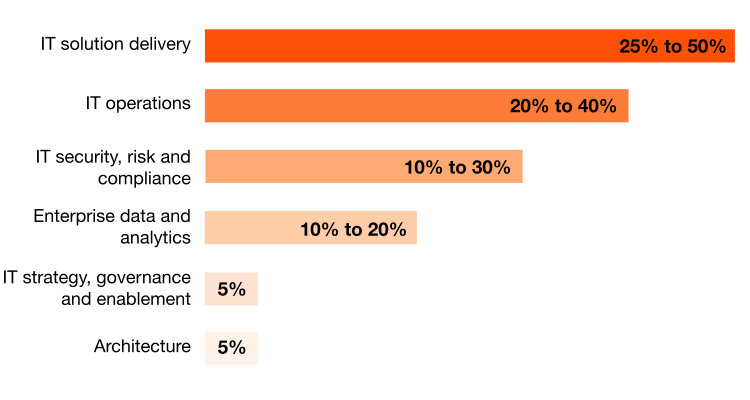
From lines of code to lines of impact
Across IT, AI agents can take full ownership of some tasks, assist with others and leave the higher-value and higher-risk ones in human hands. In IT solution delivery, software development is one natural starting point. At one major retailer, for example, agents are reducing software development cycle times by as much as 60% and reducing errors by half.
In a traditional development cycle, IT specialists manage each step — from setting up the environment to debugging and testing. With agents in the mix, that workflow shifts. AI agents now take on repeatable tasks like cloning repositories, generating scaffolding, resolving common errors and running basic tests. Developers move faster, with agents as collaborators.
This frees IT specialists to focus on higher-value work: mentoring, reviewing code for quality and risk and guiding strategic decisions. AI agents don’t just support the process, they multiply its impact, enabling smaller teams to deliver more with greater speed, security and confidence.
Consider another example: portfolio and demand intake. Imagine a hybrid human–AI workflow that kicks off when an employee submits a request — whether to fix an issue or deploy a new app. AI agents then take over. One confirms receipt, another classifies the request and tags the correct business unit, a third mines internal datasets to draft a business case, a fourth verifies the data and flags any inconsistencies, and a fifth evaluates the proposal against IT’s portfolio priorities.
Only after this groundwork is done do human IT specialists step in. They review the AI-generated business case, decide on approval and set the priority. Across IT, similar AI-driven workflows handle rote tasks, freeing your team to focus on creativity, strategic thinking and nuanced judgment.
Don't just plug in AI. Power up performance.
A single AI agent can accomplish a surprising amount on its own — reading support tickets, retrieving account data, suggesting a fix and even following up. But the real power emerges when you orchestrate multiple agents into a seamless workflow to automate even complex processes end to end. When that orchestration spans functions, from IT to finance and beyond, it unlocks an AI-enabled organization.
In multi-agent orchestration, “manager” agents delegate tasks to specialized agents and assemble the results. A powerful orchestrator, like PwC’s agent OS, serves as the control plane for each of your agents, regardless of vendor. It provides a unified dashboard, built-in governance and centralized planning. You can improve token usage, swap in new agents or insert human intervention as needed. A good orchestrator will, in short, turn isolated use cases into well-governed and high-value enterprise solutions.
The new model: Smaller teams. Smarter agents. Bigger impact.
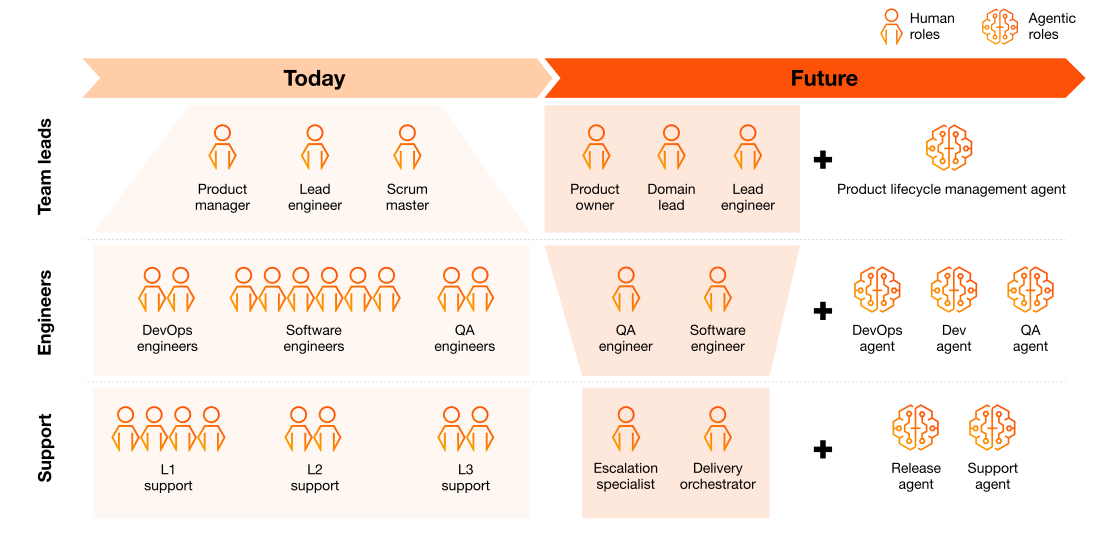
Your biggest risk with AI agents may be thinking too small. As AI agents take on more of the routine, repeatable work, IT teams don’t just get faster — they get fundamentally reshaped. In this new operating model, the traditional pyramid structure is flipped. In it, agents augment every layer of the organization, from support to engineering to leadership. The structure flattens, teams get leaner, and roles shift toward design, orchestration and decision-making.
You can roll out this model to capture value immediately and scale from there. Here’s how you do it.
- Work in new ways. Rethink workflows for hybrid human-agent teams, manage agent rollouts through agile sprints and make sure you can manage not just code but AI data and models as well.
- Embed trust. Manage the new risks tied to agent autonomy, intelligence and scale by building trusted guardrails: an orchestration layer and responsible AI.
- Align your tech. Add data upgrades, APIs and a scalable architecture as needed so you can power and oversee production-grade agentic systems.
- Futureproof your talent. Add new skills and roles, like AI product manager, agent engineer and escalation specialist. New hires might also include more creative, non-technical talent who focus on visual design, business requirements and communication.
With these measures, you can create a lean and nimble IT operating model. In this model, your people focus on strategy, high-value decisions and innovation. Under human oversight, agents do the rest.
How AI agents are reshaping IT team roles and structures
CIOs: Your playbook starts here
You can achieve ROI quickly with agents in IT, with each step paying for the next, until you achieve first an AI-enabled IT function and then an AI-powered enterprise.
- Start with your biggest problems. List your top current pain points. Identify the ones with the largest impact workflows. That’s where you’ll start.
- Go broad as well as deep. Roll out agents as a function-wide transformation. Get top stakeholders on board, including your company’s risk and strategy leads, so you can make quick decisions.
- Communicate what’s coming. Make clear to everyone in the company, in and out of IT, that this is the future of work. Agents execute and people lead. These new workflows can grow their value if you get started now.
- Roll out your new op model. With your first wave of agents delivering value, now’s the time for a new operating model. Reorganize your people into smaller, higher-impact, agent-augmented teams — then scale up so the rest of your company can do the same.

AI agents are multiplying IT impact
Together, we can help you streamline work and scale outcomes across your business.
AI Activation Leader, PwC US
Danielle Phaneuf
Technology Excellence Lead, Principal, PwC US
Douglas A. Smith
Future of Work - IT Leader, PwC US
Next and previous component will go here


