





{{item.videoDuration}}
{{item.title}}
{{item.text}}

{{item.videoDuration}}
{{item.text}}
Artificial intelligence (AI) is redefining the future of banking. It is a profound technological advancement catalyzing structural transformation across the industry. As AI, including generative AI (GenAI), scales from experimentation to implementation to enterprise-wide reinvention, it’s creating dual tailwinds directly impacting bank efficiency ratios:
Growing revenue by meeting the right customers with the right message at the right time
Cost transformation through intelligent automation and agile operations
For banking and capital markets executives, this marks a profound change where the efficiency ratio is no longer a backward-looking performance metric. It’s becoming the most telling forward-looking indicator of your bank’s ability to leverage AI innovation to compete, grow and endure.
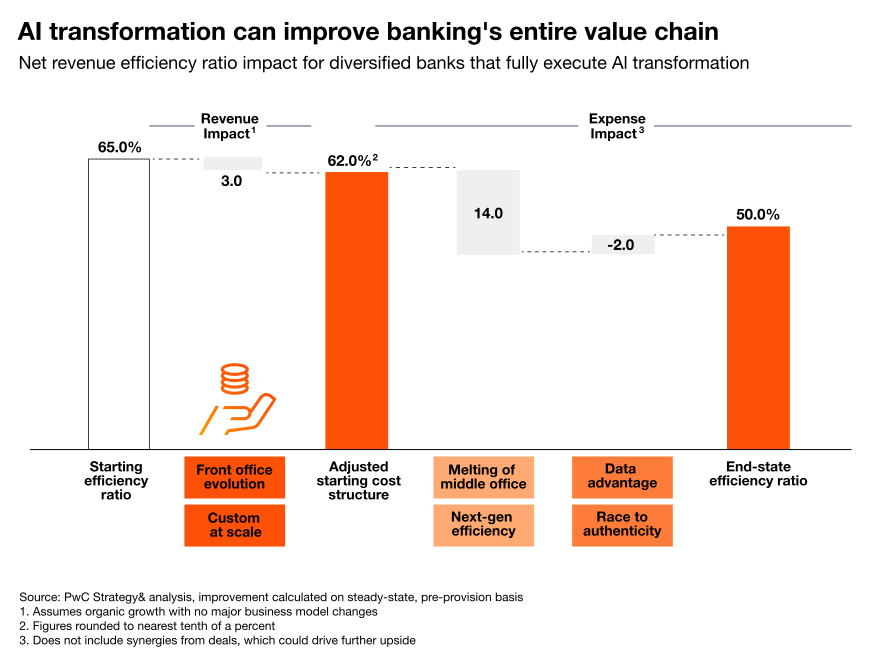
Banks that embrace AI could drive up to a 15-percentage-point improvement in their efficiency ratio.
Source: PwC Strategy& analysisYou’ve used the efficiency ratio to track costs. Now it’s becoming something more — a way to measure how ready you are for an AI future. The efficiency ratio is poised to evolve into a barometer of AI maturity. Banks using AI can more effectively capture "money in motion" and anticipate customer needs at scale to grow revenue without proportional cost increases. AI agents are driving transformation across industries, helping organizations rethink their operating models by automating routine tasks and empowering teams to focus on strategic analysis. From search engine optimization to procure-to-pay workflows, AI agents can accelerate performance by cutting cycle times, tightening controls and enabling more dynamic, insight-led client acquisition.
Banks that embed AI across middle and back-office functions can dramatically reduce manual workloads — reallocating talent to higher-value tasks — and modernize legacy systems while maintaining compliance and strengthening operational resilience. Let's look at how much more efficient and agile your bank could become.
The upside is big, but it comes with responsible use of AI. No, we haven’t forgotten that to harvest the upside you’re probably going to need to make serious investments in infrastructure, data governance and Responsible AI oversight. And your investments should be supported by a strong culture of innovation and relentless talent education. These expenditures should enable your bank to embrace longer-term agility and scalability.
Our PwC Strategy& analysis, based on a proprietary dataset indicates that institutions that fully embrace AI could drive up to a 15-percentage-point improvement in their efficiency ratio. A shift of that magnitude can reshape shareholder expectations and set a new pace of growth that can only be achieved in the AI era. The bottom line: the efficiency ratio can reflect more than efficiency; it will reveal who is winning the race to operationalize AI at scale.
AI is revolutionizing banking across multiple dimensions, but two stand out: driving revenue growth and balancing expenses. On the revenue side, banks are leveraging AI to unlock hyper-personalization, improve lead generation and enter growth arenas such as digital currencies and fintech ecosystem partnerships. This isn’t about improving banking. It’s about rethinking how banking works.
This new model of banking goes beyond simple automation. It leverages AI agents as adaptive performance engines: automating routine work, orchestrating complex processes, and positioning people where they create the most value. Together, this human–AI collaboration enables banks to compete more effectively in an AI-driven economy.
From a revenue perspective, banks are already starting to leverage AI to personalize customer experiences and make digital interactions more natural. This trend will naturally grow as institutions that leverage AI deliver tailored customer experiences that unlock new revenue streams, which in turn attracts more customers.
PwC Strategy& analysis projects that banks that capture topline growth opportunities have the potential to reduce efficiency ratios by as much as 3 percentage points (p.p.), not by doing more but by working smarter. AI innovation will enable true customization at scale and drive a significant evolution across front-office functions, allowing banks to reach the right customer with the right product at the right time.
AI is streamlining processes, automating routine work and eliminating inefficiencies — freeing teams to focus on higher value activities. We are seeing firsthand how this transformation is establishing a new frontier in ways of working and industry performance. One institution, for example, cited a 40% decrease in costs to verify commercial banking clients thanks to AI-driven onboarding and verification tools. We expect this cost optimization trend to continue, with banks adopting AI-driven operations experiencing up to a 14 p.p. drop in their efficiency ratio. AI can power cost reduction through next-generation efficiency and "melting" the middle office — collapsing traditional silos between front and back office to create more integrated, agile and scalable operations.
Achieving these gains will inevitably require continued investments into a company’s AI “backbone.” While our analysis suggests that these efforts may raise steady-state costs and temporarily increase efficiency ratios by around 2 p.p., they are critical for long-term data advantage, stronger transparency and a meaningful edge in a new race for trust and authenticity.
Here's how the rules of banking are being rewritten by AI.
AI tools are improving how teams identify high-intent prospects and enhance the precision of marketing and advisory efforts. When embedded in the banking lifecycle, these tools can boost satisfaction and retention and redefine how and where clients interact with their bank. For institutions that get this right, growth will be smarter, faster and far more personalized.
Today’s customer and client service is undergoing a fundamental shift as AI becomes embedded in day-to-day customer interactions. In the consumer finance space, for instance, AI chatbots sift through internal knowledge bases, customer account data and CRM case notes and service tickets to deliver instant, accurate and personalized customer support. In asset and wealth management, several banks are already using GenAI to deliver real-time insights and build portfolios tailored to each client’s risk appetite, spending habits, and long-term goals. Clients receiving the personalization they’re seeking can make a measurable impact on a bank’s levels of client satisfaction, engagement and retention.
AI is already moving beyond suggestions to taking action, with the goal to autonomously execute tasks within human-defined guardrails. A customer’s personal CFO interface, for example, would unify budgeting, borrowing, investing and insurance in one seamless conversation. The personal CFO then crafts a tailored portfolio or submits a micro loan application after the customer taps to approve. And as a client searches flights to Italy, the same digital agent automatically completes a travel rewards credit card application and issues a digital card immediately, calibrated to the client’s expected spending. In the background, autonomous AI agents can watch the stock and bond markets and draft orders, waiting for customer confirmation to execute trades. These capabilities remain in limited pilots today, but they paint a picture of banking becoming personal again, prompting interactions that feel proactive, deeply personal and, at the same time, almost invisible. Together, they can turn money management from a task into an intelligent service that benefits financial wellbeing.
AI embedded in everyday platforms: Banks integrating AI tools into nonfinancial apps like travel or telehealth platforms, can trigger financial offers such as credit card approvals and emergency health funds based on real-time needs — without the customer having to visit the bank’s app.
Proactive financial decision-making: AI anticipates needs before they arise, such as offering student loans when users research colleges, continuing the shift to predictive engagement.
Banks already use AI internally to transform how they identify prospects, engage clients and improve sales and marketing efforts. AI assistants help relationship managers prepare for client meetings by surfacing client-specific insights, recent transactions, earnings data and product usage trends. In sales and advisory, AI tools synthesize large volumes of deal, market and behavioral data to build personalized outreach campaigns and product proposals that resonate with client needs. These tools are increasing win rates, speeding up sales cycles and deepening client relationships, without scaling human headcount.
In the coming years, we expect AI to become the nerve center of front office productivity, reshaping how bankers work and a bank’s growth rate. Intelligent agents will support real-time targeting and offer creation and autonomously identify high-intent opportunities across channels and push dynamic content based on customer behavior, context and preferences. Marketing's calendar-based campaigns will shift to adaptive, AI-driven engagement strategies that learn and adjust in real time. Relationship managers will spend more time creating value, backed by AI assistants that act as real-time research assistants that gather data, compliance checkers and strategic thought partners to identify which clients are more profitable and what products could be right for their portfolio. The future front office is faster, more precise and more responsive, with AI acting as the fuel powering a revenue growth engine.
Autonomous lead generation and targeting: Intelligent agents disrupt static / generic SEO and affiliate channel marketing by detecting high-intent prospects across channels, and generating personalized offers and outreach based on behavior, timing and context using data from various sources like internal metrics and third-party data.
Improved relationship management: AI delivers real-time insights, automates meeting prep and surfaces client-specific opportunities to enable deep, strategic engagement.
AI already plays a transformative role in how banks run their internal operations, from streamlining repetitive tasks to enhancing the way teams access and act on information. In the future, AI tools will likely lay the foundation for faster and more resilient operations by unlocking more capacity, allowing banks to reduce friction, improving speed and freeing up talent for higher-value work.
You may already be using AI to streamline tasks and reduce turnaround times from hours to minutes. Examples include drafting internal documentation, generating deal summaries and translating automatically refactoring legacy code into modern architectures. Additional efficiency gains come from automated workflows embedded into key operational functions, reducing dependencies on legacy systems while enabling faster response times. For instance, some institutions are using AI to triage and route internal requests, flag anomalies in real time and accelerate cross-functional coordination, all of which free up talent to focus on strategic priorities. But what comes next is bigger: full-scale reinvention of how work gets done.
Looking ahead, AI will redefine how banks scale operations. Not by replacing people, but by working alongside them. Banks can deploy AI agents across their infrastructure to continuously monitor processes, flag issues, and recommend actions in real time. These agents don’t just execute tasks; they collaborate with teams to identify opportunities and accelerate decisions. To enable this shift, banks need modular, interoperable systems that allow AI to plug into existing platforms and evolve quickly, without costly full-stack overhauls. Human oversight remains critical, as operations professionals shift from task execution to becoming managers of AI agents: supervising performance, managing exceptions, and driving continuous improvement.
This new model of banking goes beyond simple automation. It leverages AI agents as adaptive performance engines: automating routine work, orchestrating complex processes, and positioning people where they create the most value. Together, this human–AI collaboration enables banks to compete more effectively in an AI-driven economy.
Autonomous operations at scale: AI agents monitor activity, trigger workflows and escalate exceptions in real time, eliminating bottlenecks and reducing manual intervention.
Modular, AI-ready infrastructure: API-first architectures allow banks to embed AI across legacy systems, enabling faster upgrades, better interoperability and scalable innovation.
AI-augmented workforce models: Talent shifts from task execution to AI governance, model oversight and exception management, unlocking productivity and organizational capacity.
AI is reshaping the middle office by automating time-consuming, manual tasks that traditionally sit between front-office action and back-office execution. Current use cases include banks piloting AI agents to reconcile trades in real time, validate regulatory data submissions and flag risk thresholds as they approach. GenAI helps simplify documentation workflows, such as model risk write-ups or internal audit narratives, while orchestration tools route exceptions and escalate only when human review is needed. As a result, banks are reallocating talent from repetitive checks to higher-value oversight and analytics roles, streamlining operations without compromising control.
What’s happening today only scratches the surface of what’s possible. Soon the middle office will feel less like a set of functions and more like a digital fabric that watches every transaction, learns from patterns and reacts in nearly instantaneously. Intelligent systems share context across risk, compliance and operations teams, giving instant insight into exceptions, exposures and bottlenecks. Tasks, such as onboarding checks, profit-and-loss attribution and trade support, can be automated, with AI not only spotting anomalies but also suggesting fixes. As governance and explainability frameworks mature, middle-office professionals spend their time supervising AI-enabled workflows, refining escalation rules and designing exception processes.
AI-driven exception management: Routine middle-office tasks like trade reconciliation, onboarding checks and P&L attribution are automated, with AI surfacing and triaging exceptions in real time.
Integrated risk and compliance orchestration: Intelligent systems break down silos across operations, compliance and risk, delivering unified, real-time oversight and faster responses.
With unprecedented access to vast real-time and proprietary data, it’s becoming clearer that three competitive advantages — speed, accuracy and trust — hinge on how well a bank governs, contextualizes and connects data. Institutions that build modern, semantic data architectures, embrace interoperability and design for explainability can innovate faster, personalize more deeply and comply more intelligently.
Banks are using AI to unlock more value from their data by automating time-intensive tasks like data cleansing, enrichment and classification. Semantic data layers are helping unify and standardize information across silos, making it easier to feed AI models with consistent, high-quality inputs. And AI agents are being deployed to trace data lineage, flag anomalies and reduce manual intervention in regulatory and compliance reporting. These internal gains are helping free up data teams to focus on designing AI-ready architectures that accelerate decision-making across the enterprise.
As models grow in sophistication, success depends on access to clean, contextual and well-governed data. Semantic architectures, the backbone of context engineering, will be fueled by both traditional sources and alternative signals like geolocation or behavioral insights. Forward-looking institutions are building semantic data architectures and real-time integration layers to support continuous learning and personalization. While these transformations require investment and may temporarily raise the efficiency ratio, they can enable faster innovation, more targeted growth strategies and increased transparency at scale. In short, data will define which banks can deploy AI responsibly, rapidly and repeatedly.
Holistic data automation: AI continuously cleans, enriches and classifies data across systems, reducing manual effort and enabling consistent, high-quality inputs for real-time decision-making.
Semantic data architectures: Banks shift to scalable, AI-ready data ecosystems that unify structured and unstructured data, enabling contextually-relevant, personalized and responsive services.
As AI is embedded across financial services, banks recognize that trust is a strategic asset, not a soft metric. It’s a distinct advantage in adoption, brand equity and regulatory agility. Today, institutions are deploying internal AI governance frameworks to monitor model behavior, ensure fairness and reduce bias. Teams are integrating explainability tools and risk dashboards that flag anomalies, document decision logic and support auditability. Many are also adopting AI evaluation frameworks (“Evals”) - systematic tests that measure model reliability, bias, and regulatory alignment - to strengthen transparency and accountability as systems evolve. Human reviewers shift from executing processes to validating AI outcomes and confirming models align with ethical and regulatory standards. Collectively, these practices form the foundation for AI systems that customers, regulators, and employees can trust.
Building and maintaining that trust will be essential to scaling AI responsibly. As models become more autonomous, banks need to demonstrate control, clarity and accountability in every decision AI makes. Institutions that proactively invest in responsible AI can be better positioned to innovate with confidence. This means embedding transparency and clear decision frameworks into their tech stacks, integrating human oversight at key decision points and designing with fairness and resilience in mind. While these capabilities require upfront effort and long-term commitment, they could ultimately distinguish leaders from laggards in the AI era.
Built-in transparency and auditability: AI systems include explainability and continuous evaluation by design, enabling banks to track decisions, flag anomalies, and meet evolving regulatory expectations.
Human-in-the-loop governance models: Banks embed human oversight at key AI decision points, balancing automation with accountability to build trust with customers and regulators.
The AI race is on — and hesitation is no longer an option. Banking executives should view the efficiency ratio as a signal of their bank’s growing AI maturity. A well-calibrated strategy connects revenue-driving innovation with cost-saving automation, while embedding transparency and governance to build enduring trust. Institutions that act decisively can improve performance and reshape the competitive landscape by operationalizing AI across the value chain.
Winning in this new era will require bold moves that align technology and talent to real business outcomes:
Redesign the enterprise around AI-first workflows. This means embedding AI in tools and also in how decisions are made, how work is executed and how value is delivered front to back. This may include appointing a Chief AI Officer to cut through interpersonal challenges, unify strategy, governance, and accountability.
Invest in foundational infrastructure. Modern, modular and interoperable systems are table stakes for integrating AI across functions at scale.
Build with governance from day one. Responsible AI is essential: it’s the backbone of trust. Banks must design for transparency, fairness, explainability and compliance across use cases.
Upskill your workforce for an AI-augmented future. Shift talent from execution to oversight, from manual workflows to agent management. Invest in the people who can manage, validate and extend the reach of AI.
The institutions that lead will be those that implement AI with clarity, control, and purpose — and PwC is ready to help with what comes next.
When breaking down silos, AI agents are a force for change.
Download “How AI is reshaping banking” to start a discussion
{{item.text}}
{{item.text}}


