



{{item.videoDuration}}
{{item.title}}
{{item.text}}

{{item.videoDuration}}
{{item.text}}
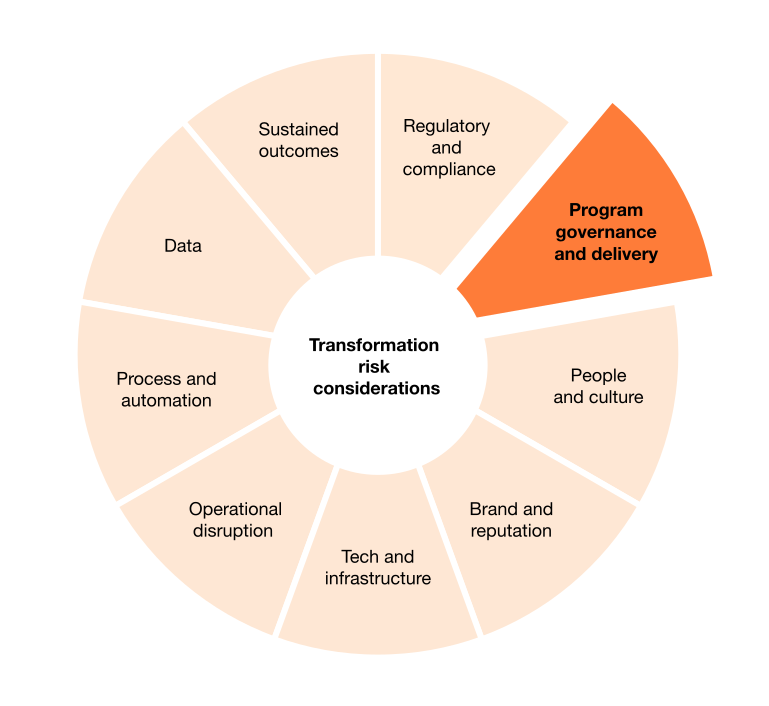
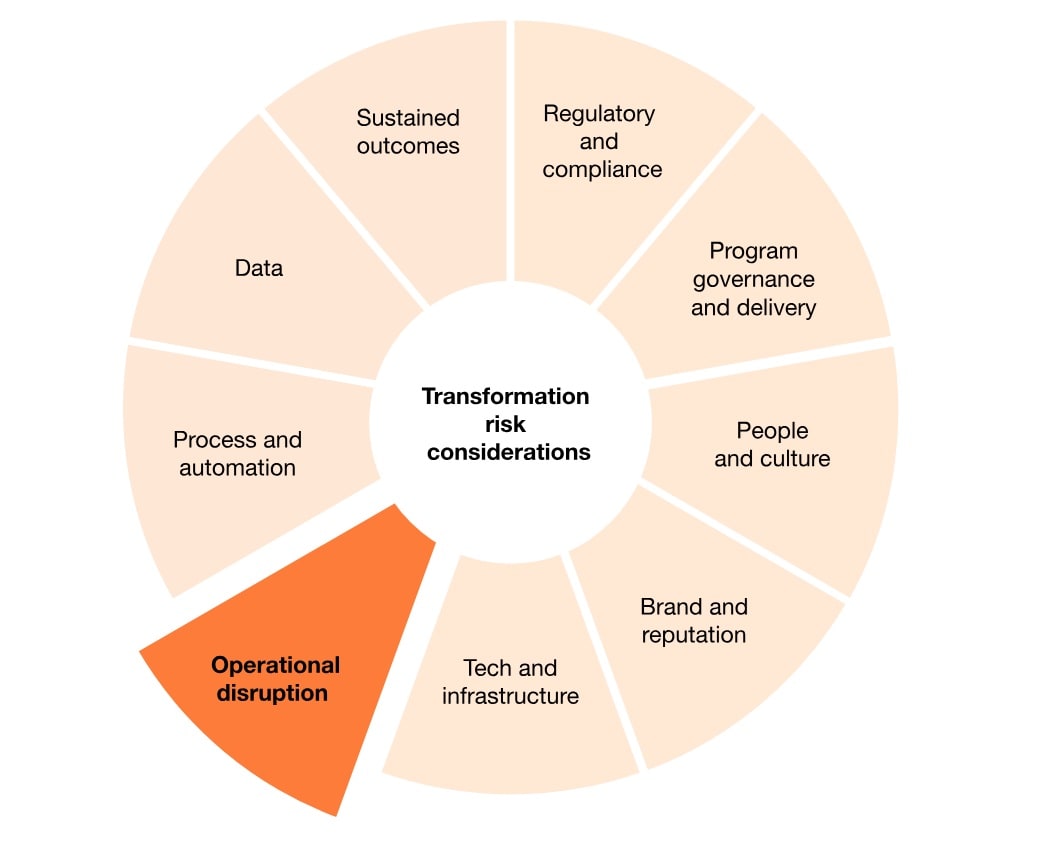
Transformation today extends far beyond technology. While modern platforms and tools are critical enablers, true transformation touches every part of the business—people and culture. Regulatory compliance. Operations. Everything. These interconnected efforts often happen concurrently, introducing a wide range of risks that can derail progress if not carefully managed.
To succeed, organizations should take a portfolio approach—one that looks holistically across Transformation risk considerations to identify dependencies, align functions, and apply controls that manage risk without slowing innovation. Industry leaders are striking this balance, delivering change at pace while protecting value and maintaining stakeholder trust.
In this series, we explore the key risk areas transformation leaders need to prioritize to keep programs on track and outcomes aligned.
Of business executives say executing transformations at the pace needed to win in the market is a challenge.
Source: PwC Pulse Survey
As businesses pursue transformation, risks from non-compliance and evolving or ambiguous rules often emerge in areas including AI, tax, data governance, and operations, requiring proactive oversight, not just reactive fixes.
With transformations accelerating in areas like AI, tax, and data governance, these risks require proactive management. PwC’s June 2025 Pulse Survey found that 34% of tech leaders cite transformation risk as a top-three barrier—ahead of technical debt and resource constraints.
Many organizations underestimate just how critical and complex it is to design and implement strong governance and delivery models—or overestimate their ability to make adjustments downstream.
Projects don’t fail at the end—they fail at the beginning.
Poor program governance or weak delivery mechanisms can introduce cost overruns, missed deadlines, operational disruption, compliance issues and inefficiencies—all of which erode value and damage trust.
Every transformation is a people and culture transformation.
It doesn’t matter whether you’re about to gain more people (a merger or acquisition), have fewer people (a divestiture or reduction in force), work with new people (offshoring or reorganization), or have the same people work in different ways (operations transformation). Any transformation has a people and culture dimension. And that means any program can be subject to people-related risk exposures, along with other transformation risks.
You can’t afford to lose the trust of your customers or shareholders, or the vendors you do business with. But while it’s simple to say, it’s difficult—if not impossible—to prevent all brand-damaging moments.
As a transformation leader, your role isn’t just to manage delivery. It’s to prevent risk from escalating—and to respond with speed and clarity when it does. That means building agile response teams, clear governance, and repeatable playbooks now, so you can protect trust while your business evolves.
When it comes to tech, managing transformation risk is more than just upgrading while avoiding outages. It’s your opportunity to find value through improved processes, enhanced technologies, and enabling your business.
Don’t just blindly update your systems so they stay supported—tech transformations are where strategy and implementation can meet.
Business transformations can offer significant benefits, from enhanced efficiency to improved customer experience. While many companies manage multiple risks during a transformation program, resiliency risk is often overlooked. If your organization isn’t adequately prepared and equipped to recover your critical services and reduce operational disruption, that can open you to more risk and damage downstream.
There’s more to automation than shelling out for the latest and greatest software. Transforming the way work gets done? Making it faster and easier for your people to—sustainably—deliver value? That requires not just automating tasks but carefully plotting out the processes and strategies behind them. Transforming processes and automation can be a major source of risk within your larger transformation initiatives.
Data readiness isn't just a one-time cleanup. It’s about establishing practices for how your organization sources, moves, governs, and protects its data at scale—and helping confirm there’s clear accountability and decision-making along the way.
That requires transformation leaders like you to get alignment across teams, set clear goals, and display a willingness to rethink how data flows through your business. The companies that most effectively take charge of their data—generating, protecting, and governing it in a data life cycle—will likely have the greatest opportunities for success.
Organizations don’t invest in projects. They invest in the outcomes those projects are supposed to create. Generating value from sustained outcomes requires defining, tracking, and creating value from the moment an initiative is conceived—across its lifecycle and across your broader portfolio. So, ask yourself: Are you defining and tracking business outcomes and the risks preventing the realization of these outcomes? Or just tracking delivery?
{{item.text}}
{{item.text}}