







{{item.videoDuration}}
{{item.title}}
{{item.text}}

{{item.videoDuration}}
{{item.text}}
Nonprofit
Climate Modeling
Pro Bono Engagement
SITUATION
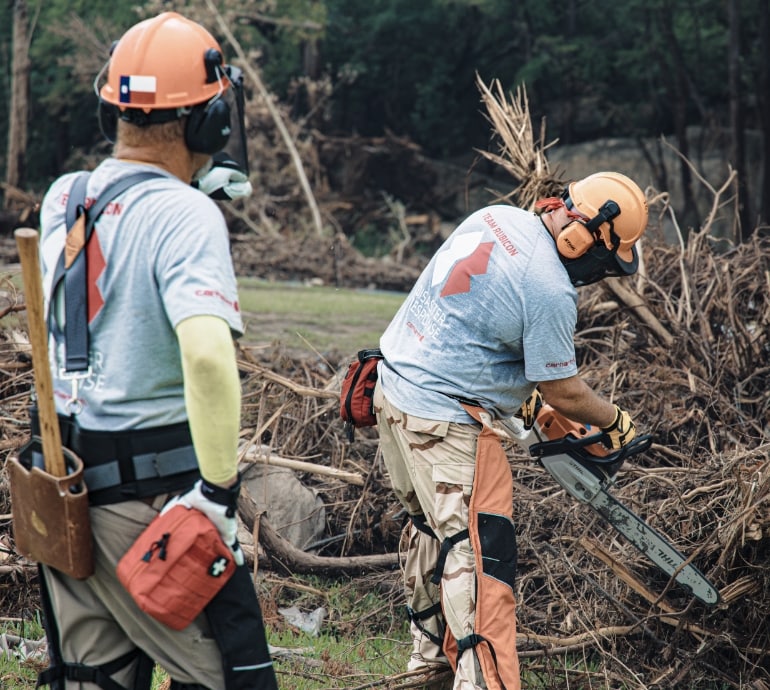
After a 2010 earthquake devastated Haiti, a small group of military veterans, first responders, and emergency medical personnel deployed to care for disaster survivors. This mission was the start of Team Rubicon, now a 200,000-plus volunteer humanitarian organization that serves global communities before, during, and after natural disasters. Over the years, its “Greyshirt” volunteers have rebuilt damaged homes after hurricanes and cleared wildfire hazards during blue-sky periods. Central to who they help and how? Data.
And their digital tools reflect this. Among them: interactive maps that leverage the CDC’s Social Vulnerability Index to pinpoint communities with limited resources for disaster recovery. The data-driven approach is paired with boots-on-the-ground “windshield analyses,” driving through neighborhoods to assess damage. This blend of digital tools, data, and legwork helped Team Rubicon serve more than 675,000 people across 875 communities in a year.
While Team Rubicon excels at rapid response, its plans relied on historical information. The organization wanted forward-looking data to anticipate which communities might need help next, pre-position assets accordingly, and show donors the data informing these decisions.
Trusted collaborators, new way forward
Longtime supporter PwC stepped in to help. For more than a decade, the PwC Foundation, a NY non-profit corporation and 501(c)(3) public charity, has contributed over $8 million to Team Rubicon. PwC wanted to build on the Foundation’s commitment by donating its greatest asset—its people—to the cause, pro bono. The nonprofit’s need for foresight and stronger resilience planning created an impactful hands-on opportunity.
Enter PwC’s Climate and Nature Impact Modeling team, which helps organizations anticipate and prepare for weather impacts on facilities, supply chains, and communities. They set out to help Team Rubicon strengthen its efficiency and effectiveness in times of disaster, when it matters most.
SOLUTION
Team Rubicon needed to see what was coming—and better prepare for it. PwC’s plan to achieve this: Assess severe weather “hot spots,” identify likely operational and community impact, and provide forward-looking data to help plan for tomorrow.
To power the vision, PwC evaluated potential severe weather impacts on communities and assets, from hotter weather driving up cooling costs to floods disrupting supply chains, which supported three key components:
These forward-looking insights now inform Team Rubicon’s strategy and data-driven approach, helping it serve communities more efficiently and effectively.
A serious stress test
The hurricane impact model faced its first real test during Team Rubicon’s annual hurricane exercise HURREX (hurricane exercise), which simulates a historic storm minute by minute. Over a week, Team Rubicon executives, staff, and volunteers ran response operations as if Hurricane Ike were striking in real time; power outages included.
HURREX is a frenetic sight. More than 50 participants field mock media calls, map routes through simulated disaster zones, and secure and stage vehicles. Alongside them, PwC’s hurricane impact forecast helped the team prepare by projecting the storm path and identifying vulnerable communities via its Composite Vulnerability Scores.
RESULTS
Disaster response is just one way to use climate data. It can also support long-term strategy. By pinpointing likely severe weather impacts, Team Rubicon can recruit volunteers where they’re needed, strengthen local infrastructure, and build forward looking collaborations with emergency networks before disaster strikes. This analysis also helps make the mission tangible for donors, showing what drives decisions and where every dollar goes.
Insights that improve strategy and operations
The data has already influenced one major strategic decision: moving a logistics hub from Dallas, which has a higher likelihood of tornadoes and hail in coming years. A facility risk analysis of all 155 Team Rubicon facilities—offices, warehouses and equipment storage—identified Atlanta as better positioned to serve hurricane-prone regions and tornado alley, while remaining outside high-risk zones and near a major airport. Team Rubicon is working to secure a brick-and-mortar hub in Atlanta enhancing their resilience, positioning, and long-term continuity.
To round out PwC’s engagement, detailed user guides explain how the model works and how to keep it current through 2050. The guides also help the nonprofit anticipate possible long-term climate factors affecting operations and logistics, such as potential shifts in tornado exposure through 2050 in Dallas and Chicago. It’s a logistics insight applicable across industries.
Ultimately, the collaboration equipped Team Rubicon for both urgent response and long-term resilience—a practical approach for organizations navigating today’s challenges and tomorrow’s risks.
“PwC’s expertise helped us connect the dots: clearer forecasts, stronger logistics, and faster help when it matters.”
A window into the future of environmental impacts to your business.
Expertise. Technology. Results. Powered by collaboration. Explore our case studies to see what’s possible.
{{item.text}}
{{item.text}}


