





No more pyramids: Rethinking your workforce for the agentic AI era


Summary
- AI agents can expand worker reach, shifting high-value roles from narrow execution to outcome-focused ownership across workflows.
- Early-career talent can become a strategic advantage, ramping faster with AI agents while preserving the apprenticeship pipeline.
- Org and role designs evolve—and not in one uniform way: leaders should avoid default cuts that weaken capability in favor of rebalancing.
What if your people could deliver more, even in highly specialized, high-value areas? What if more of them could deliver this value across processes and functions—and focus, even in the back office, on business outcomes? These questions aren’t hypothetical. With AI agents now able to take on multistep, high-skill tasks, experienced people can do more, and early-career workers can ramp up more quickly—helping to create a nimbler organization, ready for faster growth.
But this transformation won’t happen on its own. It requires deliberate choices—starting with how you design roles, structure teams, and develop talent. Whether you're a CEO, CFO, CIO, or CHRO, it's time to act. Here’s how you can lead your workforce transformation with confidence.
AI can enable specialists to do so much they become generalists
If your organization is like many, it’s become increasingly specialized: deeper functions, taller org charts, and narrower roles. Now, that model is shifting. In our 2026 AI Business Predictions, we call this shift the “rise of the generalist:” a move toward broader, outcome-focused roles, which is already underway—we’re seeing it across industries, in back offices, and frontline teams. It’s one of the reasons why AI can make people—if they have the right skills and are in the right roles—more valuable than ever.
In software development, for example, you may no longer need teams of people at work in each stage: generating solution architecture and user stories, creating test cases and test scripts, or troubleshooting, reviewing, and documenting. One experienced software engineer can orchestrate teams of AI agents at work in many or even all stages.
As they shift from narrow execution to broader responsibility, these engineers—and other specialized, high-value employees like them—can become generalists: working across more processes, making faster decisions, and focusing on bottom-line impact.
If you're not building your organization with early-career talent, you may be missing out
The new generalists don’t build themselves. They’re the result of a pipeline that takes AI-literate, early-career workers and gives them—often through an apprenticeship model—specialized, real-world experience. That software engineer can work over the full development cycle because they’ve already built software without AI agents’ help. And it’s not just software. If you don’t build your pipeline now, you may soon find yourself without the expertise and leadership needed to correct AI-generated errors, spot systemic risk, or seize new market opportunities.
There’s another likely benefit to early-career workers: When they’re equipped with AI agents, they can meaningfully contribute faster than before. At PwC, for example, our audit teams use AI to help execute many specialized audit tasks and deliver a more seamless client experience. So, instead of focusing our entry-level auditors on narrow technical tasks, we also teach them to use AI agents—and to think critically, support our longstanding focus on independence, audit quality, and data security, and focus on clients’ big-picture needs.
Diamond or hourglass? Avoid the easy mistake and build the organization you need
If your organization is like most, it’s structured like a pyramid. A small leadership team sits at the top, supported by a larger middle tier of managers and highly trained specialists. Below them is an even larger group of employees, many of whom are recent hires, who focus on routine manual or process work. But since AI agents can take on many entry-level tasks—such as data gathering, processing, and reporting—some companies are reducing the pyramid’s “base.” They’re also repurposing the middle tier to train, oversee, and manage agents. The result is a diamond-shaped structure: a small leadership team, a strong middle layer, and a narrow base of new talent.
For many companies, this diamond structure can be a good choice. It can help you manage AI agents at scale, make operations nimbler, and focus people on higher-value work. But it should be a choice, not a default, because for many companies, this diamond structure can carry medium- and long-term risks.
If your company is based on knowledge work, reducing early-career workers could limit apprenticeship and starve your organization of its future: You won't be developing the high-performing generalists and business leaders (with experience in your unique processes) who could fill your upper ranks and be your differential. For these knowledge-intensive firms, an hourglass structure—which we’re building in-house at PwC—can be a better choice. Here, entry-level roles can expand as AI-literate, business-savvy, and change-ready employees ramp up quickly, so they can contribute at a high level across workflows. Experienced specialists can expand their reach, combining their creativity, experience, and strategic insight with the scale and speed of AI agents.
With fewer routine tasks performed by people who need routine management, there’s likely less need for expensive and often change-resistant middle managers. Instead, these experienced workers can take on higher-skill roles in exception handling, coaching, and high-value decision-making. Leaders can gain broader visibility and greater influence, as AI-enabled workflows accelerate the need for new operating and business models. With a strong, capable base and a forward-looking leadership tier, connected by a lean, high-performing middle, your org chart looks like an hourglass.
Fewer specialists, more generalists: How it works in key business functions
The rise of AI-enabled generalists is already changing how core business functions operate. In finance, IT, marketing, and HR, we’re seeing real examples of how agentic workflows are expanding roles, elevating responsibilities, and helping teams focus on outcomes instead of tasks. These changes aren’t uniform. Each function is evolving in its own way, and leading organizations are designing roles and structures to keep pace.
AI-enabled finance: Becoming an engine for growth
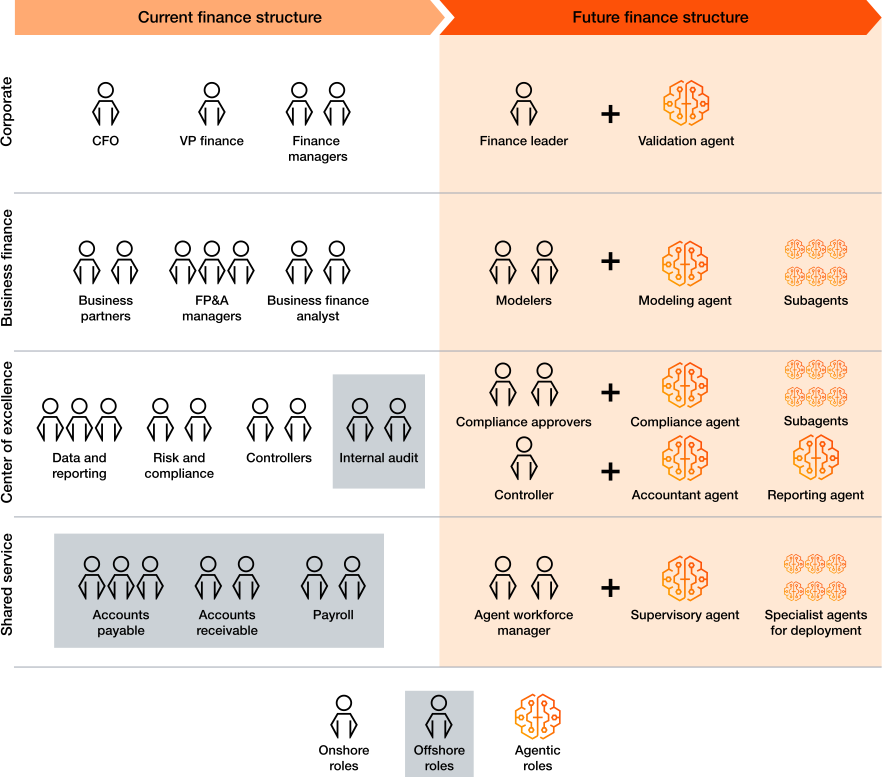
In AI-enabled finance functions, professionals can work across full workflows—such as financial modeling, risk and compliance, or accounts payable and receivable—by directing teams of specialized AI agents. As a result, speed and capacity can increase. Offshore roles begin to decline, while onshore roles consolidate and shift. New positions emerge, focused on strategy, insight, and business outcomes. Here’s what CFOs and finance leaders should know:
- Shift from number-crunching to business value. As AI agents execute routine tasks, people can apply financial judgment and commercial awareness to translate agent-produced analyses into performance drivers, tradeoffs, and strategic implications—helping the business make better decisions.
- Core skills are vital but are not enough. People with strong skills in finance fundamentals remain vital. But finance professionals may also need skills in AI, analytics, and collaborating with the business—as well as roles and an organizational structure that serve your new emphasis on business outcomes.
- Finance operating models evolve for growth. A new finance operating model, built on people and AI agents collaborating, can change finance from a back-office operator to an enterprise growth driver: helping to grow financial flexibility, steer capital toward high-return opportunities, and provide rapid, data-backed insights for strategic decisions.
AI-enabled IT: Proactively building an intelligent enterprise

AI agents are opening the door to a fundamentally different role for IT. Instead of being the team that responds to business needs, IT can become the team that helps shape them—designing intelligent workflows, managing AI systems, and accelerating innovation. But realizing this opportunity depends on making intentional changes to focus, roles, and structure. Here’s what CIOs should know:
- Priorities shift from support to strategic value. With AI agents handling many support and QA tasks, fewer resources may be needed for maintenance and troubleshooting. IT teams can redirect their efforts to building AI-powered workflows and making sure those systems align with business goals.
- New and evolving roles emerge. To support your new focus, you may need new roles such as support agent orchestrator. Existing roles can evolve to include model oversight, business integration, and workflow design—helping to turn more IT professionals into high-impact contributors.
- IT delivery models drive speed and scale. AI agents can make possible a new IT operating model, where agents multiply capacity, speed up delivery, and free your people to focus on innovation and work that truly adds value.
AI-enabled marketing: Anticipating customer behavior and fostering creativity
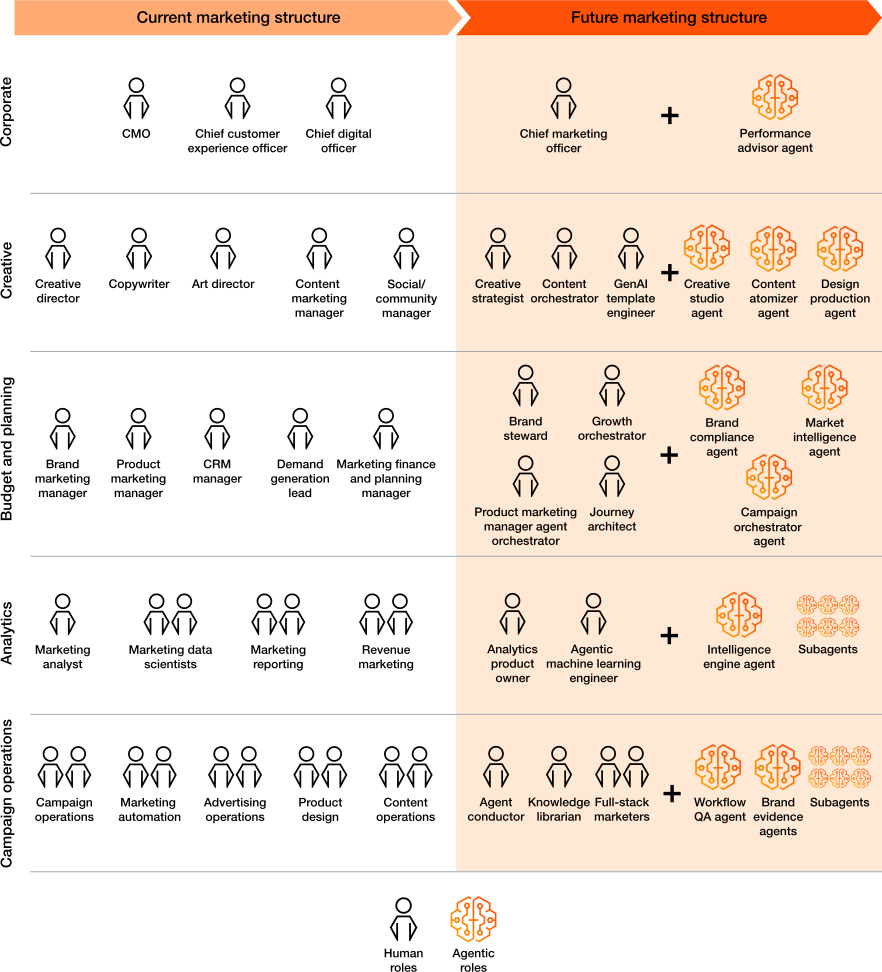
AI is transforming marketing into a proactive driver of growth. With AI agents handling tasks across content, campaigns, planning, and analytics, marketers can focus on creativity, strategy, and customer connection. In this new model, humans can bring empathy and brand insight while AI delivers precision and scale. Together, they can create faster, more personalized, and more effective experiences with insights and optimization opportunities identified proactively rather than reactively. Here’s what CMOs should know:
- Delivery accelerates. In an AI-enabled operating model, AI agents overseen by marketing generalists execute work across content, campaigns, analytics, and planning—helping to increase delivery speed and enable you to organize around customer journeys, performance insights, and demand generation.
- Full stack marketers can work across the function. As agents take on more specialized work, marketers can manage the full cycle—from planning through activation and analysis—enabling more coherence and more focus on data-driven customer signals pre- and post-campaign launch, placing additional emphasis on creativity and strategy.
- Leadership roles may converge. With specialized AI agents at their command, a small group of senior leaders who understand the customer, drive demand, and grow customer lifetime value could take on many distinct, senior roles that currently cover marketing strategy, planning, customer experience, digital, paid media, analytics, and more.
AI-enabled HR: Building a more capable and nimbler workforce
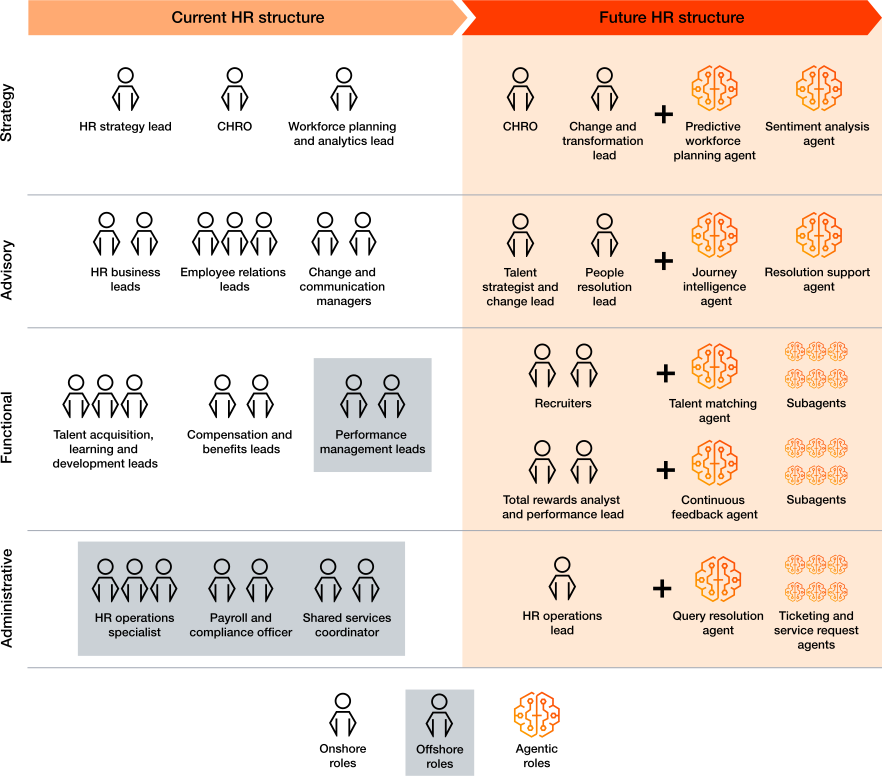
AI gives HR the opportunity to move beyond process management and become a strategic driver of workforce performance. With the right design, HR can shape how work gets done, how capabilities grow, and how the organization adapts to change. Here’s what CHROs should know:
The HR business leader can become a business strategist. As new HR generalist roles—like HR operations leads and talent strategists—direct AI agents to handle routine tasks, HRBPs can focus on business outcomes. They can, for example, create bespoke, x-capability focused pods and upskill these pods not by position, but as a team.
New skills and focus can remake the function. HR’s own mix of roles, skills, recruitment, and incentives should evolve too: Skills in people management and policy still matter, but so do new skills in interpreting data, designing experiences, operating across multiple HR domains, and working hand-in-hand with the business.
More capacity to connect talent to business outcomes. With a new, AI-enabled HR operating model, you can reduce human effort by 40% to 50% across HR. That can free your team to focus on workforce, incentive, succession planning, location strategies, operating model implications, strategies for high-potential employees, and other ways to connect talent to business outcomes.
Six ways to begin
The organizations that are successful with AI typically aren’t starting at the edges. They’re starting at the top. Leadership identifies a few high-impact areas for investment, sets a clear strategy, and guides a focused path to value. That can include building a user-friendly orchestration layer to help create and manage workflows and focusing on Responsible AI to enhance performance and grow stakeholder trust.
But strategy alone likely won't deliver outcomes. Here’s how you can get started.
- Redesign workflows—and think big. Instead of asking how AI can improve a process, ask how you can reinvent it with AI at the core. People should be at the helm: always in charge, always making the big decisions, and always accountable for outcomes. But AI agents may be able to shave off as much as 50% of human effort.
- Map out the impact. As you construct or assess an AI business case, make sure that it covers which roles are likely to be automated, augmented, or created—and what these changes mean for headcount, career paths, and reskilling.
- Clarify who does what. For each role in an AI-enabled workflow, classify the work into AI-only / human + AI / human-only, then rewrite role purpose and skills accordingly. If you don’t have active AI roles yet, take this decoupling and tagging step before proceeding.
- Transform key positions. For critical roles, create an explicit “AI collaboration profile” that defines how AI should be used, what should remain human, and which skills matter most. Consider this data for talent reviews and workforce investment decisions.
- Drive strategic alignment. Work with fellow leaders to modernize the job catalog, define AI-era roles, and standardize AI responsibilities and skills. As AI-enabled generalists spread, cross-functional standards and collaboration can become a strategic imperative.
- Double-down on human intelligence. In the age of AI, people are still your differential. Hire and develop AI-savvy, change-ready, early-career workers; show current employees what their future roles might look like and how they can prepare; reward those people who strive to create advantage with AI; and cut through any organizational "permafrost" that might get in their way.

Next and previous component will go here


