







{{item.videoDuration}}
{{item.title}}
{{item.text}}

{{item.videoDuration}}
{{item.text}}
No one denies that personalizing the customer experience is table stakes, yet many CMOs and their teams lack what’s needed to do so effectively. Personalization remains one of the most elusive opportunities in marketing.
Despite bold ambitions and significant technology investments to improve personalization efforts, companies struggle to measure the value. Brands claim to prioritize personalized experiences, yet many find themselves stuck in pilot purgatory where experimentation begins but meaningful outcomes often struggle to scale, or they’re left with accepting channel-specific “personalization” experiences at best.
Often, these efforts falter not because of lack of ambition, but because of execution gaps.
Ironically, the path to personalization has become clearer. With advances in AI and integrated technology, we now know what it takes to deliver tailored experiences at scale, in real time and across digital channels. So why do so many organizations still struggle to realize value?
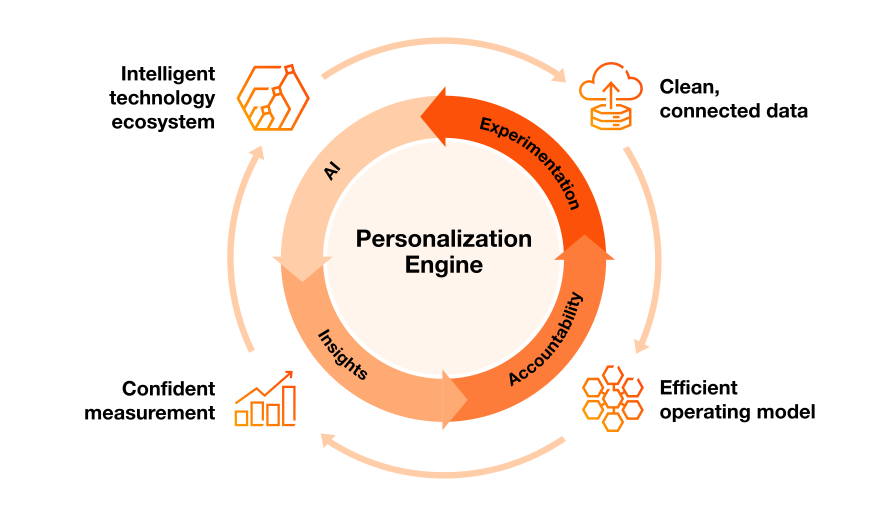
Many organizations assume that deploying a new AI model or adding another marketing technology tool can unlock next-level personalization. In reality, high-impact personalization requires coordinated maturity across four interconnected areas: technology, data, operating model, and measurement—what we call the personalization engine.
This is where the paradox lies. Companies have more tools than ever, yet many can’t produce meaningful outcomes. Here’s what it takes to break through and why real transformation often starts where technology ends.
1. Intelligent technology ecosystem
CMOs are aligned on the goal: Deliver more personalized experiences at greater speed and scale. The problem is a lack of integration. Personalization at scale requires more than just powerful individual technologies. It requires an intelligent ecosystem that connects data, content, and delivery in real time across each touchpoint.
That means moving beyond point solutions and building an end-to-end foundation that eliminates silos, integrates decision-making, and uses delivery platforms to enable dynamic, omnichannel experiences. As personalization evolves from deterministic to probabilistic models, systems should be equipped to act on petabytes of data instantly and intelligently.
2. Clean, connected data
Data is both the fuel and the friction in personalization. Many CMOs recognize its importance, but few feel confident in how it’s being used. In our May 2025 Pulse Survey, CMOs said unclear ownership or access to data and tools was their No. 1 barrier to delivering on their marketing strategies.
More than half of the consumers in our 2025 Customer Experience Survey say that it’s worth sharing personal data to make their experience interacting with a brand smoother. Yet many organizations still grapple with fragmented or incomplete datasets that hinder this experience. This gap comes at a time when customer expectations around personalization are rising.
High-performing teams are treating data as a strategic asset and investing in unified customer profiles, rigorous data hygiene, and enrichment strategies that enable real-time experimentation and scaled execution. And while technology and data create the potential for personalization, it is process that can turn that potential into performance.
3. Efficient operating model
Leading organizations don’t treat personalization as a side project. They establish dedicated, cross-functional teams or robust governance structures that bring together marketing, product, and analytics to enable tighter collaboration and faster iteration.
Still, fewer than one in three companies have adopted agile methods across the enterprise, and many that have still find it difficult to expand. Without a clear operating model, personalization efforts often remain fragmented and slow.
High performing organizations take a different approach. They implement agile frameworks that fuel a continuous cycle of experimentation and have a robust operating model to scale successful experiments. Each win feeds the next test. The result? A system that compounds revenue over time and keeps improving with each iteration.
4. Confident measurement
Intelligent technology, connected data, and an efficient operating model matter only if you can measure the impact. Personalized marketing is a top three investment area for executives looking to elevate CX, according to our 2025 Customer Experience Survey, but most executives also say they need better measurement tools to assess which factors most influence purchases. This means that while personalization is an important investment area for executives, they don’t have the tools to determine what’s actually driving purchase decisions.
As personalization programs scale, measurement should evolve from surface-level KPIs to holistic models focused on ROI and CLV that capture impact and forecast future performance. That’s where purpose-built tools like PwC’s Experience Value Analyzer come in, solutions that offer near real-time, omnichannel visibility into digital behavior and experimentation outcomes, enabling teams to:
The result is a measurement strategy that’s both technically rigorous and practically actionable. This enables faster decision-making, reveals new insights and instills trust in the overall value of the investment in personalization.
Solving the personalization paradox means closing these gaps and unlocking the full value of the investments you’ve already made. But closing the gap often requires more than tools or strategy. It comes from firing up the personalization engine by improving data, reorganizing teams, implementing new processes, and streamlining measurement.
Organizations that close the gap can deliver better customer experiences and drive real business results. We see it across industries through higher conversion rates, larger basket sizes, and greater customer loyalty and lifetime value.
In many cases, big wins don’t come from one-time breakthroughs. They come from building a system that compounds value over time. In these organizations, each insight is applied, each team is accountable, and each test informs the next.
Personalization shifts from a marketing tactic to a strategic growth driver when infrastructure is integrated, data is clean and actionable, teams work in sync, and measurement is clear. This is the real power of a connected personalization engine.
Here’s what you can do today to start translating personalization from promise to performance.
Whether you’re still shaping your personalization strategy or figuring out how to scale a system, the opportunity remains the same: closing the gap between ambition and performance.
{{item.text}}
{{item.text}}
