
{{item.videoDuration}}
{{item.title}}
{{item.text}}

{{item.videoDuration}}
{{item.text}}
What if, as a Chief Marketing Officer (CMO), you could finally find that “holy grail”: Be able to launch a virtually unlimited number of personalized campaign variants across markets—and know that every asset is rights cleared, brand approved, meaningful, culturally relevant, and aligned with real-time market signals?
And what if you often paid almost nothing for this content, because you already own it—and you could launch this campaign with remarkable speed, because your system has helped you identify and prioritize the most relevant content for each audience and moment?
A “content knowledge graph” (CKG) can make this dream a reality. It builds on tools that most marketing functions already have, so you can often stand one up quickly and cost effectively. And with its AI-powered telemetry loop, it can learn more every time you use it.
CKGs are new, but we expect them to spread fast. Here’s what you need to know.
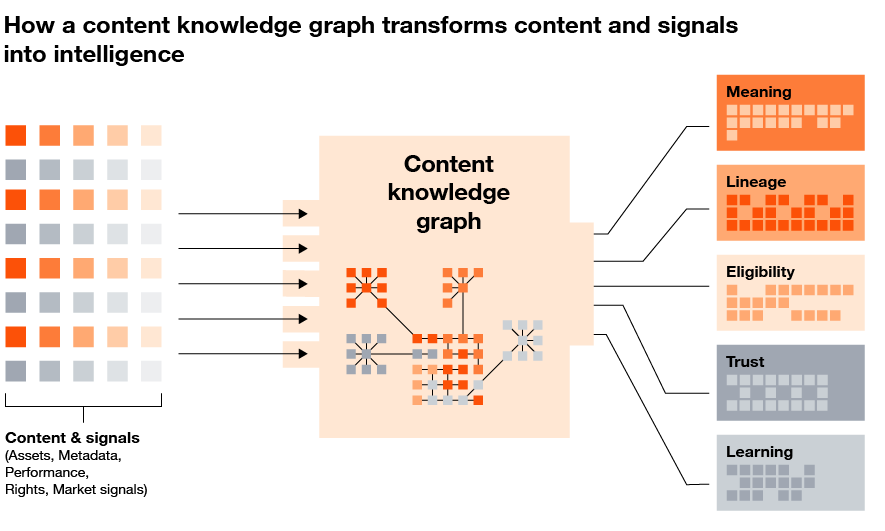
What sets a CKG apart is that it doesn’t just store, organize, and manage your content. It models your assets, the connections between them, and their real-world context, so you can better use, reuse, and personalize what you have.
A CKG’s “raw material”—the data that it holds—is sophisticated content knowledge:
If you don’t already have that data at your fingertips, don’t worry. The CKG can work with imperfect data—which it will improve over time: AI can “bootstrap” data enrichment and natural language discovery for the CKG, suggest lineage and embeddings, and more.
Other AI tools help you find content based on meaning and impact, not keywords, or they can recommend next-best content. AI can also flag compliance risks and tell you rights and lineage. And with an AI-powered telemetry loop continuously monitoring its own performance, your CKG can note its own mistakes and do better next time.
In our work with marketing functions in some of the largest, most innovative companies, we see over and over the same content challenges—which a CKG can help solve.
AI creates supply—which you can’t use. Generative AI can create content cheaply. But it often has inconsistent quality and messaging, and governance and brand risks. With a CKG—containing approved fragments, taxonomies, and constraints—to help, people can quickly review and improve AI-generated content so that it has the impact, consistency, and risk management that you need.
Content is hard to find—and harder to reuse. It happens all too often: A team creates a new asset, when you already had something similar. The reason? They could only search content for keywords, not meaning or eligibility. A CKG can let you search your assets for meaning, impact, rights, and more.
Trust, compliance, and provenance concerns slow you down. As Content Credentials, C2PA standards, and privacy demands rise in importance, provenance and verification has to travel with assets end-to-end. A CKG can deliver that, along with governance, traceability, and policy controls. By driving consistency and ending variant sprawl, it can also help enforce policy across channels.
Performance insights don’t actually improve performance. Without a CKG, analytics typically only show “what happened” in a campaign—not which content blocks had which impact. So, your path to improvement can be murky. A CKG can trace impact back to specific fragments of content.
As a CKG helps you reuse more approved assets and fragments—instead of needing to start from scratch—you can cut costs. With faster discovery of what’s approved and eligible for a given audience, channel, and market, plus streamlined localization (since the CKG links derivatives to masters), you can slash time to market.
As your CKG helps you select next-best content, performance improves. Since it measures how impressions, clicks, and conversions relate to content over time, you can growing your impact. As since it can enforce rights and policies at decision time, preserve provenance and credentials, and support Responsible AI, risks fall too.
Standing up a CKG works best in two stages. First, you integrate your in-house content. Then, you add in real-world, real-time cultural and context signals, so that it becomes a “content and culture graph.” Here’s how to get started.
{{item.text}}
{{item.text}}