







Your customers' AI is already buying. Is yours ready to sell?

Hero Image
  • June 08, 2026

Customers already use AI agents to research, compare, and buy. Companies that still run siloed, human-intensive front offices are falling behind. The agentic front office redesigns marketing, sales, pricing, and service as one intelligent system—sensing, deciding, and acting in real time.

Key takeaways

  • Traditional front offices—with marketing, sales, service, and pricing in separate silos—are structurally unable to keep pace with AI-enabled buyers and compounding cost pressure.
  • Leading organizations are creating an intelligent customer edge by redesigning the commercial operating model into one integrated system where AI agents sense customer intent, analyze in real time, and execute transactions without a human touching a keyboard.
  • A "commercial brain" of sensor, thinker, and doer agents turns proprietary customer data into a durable competitive advantage that compounds with every interaction.
  • Governance and guardrails are designed from the start, making agentic operations demonstrably less risky than human-centric workflows prone to discount leakage and inconsistent execution.
  • Early AI leaders are cutting front-office operational costs by up to 40% while growing revenue, breaking the historic link between headcount and commercial capacity.

For decades, companies have organized their commercial operations around isolated functions: marketing, sales, pricing, customer service—each with its own metrics, processes, and view of the customer. But AI is making that structure increasingly outdated as customers increasingly use agents to research products, compare prices, and bid on products. If your front office is still largely manual and isolated, or your AI implementation is simply layering new tools onto existing processes, you’re falling behind.

While rethinking how the front office is designed and run isn’t new, leading organizations are redrawing functional boundaries to create a consistent customer experience. Building an intelligent customer edge means developing a model that incorporates every customer-facing function into a single, intelligent system designed around your customers, powered by data only you own, and built to grow smarter with every interaction. At its core are AI agents that anticipate customer needs, initiate interactions, and operate across channels in real time—not as a replacement for human judgment but an extension of it. The result is a front office that is coordinated, proactive, and built for the way customers actually buy today.

AI-centric organizations that take this approach can boost their top line and their margins, capitalizing on the technology’s ability to sense, decide, and act faster than in the past. At a time when many gains from AI have been cost reductions, 30% of CEOs in PwC’s 29th Global CEO Survey reported increased revenue from AI in the last 12 months.

Many industries are seeing efficiency gains as well. For example, an early AI leader in banking has reduced front-office operational costs by up to 40% while simultaneously improving output quality. Customers get a better experience, and the bank has improved its financial performance without having to build larger sales teams.

Why traditional commercial models fall short

Long-standing commercial models are under pressure today from a wide range of challenges:

  • Changing customer behavior. Path-to-purchase isn’t a linear process anymore. It’s a real-time, dynamic web of algorithms and instant decisions. In PwC’s 2025 Customer Experience Survey, 70% of executives say that customer expectations are evolving faster than their company can adapt.
  • Slowing top-line growth. Once-reliable growth levers like market expansion, price increases, or hiring bigger sales forces are at the point of diminishing returns. In PwC’s most recent Global CEO Survey, only 30% of CEOs are confident in organic revenue growth over the next 12 months.
  • Relentless cost pressure. Rising input costs and other factors are pushing companies to reduce costs. As noted by Gartner in a survey, “56% of CFOs rank achieving enterprise-wide cost optimization targets in their top five, while 51% of respondents rank improving financial forecast accuracy and quality in their top five.” In the human-centric commercial model at many companies, sales, marketing, and service functions consume nearly 30% of revenue in operating costs, on average.
  • AI-enabled buyers. Retail consumers and B2B customers increasingly use AI to buy products and services. Gartner predicts, “by 2028, 90% of B2B buying will be AI-agent intermediated, pushing more than $15 trillion of B2B spend through AI agent exchanges.” Commercial systems should be designed to engage intelligently not just with human buyers, but with the AI agents acting on their behalf.
  • Insufficient value from AI thus far. Many companies have yet to see real ROI from AI, and the reason is structural. Most still deploy AI to automate existing tasks, but even more value can come from redesigning processes and functions to capitalize on agentic capabilities—a step many organizations haven’t taken yet.

The four pillars of an agentic front office

Instead of quick fixes, companies need to redesign their commercial operations into an agentic front office that leverages AI to better serve customers. We recommend basing your approach on four pillars.
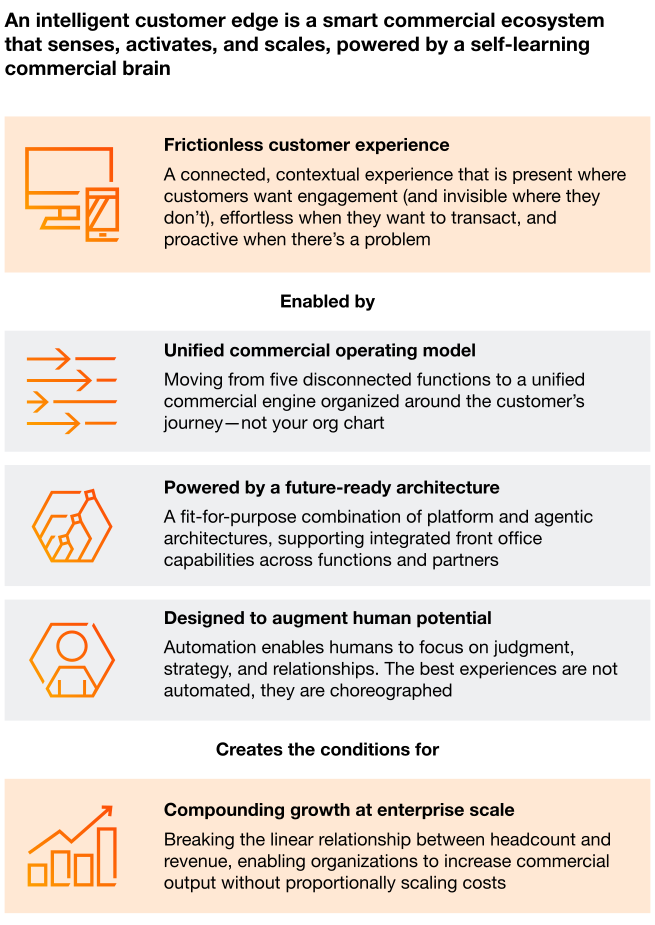
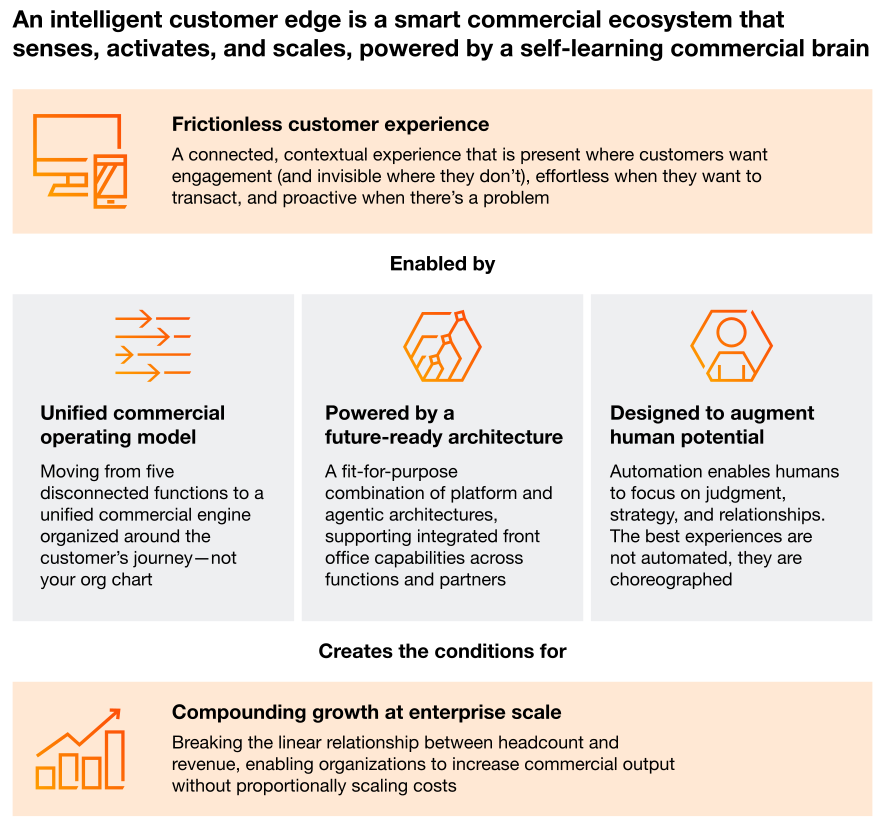
1. New commercial operating model. Rather than marketing, sales, pricing, and customer service operating in isolation (or fighting for resources), companies break down functional boundaries to create an integrated entity governed by shared outcomes and unified intelligence.

Provide all teams with consistent metrics, incentives, and accountability. Organize work around the customer journey, not your internal reporting structure. Your overarching goal is to meet customers where they are, anticipate what they need, and respond with greater speed and quality through AI. That can give customers a more coherent experience with fewer handoffs across functions, with the commercial function operating as an orchestrated network of human judgment and agent execution.

2. Commercial brain. This is the intelligence layer where AI agents work together to analyze and execute transactions, and where companies synthesize their proprietary customer data into a highly competitive offer. It entails different types of AI agents.

  • Thinker agents are the analytical processors. When a sensor agent alerts them of your VIP customer’s interest, they can instantly review that customer’s purchase history, calculate their lifetime value, and model your company’s real-time margin capacity. They then do the heavy math required to determine what kind of offer makes sense.
  • Doer agents execute the transaction. When flagged by a thinker agent about an optimal deal, the doer agent generates a preapproved, hyper-personalized proposal—including a custom discount—and emails it to the customer’s procurement bot.
  • Sensor agents are the eyes and ears of the system, watching signals across the overall market and at the level of individual customers. For example, a sensor agent could notice that a high-value client is currently spending time on the pricing page of your company’s website.

All these steps—sensing the intent, analyzing the financials, and executing the outreach—happen autonomously in seconds, with humans only reviewing the output. In addition, the brain analyzes transactions to get smarter over time, through a closed loop of compounding intelligence.

3. Design that augments human potential. The best customer experiences are choreographed.

  • Agents own orchestration, speed, and consistency.
  • Humans own the moments that require judgment, empathy, and trust.
  • Sales teams can build relationships with customers.
  • Marketers can dream up new ways to communicate value propositions and stimulate demand.
  • Customer service can delight clients with superlative interactions.

The output of a well-designed human-agent team isn't additive but rather multiplicative. And designing that choreography deliberately—deciding where agents lead and where humans step in—is itself a source of competitive advantage.

4. Compounding growth at enterprise scale. The agentic front office breaks the linear trap between revenue growth and headcount. Companies applying AI widely to their customer experiences achieved nearly four percentage points higher profit margins than those that didn’t, a PwC analysis found. The value potential of an integrated agentic front office is measurable across every commercial function:

  • Sales productivity and growth: AI-enabled sellers are 3.7 times more likely to meet their quota, according to the Gartner Sales Survey, 2024. PwC sales transformations deliver 10% to 20% revenue lift per rep and 15% to 25% shorter sales cycles.
  • Commerce and conversion: According to Salesforce, AI-influenced commerce already drives 20% of all online purchases—$67 billion during 2025 Cyber Week alone. PwC retail engagements have boosted conversion rates by up to 40% by delivering unified, AI-powered digital experiences.
  • Pricing and margin: PwC pricing, promotions, and revenue management deployments are recovering 3% to 5% of revenue by reducing pricing leakage.
  • Service transformation: PwC service engagements are now helping companies divert 30% to 50% of incoming queries to self-service options, reduce operational costs by 30% to 40%, and increase net promoter scores by 10 to 15 points—all while maintaining consistent quality.

The intelligent customer edge in action

The pattern is consistent: When commercial operations are made more autonomous, more responsive, and more efficient, revenue, customer experience, and cost trajectories all improve. Consider the following real-world examples:

PepsiCo deployed agentic AI ordering intelligence that expanded lifetime value per account while lowering cost-to-acquire and -serve, turning routine ordering into a scalable commercial intelligence engine.

Wyndham Hotels & Resorts used agentic automation to compress billing cycles by 85%, from 48 hours to less than seven.

The San Francisco 49ers delivered personalized, AI-powered VIP experiences to 70,000 fans on game day, unlocking new revenue streams.


Trust by design

When we talk to business leaders about the agentic front office, we hear a common concern: What about oversight and governance? AI agents that autonomously set prices, make offers, and engage customers—who increasingly have their own AI agents—can leave even forward-leaning executives uneasy. It’s a fair concern, but the wrong frame.

Trust ultimately is an architectural decision. The organizations that move fastest on agentic deployment have embedded governance most rigorously from Day One. You don’t deploy agents and then add governance. You design governance into the agents themselves, before the first transaction goes live.

In practice, this means four things operating simultaneously:

  • Decision rights and autonomy tiers. Each agent has explicit boundaries defining what it can execute autonomously and what requires human judgment. These boundaries evolve as agents become more reliable over time.
  • Real-time policy enforcement. Pricing floors, discount thresholds, brand voice, and regulatory constraints are coded directly into agent logic and enforced in the stream of every transaction (not after the fact).
  • Supervisory agents. A second tier of agents validates every proposal before it reaches the customer, flags anomalies, and enforces financial discipline.
  • Continuous traceability. Every autonomous action is logged, replayable, and explainable. Models are continuously tested for bias, drift, and performance.

The counterintuitive result is that this approach carries less risk than the human-centric model it replaces. Discount leakage, off-policy commitments, and inconsistent customer treatment are endemic in human-led commercial operations. In an agentic model with governance embedded by design, policy is enforced uniformly, every time, with a complete audit trail.

Governance is the economic enabler of agentic autonomy, not a constraint. Organizations that get this right will outpace their peers not because they have better AI, but because they have built the architecture that lets AI be safely turned loose.

A growing need to act

Companies are at different stages of AI maturity, and the next step in building the intelligent customer edge will vary for each. But one consistent element is the growing need to act. Every day that companies stick with their traditional organization design is another day they fall further behind. Given growth and cost pressures, the need to get value from AI investments, and—critically—the fact that customers increasingly use AI agents, companies can defend their market position and grow only by also embracing AI. Instead of simply automating yesterday’s workflows, winning companies will redesign how they engage with customers, create value, and grow.

$1.4B+ through reinvention

Trimble transforms silos into seamless experiences

Wyndham: loyalty reimagined

Modern technology, loyal guests

FAQs

An agentic front office is a commercial operating model where AI agents work alongside humans to sense customer intent, orchestrate decisions, and execute transactions in real time. Unlike traditional front offices organized by function—marketing, sales, service—an agentic front office unifies these into a single, self-improving system driven by shared outcomes and customer data only you own.

Agentic AI transforms front office operations by replacing isolated, manual workflows with a coordinated system of specialized agents. Sensor agents monitor buying signals; thinker agents analyze customer data and model margin scenarios; doer agents execute compliant, personalized offers, all autonomously and in seconds. This breaks the linear link between headcount and commercial output, letting organizations grow revenue without proportionally scaling teams. PwC clients have seen 10–20% revenue lift per sales rep and 30–50% reduction in service costs.

Organizations that build an intelligent customer edge see measurable gains across every commercial function: up to 40% higher conversion rates in digital commerce, 3–5% revenue recovery from pricing leakage reduction, 30–40% lower service operational costs, and 10–15 point NPS improvements.

The model is built on deliberate choreography, not replacement. Agents handle orchestration, speed, and consistency—qualifying leads, enforcing pricing guardrails, routing service requests. Humans own judgment, empathy, and relationship-building: the moments where trust is earned. The output of a well-designed human-agent team is multiplicative, not additive.

Governance is an architectural decision, not an afterthought. Effective agentic governance embeds four controls from day one: explicit autonomy tiers defining what each agent can execute independently; real-time policy enforcement of pricing floors, brand voice, and compliance rules coded directly into agent logic; supervisory agents that validate proposals before they reach customers; and complete decision traceability so every autonomous action is logged, replayable, and auditable. This makes the agentic model less risky than human-led operations, where discount leakage and policy inconsistency are endemic.

Contact us

Ian Kahn

Customer and Commercial Excellence Platform Leader, PwC US

Pete Choo

Principal, Customer and Commercial Excellence, PwC US

Jose Linares

Director, Customer and Commercial Excellence, PwC US

Follow us

Required fields are marked with an asterisk(*)

Your personal information will be handled in accordance with our Privacy Statement. You can update your communication preferences at any time by clicking the unsubscribe link in a PwC email or by submitting a request as outlined in our Privacy Statement.

Hide