






{{item.videoDuration}}
{{item.title}}
{{item.text}}

{{item.videoDuration}}
{{item.text}}
Grow faster. Improve productivity. Protect your margins. It seems like commercial, marketing, and experience leaders all face similar challenges in a complex market. Yet many are trying to address them with an operating model designed for a very different market. AI investments are accelerating individual tasks—from marketing content creation to sales administration and customer service—but many companies still struggle to create measurable value at an enterprise scale.
As today’s customers move seamlessly across marketing, digital commerce, sales, pricing, and service, they expect interactions to reflect who they are and what they need. Fixing the disconnected processes, fragmented data, and manual coordination that result in inconsistent experiences means redesigning how the commercial enterprise operates—or as we call it, building an intelligent customer edge.
Creating an intelligent customer edge begins with a new commercial operating model that integrates marketing, sales, commerce, pricing, and service into a coordinated system organized around the customer journey. This is supported by three additional pillars—a “commercial brain,” human augmentation, and a scalable architecture—but those capabilities depend on a common operating model that allows the entire commercial organization to work as one.
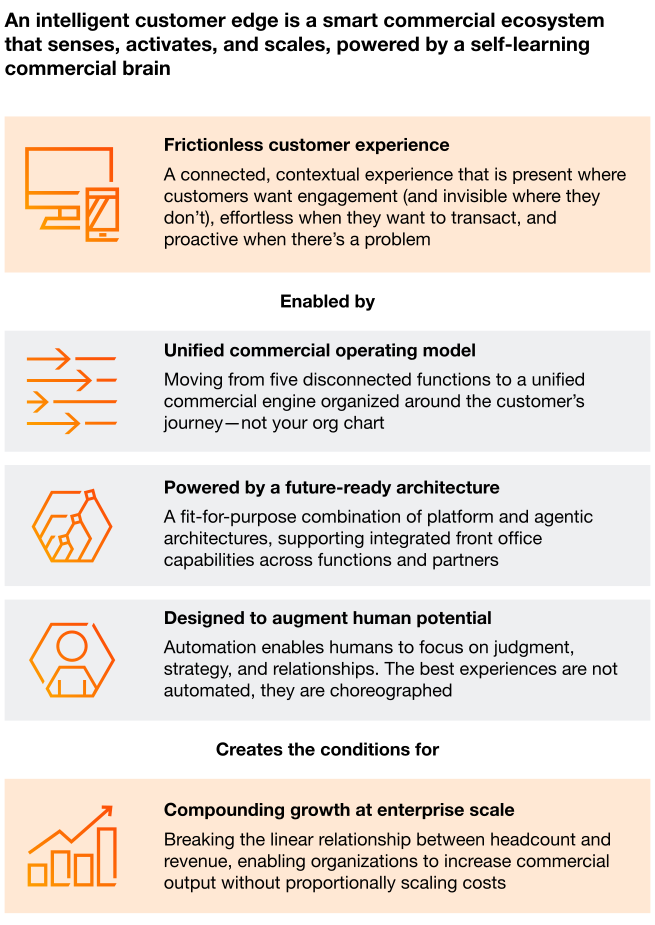
Without this foundation, AI implementation will remain fragmented. With it, your company can create a commercial engine that continuously learns, coordinates, and improves.
In traditional commercial operations, marketing generates demand, sales converts opportunities, commerce fulfills transactions, pricing governs profitability, and service retains customers. Each function enhances its own performance, supported by its own technology, metrics, and leadership. And that was fine … when buying journeys were predictable and commercial decisions unfolded over weeks or months.
Today, customers expect personalized interactions across every channel, with buying decisions happening quickly. The speed of the market now exceeds the speed of many organizations, where disconnected commercial functions struggle to respond as one enterprise. Valuable information sits inside individual systems, teams make decisions using different versions of the truth, and customers experience the gaps even when an organization believes it’s delivering a seamless journey.
Four structural realities are making this increasingly difficult to ignore.
Instead of focusing on individual functions, leading organizations are redesigning the front office so marketing, sales, commerce, pricing, and service operate from shared intelligence, coordinated workflows, and common commercial objectives. Most companies will progress through four stages.
The key difference between these stages isn’t just increasing technology and automation but making better commercial decisions by bringing the entire enterprise to every customer interaction. Rather than operating from isolated data, teams work from a single commercial picture. Shared intelligence replaces fragmented knowledge. Coordination replaces handoffs. Every commercial function contributes to and benefits from a common understanding of the customer.
In traditional organizations, work passes sequentially from one function to another, introducing delays and breaking customer context. In an agentic operating model, commercial activities happen in parallel, and customer context persists throughout the relationship. Customers don’t need to repeat information, and employees spend less time searching for answers because each conversation begins with a more complete view of the relationship.
The objective isn’t automating expertise but amplifying it. Consider a customer who wants to expand a long-standing relationship with a technology provider. Product usage shows growing demand in one business unit, while marketing engagement suggests interest in adjacent solutions. Recent service interactions reveal implementation challenges that should be addressed, and pricing analytics identify how to package services more effectively.
Rather than multiple teams assembling this picture manually, the commercial operating model brings insights together automatically. The account team can then go beyond just selling another product to actually solving the customer’s business challenge. That’s the difference between improving functions and orchestrating an enterprise.
Operating model transformation changes commercial functions and how they enhance each other and the business as a whole.
Viewed independently, each of these changes creates measurable value. Viewed together, they redefine how organizations compete.
Most importantly, companies can establish a commercial engine capable of delivering profitable growth without relying on proportional increases in headcount. That could be increasingly important in a volatile market.
Building better products, expanding into new markets, increasing digital investments … all of that is still important. But for many companies, beating the competition will depend on how effectively you coordinate commercial activity across the enterprise. Now is the time to examine your commercial operating model with fresh eyes.
You don’t need another framework for adopting AI. The agentic front office provides a blueprint for reinventing how the front office operates, and a new commercial operating model provides the foundation.
{{item.text}}
{{item.text}}


