
AI strategy for CEOs: Where to lead, lag, or exit

  • Blog
  • April 29, 2026
Dan Priest

Dan Priest

Principal, PwC US

Kumar Krishnamurthy

Kumar Krishnamurthy

Strategy Platform Leader, PwC US

Matt Mani

Matt Mani

Principal, PwC US

Key takeaways

  • AI advantage comes from focused investment—not widespread experimentation
  • Most AI challenges are strategy problems, not technology problems
  • The Lead–Lag–Exit framework turns AI into a strategic portfolio decision

After an initial Wild West period of bottom-up experimentation, AI’s transformational potential is shifting into a more mature stage. Early pilots and low-risk automations helped deliver incremental wins, but many such efforts eventually hit a ceiling. Not every part of a company may be ready for AI transformation, and the models are not ready to handle every part of a business—at least without significant investment. The top leaders are harnessing this insight to shape their strategy and deploy capital and top talent to high impact areas where AI is ready and the business is ready for AI.

A PwC analysis shows that those making a meaningful AI investment—1-2% of revenue—outperformed their sector median total shareholder return (TSR) by 21% from 2022-2025. Those investing less underperformed by 2%. The companies pulling ahead are not the ones with the most AI agents throughout the organization. They’re the ones making the most deliberate choices about where and how to deploy the technology.

AI value creation isn’t always linear. It follows a hockey stick curve in which early investments may not show immediate returns but can be followed by a dramatic rise when a collection of capabilities comes together to create distinguished value. That dramatic rise is made possible by deliberate strategic decisions, not by scattering bets across the enterprise and hoping something compounds.

AI isn’t a standard technology to be delegated to the CIO or CTO. CEOs and CFOs should set strategy, prioritize investment, and maintain focus on execution. To set the stage for success, company leaders should first answer three questions.

  • Where do we invest ahead of our peers to build value creation capabilities that cascade through the organization?
  • Where do we follow the competition at a more measured pace?
  • Where should we stop placing bets and consider exiting?

A lack of structure around how to execute an AI strategy can create clutter—too many initiatives, unclear proof thresholds, slow scaling. Unfortunately for many companies, the first instinct is to look at what their peers are investing in or which agents they’re deploying.

This approach may seem safe, but it can be detrimental to creating long-term structural advantages in key areas. Instead, companies should use a Lead-Lag-Exit framework to make explicit strategic choices around where and how to invest resources.

A realistic look at why AI failures are often a strategy problem

Having a decision-making framework is important because AI projects often fail due to weak strategy, not just technological shortcomings. One strategic culprit is poor prioritization, which diffuses value instead of compounding it. We’ve seen this in many clients that were running dozens of pilots across functions without tying them to key metrics like revenue growth, margin expansion, or cycle-time improvement. Without a more disciplined approach, companies may end up spreading capital and talent thinly across too many experiments. Our April 2026 C-Suite Outlook backs this up with 81% of executives saying they’re still at least 12 months away from meaningful returns on their AI investment beyond efficiency.

Unclear proof thresholds also can stall scaling. Many AI pilots launch without predefined financial targets that could later help the C-suite evaluate whether to expand the project, pivot, or shut it down. Without those triggers, initiatives can linger indefinitely in proof-of-concept mode, and capital allocation becomes a matter of judgment and internal politics rather than a rules-based decision. PwC’s new 2026 Global AI performance study found that 50% of industry leading AI organizations conduct portfolio reviews to scale AI initiatives at least monthly, compared to 35% for non-leaders. CEOs at those industry leading companies understand that their organizations require consistent monitoring, including clear go/no-go criteria established before the first dollar is spent—not after reporting disappointing results.

Poor sequencing can be another common strategic problem. AI generates sustained returns when foundational elements are already in place—strong data governance, clear process ownership, and aligned incentives. When companies skip these steps and layer AI deployments onto fragmented systems, they tend to produce isolated efficiency gains rather than structural performance improvement. The technology works, but it works in a vacuum, disconnected from the broader operating model.

How do you determine where to make AI investments?

A solid strategy is important because while AI value is real, it’s not evenly distributed across the enterprise. Many AI returns accrue in a small number of areas—the decisions and workflows that drive revenue, margin, and cycle time. The Lead-Lag-Exit framework is designed to force choices early and make them explicit. It gives CEOs and their leadership teams a structured way to allocate resources. Think of it as the strategic equivalent of a portfolio review—not for financial assets, but for AI-driven capabilities across the enterprise.
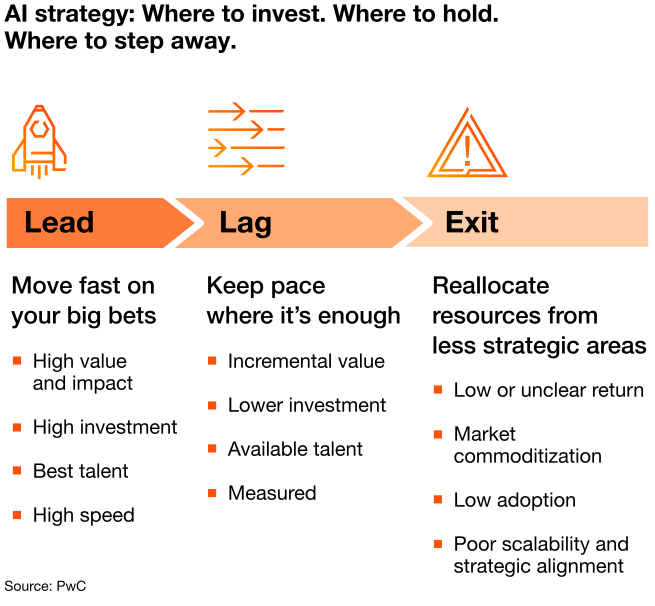
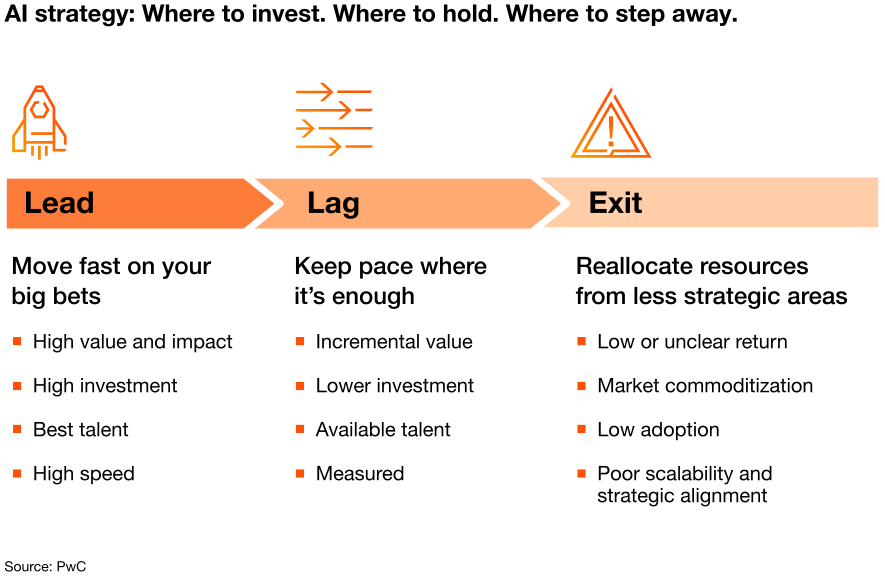
Aim to lead where you have advantages in technology, data, and talent. These differentiators can fundamentally change the basis of competition—whether that’s pricing, speed, personalization, risk management, customer experience, or cost structure. Companies also should pick areas to lead in table stakes that are essential to competing. Leading is not only about capturing today’s large value pools that can reasonably be transformed. It’s also about expanding future options.

In rapidly evolving AI markets, early movers build proprietary data feedback loops, institutional capability, and operating muscle that widen their strategic options over time. Even imperfect first deployments can create compounding advantages. Waiting for certainty may feel prudent, but it may narrow future choice. Organizations that lead shape how the value chain evolves rather than reacting once it has already been redefined.

Leading is high-intensity, high-impact change aimed at the largest, most durable value pools in the business. It requires reinvention across workflows, data, operating models, and the workforce itself.

How it works in practice: A national retail merchandise company chose to lead by deliberately selecting a small number of high-value domains where it had both the data advantage and operational control to drive measurable impact. It deprioritized lower-differentiation areas, leaving their transformation for later or through vendor-led solutions. Rather than dispersing effort broadly, the company anchored its strategy in core retail value pools across merchandising, store operations, and real estate—areas directly tied to revenue growth, cost avoidance, and capital efficiency and where AI could reshape decision-making at scale.

This focus was informed by a structured prioritization process that assessed each opportunity based on value potential, feasibility, and readiness, resulting in a portfolio of more than 40 use cases. Based on this work, the company sequenced an initial wave of four minimum viable products in high-impact, high-readiness areas to demonstrate measurable results within 14 weeks and establish a scalable foundation for broader deployment.

Companies can choose to lag where a business capability is a commodity, vendor-led, or parity-driven. In some cases, the value pool is real but not differentiating. In others, uncertainty remains too high to justify a leadership-level bet.

There are different operating choices for lagging. It can mean making lower, targeted investments and using available talent rather than redeploying top-tier leaders, engineers, domain specialists, and change managers. It also can mean using vendors where differentiated capabilities aren’t required. Critically, lagging is not passive and requires closely monitoring competitors to understand the lessons they’ve learned. Leaders define in advance the specific triggers—market shifts, competitive moves, and cost thresholds—that would justify escalating to a lead posture or, alternatively, moving toward an exit. Without those triggers, lag risks becoming drift.

How it works in practice: A global consumer packaged goods company determined that its contact center was not a source of competitive differentiation, even as AI rapidly transformed customer service capabilities. Rather than investing heavily to build in-house AI solutions, the company chose to collaborate with a third-party provider under an outcome-based model.

This approach allowed the company to access continuously improving, AI-enabled capabilities while avoiding significant internal investment and complexity. By relying on a partner whose core business was advancing these capabilities, the company maintained competitive parity in a non-strategic area while concentrating its capital and talent on higher-impact, differentiated priorities. This approach also prevented the lag from creating such a big gap that the company was out of position in the market.

In some rare cases, the more proactive AI decision a leadership team can make is stepping back from a legacy activity and reallocating those resources to where AI creates real advantage. Exits should be made in areas where AI is eroding the value pool. They should be considered an example of discipline, not failure. Some instances we’ve seen where clients decided to exit include discontinuing bespoke builds when value is eroding quickly, sunsetting legacy programs, outsourcing or standardizing functions for managed efficiency, and divesting stranded assets.

How it works in practice: Consider a theoretical example in which a consumer products company was evaluating its portfolio as AI reshapes cost and competition. Its private label manufacturing business was a small share of revenue but was becoming increasingly commoditized, with AI-enabled competitors driving down costs at scale. Remaining competitive would have required significant investment in AI-driven manufacturing and supply chain capabilities.

But instead the company could choose to exit the business and reallocate capital to higher-margin, differentiated areas where AI could strengthen competitive advantage. This reflects a broader pattern: as AI compresses value in commoditized segments, companies may choose not to invest to keep pace—freeing up capital, talent, and leadership attention to focus on areas where a collection of AI-enabled capabilities can drive outsized impact.

Where to start with an AI portfolio strategy?

The Lead-Lag-Exit framework clarifies where to invest and where you’re going to organize a disciplined approach to execution. In an AI environment that compresses time and advantage, companies should to embrace what we call a bi-modal approach to transformation. Mode one focuses on value over volume. Mode two is more experimentation-based and is led by workers, not senior leadership, so a higher volume is acceptable. Mature adoption is mode one, and it falls under the framework’s “Lead” category. Once strategy reveals the highest-value AI impact zones, companies should make big bets on a small number of transformative projects where execution can reliably move the needle while lagging or exiting the others.

  • Make AI strategy a CEO-level mandate. Elevate AI from an IT roadmap discussion to an enterprise agenda item owned by you and your executive team. Declare publicly—to your board, your leadership team, and your organization—where the company intends to lead with AI and where it does not.
  • Create a Lead-Lag-Exit plan during planning cycles. The plan should address where your enterprise can lead with AI and the specific economic outcome expected, where it can intentionally lag, and where investment should stop or be redeployed.
  • Concentrate capital and talent on your lead bets. Fund disproportionately in the areas you have chosen to lead and deploy your strongest operators and engineers there.
  • Benchmark before you bet. For every AI initiative, predetermine the specific performance benchmarks that justify moving from pilot to full-scale deployment—and the timeline by which those benchmarks should be met. Resist the temptation to measure progress with vanity metrics like the number of AI agents deployed; instead, benchmark against the outcomes that signal competitive advantage in your industry. If an initiative does not hit its triggers, reallocate the capital and talent to an area where the return is likely more certain.
  • Align with your CFO around an AI capital allocation framework. AI transformation does not have the familiar funding precedents of an ERP implementation or a traditional technology program, and many CFOs are struggling with how to allocate capital to an investment without a clear endpoint. Work with your CFO to establish a funding model that treats AI as a strategic portfolio—with defined investment horizons, expected returns by category, and the discipline to exit when economics no longer justify continued spend.

The bottom line

AI capabilities are maturing. But many companies don’t have the ability, the capital, or the talent to transform every aspect of their business simultaneously, which is why strategic analysis is so important. C-suite leaders should understand which spots make more sense for investing in AI transformation that can move the needle on P&L. The companies that can define the next era are not the ones with the most agents or conducting the most AI experiments. They are the ones making the better choices and aligning their entire enterprise around those choices. The technology is just a tool. The real differentiator now is leadership.

Build your AI investment strategy

Explore how to prioritize AI investments for measurable impact.

Follow us