





Key findings
NextEra’s $67 billion acquisition of Dominion, valued at $420 billion enterprise-wide, represents a landmark deal in the sector and may be the catalyst for further consolidation.
Even with the increase in strategic M&A activity, the power and utilities sector remains an attractive market for financial sponsors, with continued investment in independent power producers (IPPs), behind-the-meter platforms, and energy-as-a-service (EaaS) models. Sponsors are particularly focused on utilities in favorable regulatory areas that offer timely cost recovery and strong return on equity (ROE).
The era of renewable generation as the key driver of M&A activity is waning, with the focus shifting to dispatchable generation to meet load demands.
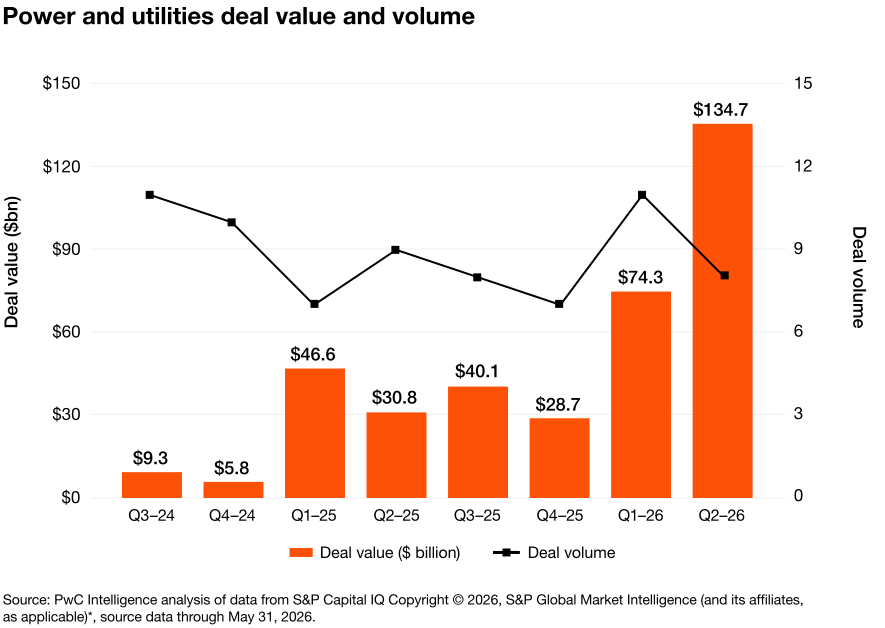
Over the six months ended May 2026, announced power and utilities M&A activity totaled $216 billion1 across 23 transactions, up 173% from $79 billion across 23 transactions in the prior comparable period ended May 2025.
Key transactions between November 2025 and May 2026:
Consolidation to form the “super utility”: NextEra Energy announced the $67 billion acquisition of Dominion Energy, the largest regulated utility transaction ever announced, via an all-stock deal. The combined enterprise value of the landmark transaction is approximately $420 billion. The transaction provides Dominion access to NextEra’s scale and capital base to fund outsized capex programs serving the growth in northern Virginia’s “Data Center Alley,” while reshaping NextEra’s portfolio mix with a heavier weighting to regulated cash flows.
Capital for AI-driven load growth: A BlackRock Global Infrastructure Partners (GIP) and EQT-led consortium announced the take-private acquisition of AES Corporation for $49.6 billion. The deal addresses AES' capital needs to support growth beyond 2027, including delivery of 11.8 GW of contracted clean energy agreements with major technology customers.
Private capital stepping in to fund renewables buildout: Brookfield and La Caisse’s $6.1 billion take-private of Boralex, converting a public IPP into a privately funded platform, accelerating execution of Boralex’s development pipeline across North America and Europe.
Data-center demand driving utility asset recycling among sponsors: Stonepeak and Bernhard Capital’s $6 billion acquisition of Cleco from the Macquarie-led consortium reflects intensifying competition among private infrastructure capital for regulated utilities with data-center-driven rate base expansion.
Confluence of the technology and power sectors: Alphabet’s (Google’s parent company) acquisition of Intersect Power for $4.75 billion signaled a shift from offtake-only partnerships to direct ownership of in-house generation development, accelerating access to power by bypassing interconnection timelines and grid capacity constraints.
Policy, geopolitics, and structural market shifts: midyear update
Industry recalibration continues to weigh on renewable project pipelines and financing. The One Big Beautiful Bill Act (OBBBA) accelerated the phasedown of the Production Tax Credit (PTC) and Investment Tax Credit (ITC) for wind and solar projects, while the foreign entity of concern (FEOC) and domestic content provisions have added supply chain complexity. Excluding Google’s acquisition of Intersect Power, there were six renewable-focused M&A transactions in the last six months period for combined deal value of $10.7 billion, down 14% from $12.4 billion across eight transactions in the prior comparable period.
The conflict in the Middle East has accelerated US liquefied natural gas (LNG) export demand, resulting in domestic gas supply competing with export cargoes. Consequently, financial sponsors are re-marking gas-fired generation assets to higher and more volatile forward gas assumptions. Operating gas peakers and combined-cycle plants are expected to benefit from stronger short-term capacity payments and energy margins, particularly those with pre-conflict long-dated gas supply contracts locked in, driving accelerated deal activity and capital allocation towards such assets within the sector.
The announced NextEra Energy-Dominion Energy merger highlights the strategic value of scale and geographic positioning in meeting AI-driven load growth, combining NextEra’s competitive generation platform with Dominion’s regulated footprint in the country’s largest data center market. Excluding the NextEra-Dominion merger, the regulated utilities deal activity has largely focused on the divestiture of noncore and nonregulated business units to focus capital allocation across generation, transmission, and distribution. State Public Service Commission (PSC) approval remains a binding constraint for regulated utility M&A, with successful deals increasingly featuring pre-committed customer benefits (e.g., the proposed $2.25 billion bill credits for Dominion’s customers post-close of the announced transaction) and other commitments to lessen the local impact of these transactions.
Key M&A trends set to influence power and utilities
Hyperscaler vertical integration and deal capital diversification: AI-driven load growth is reshaping the investment landscape, with more hyperscalers and AI firms directly developing and owning generation via platform acquisitions. The next six months are likely to see hyperscaler activity in IPP platforms, behind-the-meter generation, and early-stage small modular reactor (SMR) infrastructure. Offtakers prioritize reliability, resilience, and cost certainty. Tech firms/developers are also expected to acquire legacy industrial sites for interconnection rights.
Dispatchable supply scarcity: Data-center demand driving power/utilities M&A must address supply constraints, including labor/materials shortages, rising costs, multiyear gas turbine lead times, a tight LNG domestic gas market, and regulatory hurdles for large-load interconnection. This causes structural scarcity of new dispatchable capacity and increases valuation premiums for gas peakers, combined-cycle plants, and utilities with data center growth in their rate base.
OBBBA renewables cliff: The July 5, 2026 “begin construction” deadline for PTC and ITC eligibility under OBBBA creates a compressed window of deal activity as developers rush to secure safe-harbor status. Post-deadline, safe-harbored projects will likely see higher premium valuations. The November 2026 midterms add uncertainty; a Democratic majority could ease OBBBA’s renewable limits for 2027 and beyond.
Capital intensity and financial sponsor activity: Meeting AI-driven generation, transmission, and distribution needs attracts record financial sponsor dry powder deployed through hybrid structures like preferred equity, private credit, and minority-stake partnerships alongside strategic buyers. Dealmakers must recognize hyperscalers as distinct strategic buyers and position to compete on operating assets or partner on development deals.
Regulated utility whole-company consolidation: The NextEra-Dominion deal may spark more large-scale utility consolidation as utilities seek scale to fund capex, integrate diverse generation, and serve AI-driven load growth. Multistate regulatory approvals and customer-benefit commitments are likely to remain key constraints on deal feasibility and structure.
“The IPP- and utility-focused deal market has been driven by surging demand from data centers, AI, and electrification, with the announced NextEra-Dominion merger signaling the return of large-scale whole-company consolidation alongside continued platform M&A. Acquirers are focused on funding growth, scaling platforms, modernizing infrastructure, strengthening grid resiliency, and leveraging platform capabilities to capture emerging growth opportunities and while positioning themselves to serve hyperscale customers across multiple jurisdictions.”
Kenyon Willhoit,Power and Utilities Deals Principal, PwC USThe bottom line
The mid-year period signals a return of strategic IOU consolidation, with the announced NextEra-Dominion merger potentially catalyzing additional whole-company combinations. Future utility combinations will be analyzed against customer affordability and opportunities to capture load growth demand and hedge current regulatory jurisdictions. In addition, load growth demand will continue to drive generation deals, especially for dispatchable generation. However, we expect dealmakers to keep a close eye on potential societal and political headwinds that could slow AI adoption and build out.
FAQs


