





US industrials and energy leaders are on the clock to shape a new golden age
The business of America is business — entrepreneurial, risk-ready and opportunity-driven. When industry seizes not just one innovation but dozens and fuses them together, the result isn’t transformation. It’s creation.
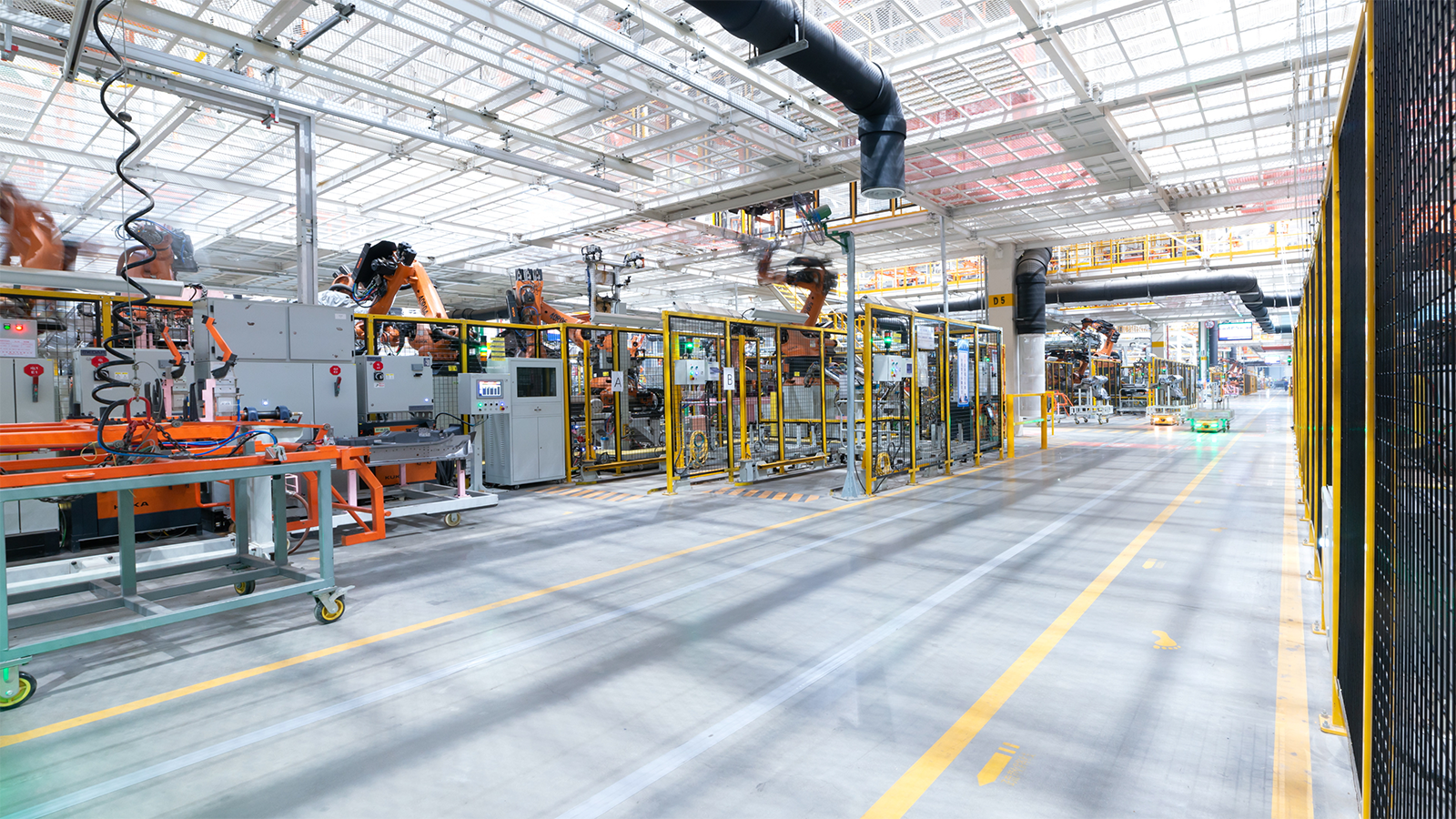
That’s what’s happening now. US industrials and energy leaders, including manufacturers, power providers and utilities, are building something new: a self-healing, intelligent enterprise powered by AI, automation and data. This isn’t a patchwork of upgrades. It’s a paradigm shift that could reposition America at the center of global industrial leadership.
America’s industrial strength is already backed by hard metrics. Take manufacturing. In 2024, US manufacturers contributed $2.91 trillion to the economy — more than the GDP of entire countries like France or the UK. If it stood alone, the US manufacturing sector would rank as the eighth-largest economy in the world.1 That’s just one pillar. Add in energy and utilities powering this transformation and the scale of reinvention is even greater. This isn’t recovery, it’s reinvention at scale, positioning the US firmly at the center of global industry — and the next wave of innovation.
In this future, chips are the new oil. Data centers are the new factories. And by 2035, intelligent, autonomous systems could redefine the sector. Industrials and energy leaders sense a revolution, yet many companies aren’t moving fast enough. The window is open, but not forever.
In PwC’s new Future of Industrials Survey of 500+ industrials and energy C-suite leaders, 93% say we’re on the brink of the next industrial revolution. Political winds may change, but this movement won’t. The convergence of pandemic-era supply chain failures, geopolitical conflicts and automation breakthroughs has locked in a long-term industrial reset. Tariffs are simply one tool. The deeper commitment is to prosperity and security through making critical goods at home.
Unlike prior eras of industrial change, this one isn’t about technology alone. It’s about strategic reinvention — evolving the broader US economic system with innovation, resilience, sovereignty and national ambition at the center.
[1] National Association of Manufacturers, Facts About Manufacturing, May 2025, https://nam.org/mfgdata/facts-about-manufacturing-expanded.
The future of energy and manufacturing
Stronger, smarter, sovereign
American industrials and energy players are aligning innovation, policy and ambition
The industrials and energy sectors are standing at a crossroads, and executives are already signaling where they expect the most reinvention by 2030. This is not a moment for cautious adaptation. It is a call for transformation across core systems, from supply chains and intelligent manufacturing to data integration and regulatory agility. Roughly three out of four (73%) executives believe that companies failing to embrace industrial realignment will be irrelevant within a decade. That's not hyperbole. It's the new reality for leaders facing seismic shifts in technology, policy and global competitiveness.
The bar is higher than ever. Most industrials and energy executives (95%) say organizations need to focus on redefining their market approach rather than simply adapting to current conditions. And they’re betting big. Ninety-two percent believe the industrial sector will progress faster than the technology sector in the next five years. That level of confidence is fueling the momentum behind this new wave of reinvention. This isn't about incremental improvement. It's about seizing the opportunity to rethink everything, including business models, supply networks, production ecosystems and customer engagement strategies.
What's changing? Industrials and energy leaders are reimagining core operations around six nonnegotiables, unified by the digital thread that connects design, production and operations to drive both performance and strength. These include supply chain resiliency; manufacturing modularity, self-healing manufacturing processes that automatically detect and repair errors without human intervention; energy independence; AI-enabled intelligent systems; autonomous operations driven by robotics; and agility in adapting to regulation.
What’s changing? Industrial leaders are reimagining core operations around six nonnegotiables
Factor 1 Reshoring manufacturing isn’t a tactic. It’s the new industrial mission.
Why building a resilient supply chain is a matter of economic survival
America’s industrial revival starts with bringing strategic elements of production home. Ninety percent of leaders surveyed tell us that companies relying on distant suppliers in 2030 “will be extinct by 2035.” Automation has lowered the cost of reshoring, tariffs may be driving it and US tax policy is incentivizing it. Executives overwhelmingly agree (92%) that advanced automation technologies makes onshoring more viable. Nearly a third (32%) say they’re pursuing strategic or aggressive reshoring now.
While the obstacles to reshoring are significant, local production promises better quality control and speed to market — something that’s ever more important in meeting the high demands of today’s consumer. Perhaps most importantly, reshoring encourages infrastructure investment, which has a multiplying effect across sectors and across the economy.
The implications are clear. Resilient supply chains are no longer just about efficiency. They’re about sovereignty.
Factor 2 Modular manufacturing is rising, and it’s self-healing
Welcome to factories that fix themselves, powered by predictive maintenance
Forget static assembly lines. Modular systems, built on plug-and-play platforms that flex with demand, are becoming the new industrial architecture. Five years from now (2030), nearly half of industrials and energy executives (49%) expect their operations to be fully modular, up from just 6% that consider themselves fully modular today.
This shift is already reshaping capital priorities. Industrials and energy leaders are investing in plug-and-play agility, with 52% focusing on flexible production line reconfiguration that adapts to changing products and demand patterns. Another 46% are backing standardized production modules that use interchangeable equipment components. These design strategies are enabling faster, more responsive manufacturing environments that can scale or pivot as needed.
But it doesn’t stop at agility. Executives are backing self-healing supply chains: systems that automatically detect, diagnose and correct disruptions. They’re investing in predictive equipment maintenance (43%), intelligent workforce reallocation (38%), adaptive production scheduling powered by AI (33%) and digital twin simulation and correction (30%).
These technologies are helping to hardwire resilience into operations and reduce the risk of costly downtime. Still, most companies are only beginning to scratch the surface. Without broader implementation, these innovations risk remaining isolated upgrades rather than sector-wide breakthroughs. The opportunity is massive, but so is the risk of falling behind.

Factor 3 From gridlocked to grid-smart: The race for energy resilience
Why industrials and energy must decentralize, decarbonize and take control
Only 38% of leaders surveyed believe their current energy infrastructure can meet evolving needs over the next five years. But change is coming fast. Eighty percent plan to increase investment in energy resilience within three years — and not just for sustainability reasons.
According to 94% of leaders surveyed, this push is about operational control and improving organizational resilience. As customer demand becomes more complex and diverse, both established players and new entrants will collaborate and compete to provide power. The winners will be those who can use real-time data insights to develop innovative solutions that generate new business.
In the near term, gas will be key, and nuclear power will grow in importance as the promise of small, nuclear reactors is realized. Eventually, hydrogen, biofuels and synthetic compounds may power the future as climate change continues to spur technological innovation to lower carbon emissions. Batteries and other storage technologies could offer compelling solutions to the intermittent availability of wind and solar power, allowing energy providers to better match supply and demand. But the timeline for green energy is longer and the country is in an international energy race. Growing capacity is a competitive advantage.
Sovereign energy is key for sovereign industry.
Factor 4 AI in manufacturing takes the wheel
Intelligent systems as industrial backbone
AI is no longer just an experiment in manufacturing, it’s becoming the backbone of industrial competitiveness. Eighty-one percent of the executives surveyed tell us they plan to increase AI investments in the next three years, and 93% say America’s industrial advantage will be built on intelligent systems.
But the growth story is uneven. High-growth companies — defined as those that have experienced significant revenue growth (10%+) over the last two years — are pulling ahead, investing in technology faster than their peers. They’re concentrating their resources on areas that scale intelligence across the enterprise and hardwire resilience into operations with a greater focus on cloud-based analytics, supply chain data visibility and predictive capabilities as the breakthrough most likely to transform their industry. They also place higher priority on scalable, flexible IT architecture that enables decentralization.
The gaps are consistent. High-growth companies are between eight and 17 percentage points more likely than peers to prioritize these investments. For them, intelligent systems are not optional but foundational to the future industrial advantage.
Factor 5 Smart manufacturing meets the AI-native workforce
Why robotics in manufacturing is augmenting — not replacing — the human edge
Industrials and energy leaders are not bracing for AI to take jobs away. They are preparing to use it to make jobs better. Only 6% expect a future with limited AI use for specialized tasks only. The rest are building toward a workplace where most roles are AI-augmented, decision-making is sharper and routine work is handled automatically.
Nine in 10 executives say AI is prompting a fundamental rethink of job roles in their sector. That means redefining what those jobs are, the skills required to perform them and the way work is organized.
Preparing employees for this shift has become the top workforce development priority. It is a re-skilling imperative and a race to build AI fluency into every role so that humans and AI can work in step.
Eighty-one percent of leaders plan to increase investment in robotics. Working alongside robots that are safer, smarter and more affordable than ever, the modern industrial worker will be skilled, AI-native and internationally competitive.
Factor 6 Regulatory foresight becomes your next strategic advantage
Why compliance is the new competitive edge
Industrial leaders talk a big game about foresight. Almost all (93%) agree or strongly agree that anticipating regulatory changes can turn compliance into competitive opportunities. Yet when asked to choose the top areas where AI will transform their industry, fewer than one out of five (19%) put regulatory monitoring on the list. Strategy modeling, product design and supply chain optimization won out. That gap exposes a mismatch between what leaders say and what they actually do. They may prize foresight, but they’re not ranking the tools that would deliver it.
Instead, most compliance activity remains defensive — monitoring agencies and publications, attending conferences and training programs, using external counsel. These steps are necessary, but they keep companies in reaction mode at a time when rules are being drafted, revised and enforced at unprecedented speed. Lobbying and comment letters may still be part of the proactive playbook, but they’re not enough to stay ahead.
Building 2035 together
Convergence as a catalyst for a new industrial revolution
Industrials and energy leaders overwhelmingly agree that the biggest value creation opportunities lie at the intersection of sectors. And convergence is accelerating.
64% expect meaningful convergence within five years.
94% agree the lines between sectors are blurring fast.
95% believe the most successful companies will create new cross-sector categories.
Strategic, cross-sector collaborations are leading the way — from tech alliances in aerospace to customer co-development in energy. Executives are betting that platform thinking, cross-pollinated ecosystems and hybrid business models will be the keys to growth. Convergence is reaching beyond industrials and energy, influencing healthcare, consumer and other sectors as policy, resilience and new capabilities reshape global strategies.
As industries converge, whoever owns the intersection owns the advantage.
A vision for 2035 begins to come into focus. The next phase of industrial development — driven by innovation, resilience and national ambition — has ushered in a new era of American ingenuity. It’s an era defined by onshore, autonomous factories, powered by robotics and optimized with AI. Energy is local, sovereign and resilient. Supply chain disruptions are minimal, because they’re onshore, digitized and self-healing. Manufacturing is modular — tailored locally and scaled globally. Meanwhile, AI-enabled workers lead globally, from anywhere.
This strategic change is already underway. Whoever masters it can master the future.

Made in America: Unleashing the next industrial revolution
Seizing opportunities to create a new manufacturing golden age
Contact us