





{{item.videoDuration}}
{{item.title}}
{{item.text}}

{{item.videoDuration}}
{{item.text}}
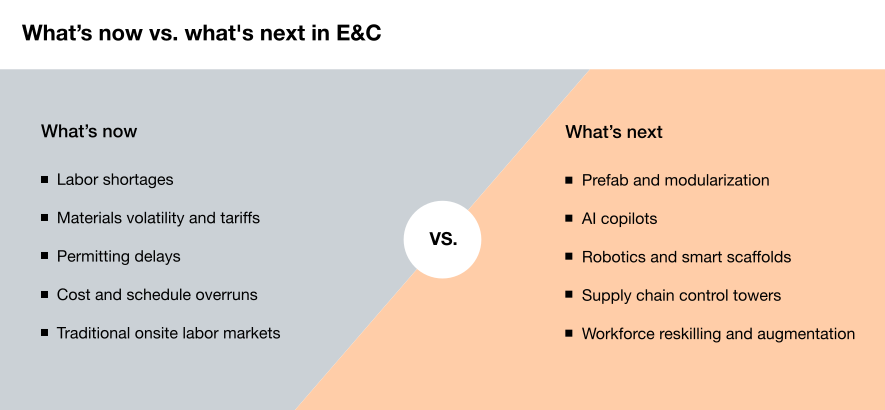
Prefab and modularization are now central to closing the labor gap and improving predictability.
AI, robotics, and digital tools amplify prefab’s advantages through real-time insight and automation.
Workforce transformation is as critical as technology adoption; reskilling must advance in parallel.
Integrated delivery models built on data, collaboration, and industrialized methods will define the next era of E&C.
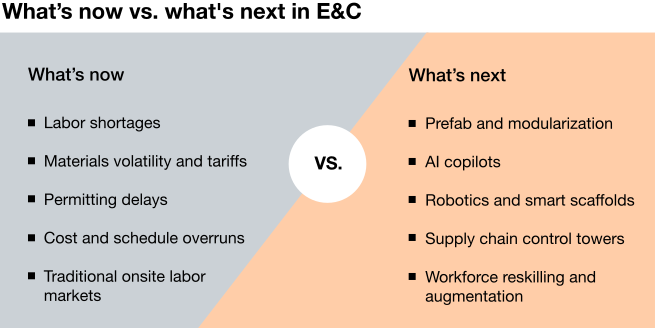
The engineering and construction (E&C) industry stands at a crossroad. Demand for new infrastructure—from data centers to renewables—is booming. And yet, delivery capacity is buckling under the strain. Skilled labor is scarce, materials are volatile, and permitting takes too long. But capital projects keep getting larger, faster, and more complex.
This mismatch between demand and capacity has turned “doing more with less” from a catchphrase into a business imperative. And it’s pushing the industry to reimagine how work gets done.
Prefab and modular construction have emerged as the industry’s most effective answer. By shifting work from open sites to controlled factory environments, companies are gaining speed, safety, and predictability, compressing schedules and reducing rework. What began as a niche technique is quickly becoming the backbone of a new industrial delivery model.
This new wave of industrial investment is redrawing the construction map. Consider how prefab and modular construction are playing a key role.
Data centers: Modular and prefab builds are helping developers cut delivery time by more than half while maintaining precision and efficiency at scale.1
Alternative energy: Small modular reactors (SMRs) and modular battery storage systems are moving from prototype to production, bringing speed and repeatability to the clean-energy buildout. The modular storage market is projected to triple by 2033, and the SMR sector is expected to grow more than thirtyfold by 2035.2
Capital projects fueled by industrial policy: The Infrastructure Investment and Jobs Act and the CHIPS and Science Act have sparked hundreds of projects—from semiconductor fabs and defense production sites to critical minerals facilities—representing about $1 trillion in announced private investment.3 Each demands the kind of precision, replication, and safety that modular construction is uniquely equipped to deliver.
The modular construction market for US offices and data centers is projected to reach roughly $2 billion by 2029, growing more than 7% a year—well ahead of traditional construction.4 The appeal is clear. Standardized modules can be designed once, then replicated at scale, cutting time and cost. Factory production eliminates many of the field’s biggest pain points, including unpredictable weather, inconsistent labor, and safety exposure. For owners, the result is greater certainty across schedule, cost, and quality, a combination that defines competitiveness in the E&C sector.
But a modularization delivery model is only as strong as the ecosystem around it. Four powerful trends are now amplifying its impact: AI and automation, intelligent supply chains, an evolving workforce, and a turbulent journey toward sustainability. Together, they form the blueprint for how construction will deliver “more with less”—not someday, but right now.
Prefab and modularization may be the cornerstone, but the full potential comes alive when paired with AI, robotics, and automation. These technologies are transforming how capital projects are planned, executed, and optimized.
AI copilots now assist project managers with real-time scheduling and predictive risk forecasting. Robots are taking on hazardous and repetitive tasks. Digital twins are fusing BIM, GIS, and IoT data to simulate designs, logistics, and installation before a shovel hits the ground.
According to PwC’s Future of Industrials Survey, a global study of more than 500 C-suite executives across industrials and energy sectors, more than half (56%) of E&C executives plan to significantly increase investment in AI and automation in the next three years, and 42% expect to boost spending on robotics. A third (33%) also anticipates AI will have a transformative impact on client service and support, underscoring how deeply intelligent systems are embedding across the construction value chain.
Consider what happens when you integrate these technologies.
AI and analytics identify bottlenecks early, enabling faster decisions and fewer overruns.
Robotics and automation, such as scaffold robots and autonomous lifts, reduce labor intensity and improve safety.
Digital twins and simulation tools test what-if scenarios virtually, optimizing logistics and permitting.
Together, these tools form a digital-physical feedback loop. Every task generates data that informs the next, improving forecasting, procurement, and design accuracy.
That feedback loop is already saving days—and in some cases, weeks—on real projects. Layout robots have compressed field layout time from five days to one.5 Real-time data analysis, combined with AI, helps track project progress and optimizes scheduling, cutting overall project time by 10-15%, allowing contractors to meet deadlines and stay under budget.6
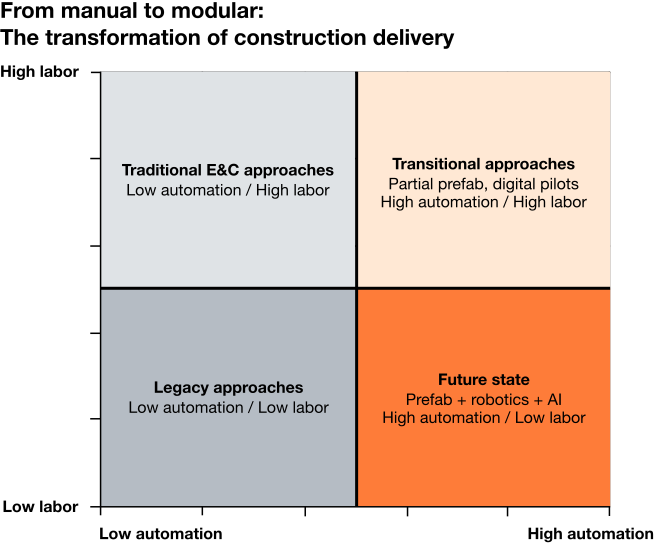
It's not enough for E&C to build differently. It must also manage uncertainty differently. Even the most advanced construction strategy can stall if materials don’t arrive or prices spike. As prefab adoption grows, so too does the need for supply-chain intelligence—another force powering the rise of modularization.
E&C firms are turning to digital control towers that provide real-time visibility from supplier to site. Predictive logistics and multi-supplier coordination tools help project leaders manage volatility in steel, copper, and other critical materials.
PwC’s Future of Industrials Survey shows that E&C leaders are reinforcing the digital backbone behind their supply chains. More than half (52%) plan to increase investment in technology infrastructure over the next three years, and nearly half (45%) expect to invest more in data centers, evidence that resilience in construction now depends as much on information flow as on materials flow.
Paired with industrialized construction methods such as standardized designs and components, just-in-time manufacturing and synchronized logistics, these systems enable projects to move with fewer delays and greater cost certainty. As companies look beyond efficiency to resilience, many are also bringing production closer to demand—a nearshoring trend driven by tariffs, logistics costs, and the need for greater control. Regionalizing fabrication and assembly strengthens visibility, shortens lead times and links modular plants more directly to project sites. In short, supply chain resilience is becoming a function of data and where materials come from as much as design.
When supply-chain precision meets modular execution, project timelines stabilize, and that stability is fast becoming a differentiator in a volatile market.
Technology alone won’t close the industry’s capability gap. Another force driving modularization lies with people and how they’re trained, organized, and supported.
The sector will need hundreds of thousands of additional workers within the next few years, but the traditional craft pipeline isn’t keeping pace. Prefab and automation reduce the pressure, yet they also demand a new mix of skills.
Prefab factories require technicians, data analysts, and robotics operators—not just welders and electricians. That means companies must invest in reskilling programs to transition experienced workers into digital and automated roles. Nearly half of E&C firms already have such programs in place, and most others plan to launch them within a year.7
Equally important, automation is augmenting, not replacing, human talent. Robots handle high-risk, high-repetition tasks, freeing people for work that requires judgment and coordination. The future crew is a blend of craftspeople paired with AI-enabled supervisors, drone inspectors, and digital planners.
Many leaders see digital oversight transforming how teams work. Our Future of Industrials Survey finds that 42% of E&C executives believe remote management capabilities will most revolutionize their industry—a signal that the future jobsite will be as much about coordination through data as about craft in the field.
This evolution can also broaden the construction talent pool. Modularization and robotics make job sites safer and less physically taxing, helping attract underrepresented groups and younger digital natives. The result is a stronger, more resilient workforce ready to thrive in a more automated, data-driven (and safer) environment.
Resilience today means more than staying on schedule or under budget. It’s about delivering assets that can withstand environmental, economic, and operational shocks. As stakeholders tighten expectations around corporate sustainability and governance, resilience has become both a sustainability imperative and a business imperative.
Modular and digital delivery models inherently support this shift. Factory-controlled environments reduce waste, cut carbon emissions by about 34%, and improve safety through standardized, repeatable processes.8 Off-site fabrication also limits site disruption and accelerates commissioning, helping firms meet growing community and regulatory expectations.
Just as important, modularization builds long-term adaptability into infrastructure itself. Standardized components can be replaced or reconfigured with minimal downtime, while digital twins and real-time data tracking enable owners to monitor performance, carbon impact, and maintenance needs across the asset life cycle.
Financial and operational resilience follow suit. Predictable costs, shorter schedules, and safer working conditions strengthen investor confidence and align with insurers’ and regulators’ evolving risk frameworks. In an industry defined by volatility, embedding sustainability principles into design and delivery is fast becoming the foundation for lasting resilience and competitive advantage.
Across energy, transport, health, and digital sectors, modular construction applies the same foundation—factory precision, digital coordination, and standardized, repeatable, design—to achieve more predictable outcomes.
The convergence of prefab, AI, robotics, and digital systems is redefining “execution excellence” in capital projects. The future isn’t just faster builds. It’s smarter, safer, and more predictable delivery from design to operation.
Nearly one-third (32%) of the E&C leaders participating in our survey anticipate radical transformation in intelligent systems by 2030, outpacing other sectors in their expectations for digital disruption. That conviction reflects a readiness to integrate design, manufacturing, and operations into a single intelligent delivery model.
In this new model:
Factory-to-site integration connects design, manufacturing, logistics, and assembly into a continuous digital thread.
Data feedback loops use sensors, drones, and AI to optimize work sequencing in real time.
Trust and transparency become differentiators as owners and contractors use shared digital models to manage performance and risk collaboratively.
For companies ready to act, this convergence offers a blueprint for competitiveness. The companies leading now aren’t merely adopting prefab or testing robotics but reengineering their entire delivery model around integration, data, and workforce transformation.
And that’s the point. The opportunity is no longer about tools or technologies alone. It’s about seizing the inflection point where engineering and construction become truly industrialized, turning unpredictability into precision and pressure into performance.
{{item.text}}
{{item.text}}