








{{item.videoDuration}}
{{item.title}}
{{item.text}}

{{item.videoDuration}}
{{item.text}}
Industrial manufacturing is entering a new phase of modernization. Smart factories, AI-enabled automation, and digital twins are becoming central to how manufacturers compete on cost, resilience, speed, and sustainability.
Beneath this momentum, however, sits a structural constraint. While ambitions are accelerating, the digital foundations meant to support them are starting to struggle. Many manufacturers are discovering that an ERP-centric approach to modernization, effective for standardization, may be ill-equipped to deliver the real-time intelligence and optimization today’s connected plants require.
This is the inflection point. The next generation of manufacturing performance won’t be unlocked by pushing more logic, analytics, and customization into ERP. Instead, the shift is towards a base plus operating model, a two-layer architecture that separates stable systems of record from fast-evolving cloud-based intelligence and AI. Creating this model begins with rethinking the underlying architecture, decoupling stability from speed and governance from intelligence.
For industrial leaders, this shift has become a strategic priority.
Over the past decade, ERP modernization has delivered real benefits, things like financial harmonization, process standardization, and a single source of truth across plants and regions.
But the way manufacturing creates value has shifted. In connected plants, advantage is increasingly defined by the ability to make the right decisions in real time. This means adjusting production schedules as demand shifts, detecting quality issues early, managing energy consumption dynamically, and optimizing performance across networks of plants rather than within individual sites.
This shift has fundamentally changed what manufacturers expect from their digital foundations. Industry leaders are increasingly seeking systems that can respond to volatility as it unfolds, enabling dynamic scheduling, predictive quality and maintenance, cross-plant optimization, AI-enabled guidance, and holistic visibility across engineering, operations, and supply chains.
This is where progress slows.
ERP systems were designed to govern transactions, not to operate as engines of real-time intelligence. Their models often struggle with the volume and variability of operational technology data, and release cycles constrain innovation as complexity grows. Over time, customizations accumulate and integrations with manufacturing execution systems (MES), historians, and SCADA (supervisory control and data acquisition) systems remain brittle and difficult to scale.
The result is a widening execution gap. Digital ambition accelerates as the underlying architecture struggles to keep pace. Companies push more analytics and logic into the core, yet performance plateaus.
Yes, ERP still plays a critical role. It anchors control, compliance, and financial integrity. But expecting it to also orchestrate intelligence at machine speed isn’t working.
The next wave of manufacturing performance is increasingly shaped by decisions, not transactions. Those decisions require real-time data, advanced analytics, and AI models that learn and adapt continuously. Waiting for multi-year core system roadmaps is no longer compatible with operational realities where disruptions unfold in hours, not quarters.
The architecture that once enabled scale can now limit intelligence.
Base plus addresses this challenge by separating what should remain stable from what should evolve quickly.
In a base plus model, the base remains the governed foundation. Core enterprise and operational systems continue to provide consistency, control, compliance, cybersecurity, and financial integrity across plants and regions.
The plus layer is where intelligence lives. It’s a cloud-native layer that integrates IT and OT (operational technology) data in near real time and supports analytics, optimization, AI, and digital twins—and it’s designed to evolve rapidly without destabilizing the core.
Governance stays anchored in the base while intelligence is developed, tested, and scaled in the plus, enabling decisions to operate across plants rather than within individual systems.
By decoupling stability from speed, manufacturers can industrialize advanced analytics and AI while keeping the foundation clean. Innovation accelerates without increasing integration complexity or technical debt. Data often becomes AI-ready because it is modeled consistently across systems, and decisions can improve because they’re informed by a broader, more connected view of operations.
This operating model also helps reshape risk management. As AI, automation, and connectivity expand, scrutiny around data governance, cybersecurity, and regulatory compliance intensifies. In ERP-centric environments, governance and innovation are tightly intertwined, so each new integration or AI use case increases complexity and operational risk.
Base plus breaks that coupling by design. Governance remains centralized and stable, with security, data lineage, and AI controls embedded into the data fabric connecting IT and OT. Controls are enforced consistently across use cases rather than retrofitted onto legacy systems.
Equally important, base plus aligns with how connected plants are built and scaled. Standards-based architectures and shared data models allow cloud providers, automation vendors, analytics platforms, and systems integrators to collaborate and scale use cases across plants without excessive customization.
Base plus isn’t a technology choice. It’s an operating model for scaling intelligence, managing risk, and converting digital investment into sustained performance gains.
Survey data from the Manufacturing Leadership Council shows that core systems like MES, PLM, and cloud infrastructure are already widely deployed or scaling. These are base capabilities, and they’re largely in place. At the same time, decision-centric tools in the plus layer—smart planning, adaptive control, digital thread, AI—are widely represented in pilot programs and planned implementations through the next few years.
This pattern matters. It shows that manufacturers have laid the groundwork, but the value still lies ahead. Visibility has improved. Optimization is the next frontier.
It also explains why many tech investments underdeliver. Without a scalable plus layer, analytics and AI may remain fragmented, bolted onto legacy systems, or trapped in pilots that never reach enterprise impact. As more tools are layered onto existing architectures, integration can become harder to manage.
The issue isn’t a lack of tools. It’s the absence of an operating model that lets those tools work together. And when that operating model is missing, complexity compounds.
Recent PwC research reinforces this point. In our 2025 Digital Trends in Operations Survey, integration complexity was cited as the single biggest reason technology integrations fail, with 47% of respondents identifying it as a primary barrier to value realization.
The data points to a structural issue. Manufacturers are investing in intelligence, but without architectural separation between stability and speed, integration strain can erode returns.
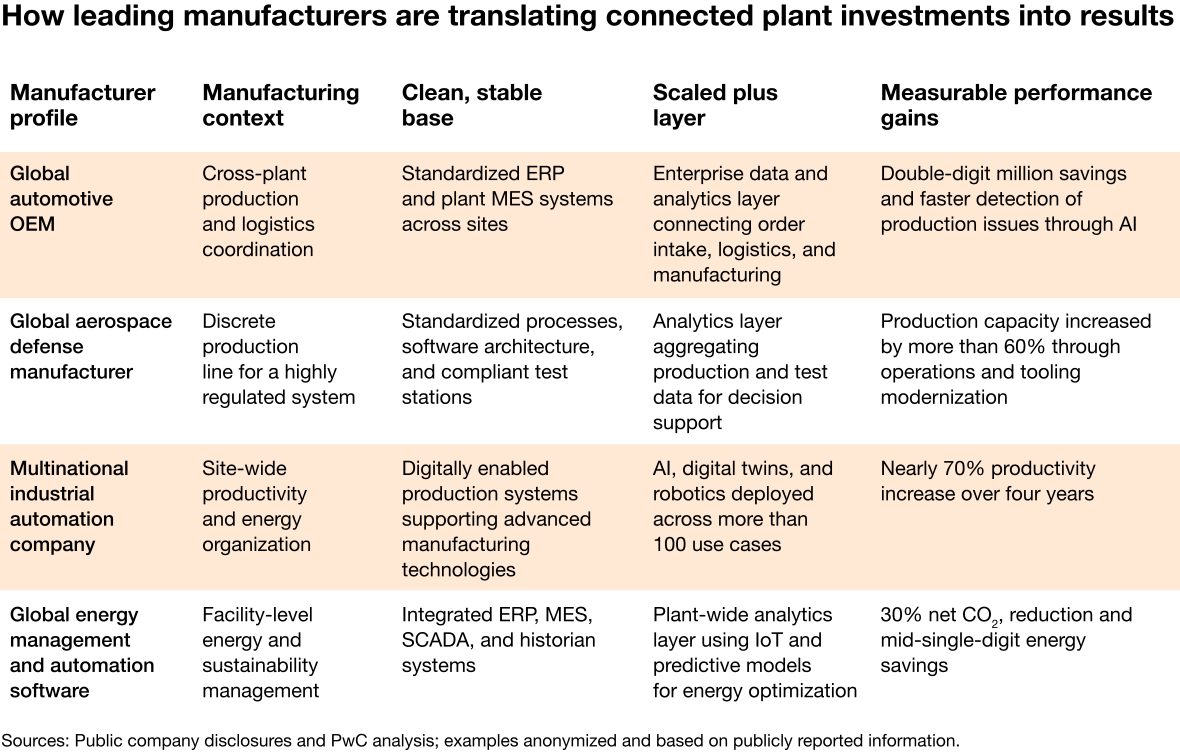
Across industrial manufacturing, leading companies are converging on a similar approach to scaling connected plants. They’re standardizing core enterprise and operational systems to provide stability and control while using cloud-based analytics and AI layers to scale intelligence across plants. The result is faster decision-making, cleaner cores, and measurable performance improvements.
Rather than pushing more logic into ERP or building plant-by-plant solutions, these manufacturers are keeping the core—the system of record—stable while accelerating the system of intelligence. Core systems anchor governance, compliance, and financial integrity. Intelligence is developed and scaled outside the core, where analytics, optimization, and digital twins can operate across sites without destabilizing operations.
The examples below illustrate this pattern in practice. While manufacturing contexts and outcomes vary, the underlying operating model is consistent—a clean base paired with a scalable plus layer that enables manufacturers to convert connected plant investments into results.
Taken together, these examples show that base plus is not an abstract concept or future-state aspiration. It’s already being applied across industrial manufacturing to translate connected plant investments into results. While the specific technologies and use cases differ, the architectural choices are often similar.
Manufacturers that keep the core stable while scaling intelligence outside it can move faster, reduce complexity, and manage risk more effectively. Those that don’t often struggle to move beyond pilots or achieve enterprise-wide impact. Across sectors, the pattern repeats. Clean base. Intelligent plus. Measurable gains.
For industrial manufacturing executives, the question is no longer whether to pursue connected plants, but how to do so without recreating the complexity and fragmentation of earlier transformation efforts.
1 Jeff Puma, “Survey: Smart Factories Enter the Execution Era,” Manufacturing Leadership Council (January 31, 2026) https://manufacturingleadershipcouncil.com/survey-smart-factories-enter-the-execution-era-39608/, accessed February 16, 2026.
{{item.text}}
{{item.text}}