
{{item.videoDuration}}
{{item.title}}
{{item.text}}

{{item.videoDuration}}
{{item.text}}
The aerospace and defense (A&D) industry is entering one of the most consequential transitions in its history. Commercial aerospace is riding a 10+ year backlog that’s stretching the global supply chain to its limits—testing throughput, cost and capacity while leaving no room for compromise on quality and safety. At the same time, shifting geopolitics are reshaping demand for defense systems, changing not just the volume but the nature of what’s needed as nations race to modernize their arsenals with advanced technology and capabilities. That’s fueling a new wave of reindustrialization and global alliances as countries compete for security and growth. Layer on top the accelerating force of AI and digital transformation and you have an A&D business model that’s being rewritten in real time.
Over the next three years, the companies that lead will likely be those that act decisively by investing in growth capacity, modernizing faster with digital tools, and doubling down on execution to build a faster, smarter, more resilient future.
While many imperatives cut across the industry, commercial and defense players face distinct challenges—and opportunities—that demand tailored strategies to unlock value and long-term advantage. Against this backdrop, A&D leaders should decide where to place their biggest bets. The moves described here highlight where to act now across commercial, defense, and industry-wide priorities.
| Priorities for commercial aerospace leaders | Priorities for defense leaders | Moves all A&D leaders can act on now |
| 1. Invest in supply chain capacity to execute the ramp | 3. Pivot portfolios toward evolving defense priorities | 5. Build next-generation program management capabilities |
| 2. Position to win when new aircraft launches reset the market | 4. Bring commercial speed to defense contracting | 6. Forge global partnerships to accelerate growth |
| 7. Rebuild supply chain resilience | ||
| 8. Invest in your workforce to educate, recruit, and upskill talent at scale | ||
| 9. Modernize your enterprise with a business-led digital transformation | ||
| 10. Use AI to accelerate your imperatives |
Commercial aerospace continues to face lingering pandemic disruptions from production bottlenecks to supplier insolvencies as the supply base struggles to ramp up. The backlog now stands at 10+ years of production at current rates, underscoring the opportunity cost of inaction. The path forward lies in targeted investments that expand capacity, boost productivity, and strengthen risk management.
A&D executives increasingly recognize the need for additional capacity, but acknowledgment alone isn’t enough. Companies across the supply chain face a classic dilemma—they know they should expand, in some cases doubling capacity, yet hesitate without long-term contractual commitments, further worsening the bottleneck.
Leaders also should invest in productivity drivers that can increase throughput, particularly digital capabilities. Predictive supply analytics, real-time visibility, and digital twin mapping can reveal weak links before they snap. Building trust-based data sharing between OEMs and suppliers can turn crisis response into continuous improvement. The post-pandemic ramp isn’t just about speed. It’s about the smarter orchestration across the overall value chain.
Finally, companies should have a new approach to risk management. Of the roughly 13,000 suppliers in the A&D ecosystem, most are small businesses. Scaling capacity requires major investment and exposes them to higher risk. Yet many prime contractors still rely on legacy approaches—short-term contracts for long-lead products that leave smaller suppliers vulnerable. Longer-term commitments could ease that strain and stabilize the supply base. With a commercial backlog that stretches beyond a decade, the industry can help mitigate the supplier risk with little downside.
While commercial OEMs enjoy strong backlogs, talk of new aircraft programs is heating up. Big questions remain. Is there a market imperative? What architecture makes sense? Should the next design be incremental or a step-change? Will Boeing move first? Ducted or open rotor engines? The timing of any launch remains uncertain, but the stakes couldn’t be higher. The next major aircraft is expected to target the narrow-body market—the industry’s profit engine—prompting companies to make bold bets, increase investments, and explore potential alliances.
On the engine front, GE Aerospace and Safran Aircraft Engines’ joint venture CFM is investing in RISE (Revolutionary Innovation for Sustainable Engines). Pratt & Whitney continues to evolve its GTF (geared turbofan) and Rolls-Royce is advancing its UltraFan. Each is pursuing next-generation engine programs and working closely with OEMs, which will likely make dual-source selections. With so many scenarios in play, major aerospace suppliers should stay proactive, hedge their bets, and avoid sitting on the sidelines.
Behind the year’s geopolitical headlines lies a fundamental shift in US defense priorities that’s reshaping investment in R&D and procurement. At the same time, a multi-alliance strategy spanning NATO, the Middle East, and the Pacific is driving a broad defense industry recapitalization. It’s not just NATO meeting its 5% investment targets. Nations around the world are boosting defense investment at unprecedented levels.
In US policy, a renewed focus on the homeland, a pivot to the Indo-Pacific, and a broad push for peace are enabling a pivot in priorities. These shifts are freeing up resources—people, assets, and budget—to focus on new areas of investment. From an industry perspective, this marks a generational portfolio reset: an end to the GWOT era and the start of a wave of funding for advanced technologies, including Golden Dome, space, NGAD and autonomy, drones and low-cost disruptive capabilities, homeland security, resilient communications, and perhaps most importantly the AI technology stack. These trends will likely shape the industry for decades and companies should position now.
At the same time Europe, the Middle East, and Asia are ramping up defense investment as well. NATO’s rapid recapitalization will require firms to rebalance portfolios toward both capacity such as munitions, and emerging capabilities like FCAS and GCAP, drones, and space systems. For legacy A&D players and new entrants alike, this represents a major growth opportunity, one that can drive internal investments, capex, collaborations, and M&A activity.
Program delays and cost overruns have long hindered defense innovation, with US major defense acquisition programs (MDAPs) running more than three years late and over 20% above budget, on average. As spending pressures grow, the US is pushing for faster, more agile, and more commercial-style procurement. One of the administration’s first executive orders called for commercial, cost-effective solutions in federal contracts, to the maximum extent possible. Industry veterans know that reform is easier said than done given the many former attempts at procurement reform, but recent moves from agencies such as the US Space Force suggest real progress is underway.
Looking ahead, expect novel contracting approaches to drive faster innovation in high-priority areas such as space, software, and AI, and even to seed new competitors in legacy markets like solid rocket motors. Borrowing from the commercial playbook, A&D firms can apply agile contracting models to shorten timelines and better manage risk. As dual-use technologies and hybrid funding structures blur lines between defense and commercial demand, those that build adaptability into every deal could gain an edge.
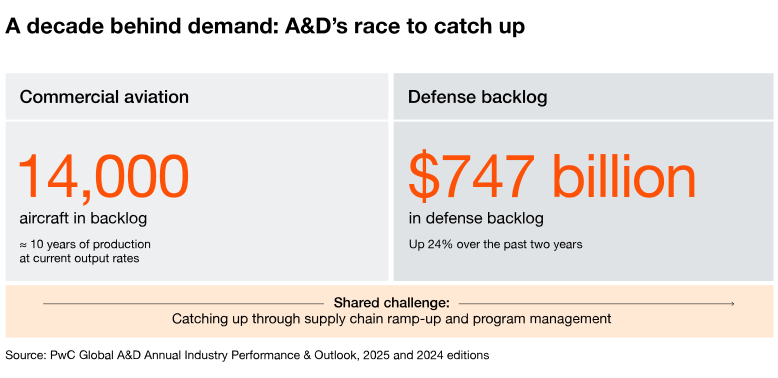
For decades, both civil and defense aviation programs have struggled with delays and cost overruns. Today, the backlog tells the story: 14,000 commercial aircraft awaiting production—roughly a decade’s worth—and a $747 billion defense backlog, up 25% in just two years. According to the Airbus Global Market Forecast 2025–2044 and Boeing’s 2025 Commercial Market Outlook, global demand could exceed 43,000 new passenger and freighter aircraft over the next 20 years, roughly 30% higher than the industry’s historical peak. As systems grow more advanced and supply chains more complex, catching up will require a reinvention of program management.
PwC’s collaboration with the Aerospace Industries Association (AIA) underscores this opportunity. Predictive program management—powered by predictive analytics, AI-enabled scheduling, and intelligent program tools—can unlock significant value and next generation execution capabilities. Leaders who embed these tools early can shorten timelines, reduce overruns, and deliver with the precision the market demands.
Both the commercial aerospace and defense sectors have been active in deepening global alliances to accelerate growth, and the pace is set to increase. Market forces are driving the shift. Airbus expects its Asia-Pacific aircraft services market to double by 2045, while Boeing forecasts Southeast Asia air traffic to more than triple by 2043. Some now say India is the new China. The rapid rise in China’s consumer class over the past 25 years nearly tripled global revenue passenger kilometers (RPKs). India is now on a similar trajectory, already the third-largest aviation market and growing at a near double-digit pace. Over the next few decades, business and leisure travel among Pacific nations—and rising demand across Africa—will likely fuel much of the world’s civil aviation growth.
As growth shifts east and south, securing strategic alliances in key markets has never been more critical for A&D companies. This trend isn’t limited to commercial aviation. Global military engine companies are also vying for a role in India’s Advanced Medium Combat Aircraft (AMCA) program, including strategic participation and technology transfer.
As with many of the US trade deals announced in 2025, future A&D alliances will often include joint public-private participation. According to PwC’s Future of Industrials Survey, a study of more than 500 C-suite executives across industrials and energy sectors, A&D leaders are leaning into government collaboration to strengthen these ties. Nearly half (49%) report active participation in regulatory comment periods or public consultations, compared with 35% across all respondents, a clear signal of growing alignment between industry and government.
We recommend identifying new allies with complementary strengths in technology, manufacturing, and market development. Expanding collaborations across commercial and defense could significantly broaden market reach and deal size. Proactive engagement with national regulators will also be essential in the face of evolving tariffs, export controls, technology transfer rules, and compliance requirements, particularly for programs with dual civilian-military use cases.
A&D leaders have learned that global efficiency can’t come at the expense of strategic vulnerability. The new priority is industrial base sovereignty. According to PwC’s Future of Industrials Survey, about one in four A&D executives (26%) is investing in redundant system failover as a self-healing supply chain capability, while nearly half (45%) expect to reshore or nearshore most of their production by 2030.
The challenge is to balance capacity and quality, building redundancy without sacrificing performance. Companies investing now in end-to-end supply visibility, digital twin modeling, and shared supplier data ecosystems are not just mitigating risk but creating a competitive edge.
Beyond supply chain constraints, talent is emerging as the biggest constraint on execution across A&D. Years of insufficient workforce planning have left many A&D players with aging teams and too few early-career employees or emerging leaders, a mix that raises the risk of production slowdowns and knowledge loss as retirements accelerate. Industry-led recruitment campaigns to attract the next generation of engineers, skilled tradespeople, and manufacturing talent can’t come too soon. Companies should also think creatively, working with local and regional organizations to reach untapped talent pools. Because the defense industrial base is widely dispersed, often in smaller communities, standard recruiting won’t be enough to close critical skill gaps.
Initiatives such as Build Submarines, backed by the US Navy and Blue Forge Alliance, show how collective recruitment and training can help close gaps in skilled trades and advanced manufacturing. The next wave of workforce initiatives should combine education, apprenticeship, and automation to rebuild the A&D talent pipeline from the ground up.
A&D manufacturers are entering a new phase where incremental improvement no longer cuts it. Findings from our Future of Industrials Survey show that A&D leaders are among those pushing hardest to modernize. With 42% of A&D executives—compared to 26% of all respondents—expecting technology to outpace infrastructure by 2030, a widening gap is emerging between digital potential and operational reality. While the digital mandate is clear, many A&D executives face a growing conundrum. The integrated PLM-ERP-MES architectures needed to create true digital threads are complex and costly. The most successful digital transformations are increasingly business-led, built on a clear ROI. Put simply, their roadmaps align tightly with business priorities, focus on outcomes, and balance large-scale enterprise investments with fit-for-purpose analytic capabilities that can be deployed quickly.
Companies that align tech investments with capital priorities will likely be better positioned to compete in a reindustrialized global economy. The space sector offers a live case study, having shifted from speculative growth to sustainable momentum through dual-use innovation and advanced manufacturing, a model ripe for replication across aerospace and defense.
AI is already redefining the A&D value chain and is set to have even more impact in the years ahead. According to PwC’s Future of Industrials Survey, 57% of A&D executives are using AI-enhanced design and engineering to transform workflows—16-points higher than the cross-industry average. Nearly half (49%) expect most of their production to be powered by AI-enabled systems by 2030.
Beyond factory floors, AI is also transforming the product and customer sides of businesses, from satellite networks to autonomous systems. A&D leaders should track AI progress and learn to deploy it more than most industries. It’s not just about integrating AI across design, production, and sustainment. It’s about understanding how these technologies could redefine end markets through advanced features and capabilities.
In 2026, leaders should use AI to accelerate their most strategic initiatives. The A&D industry is entering a pivotal period in its history, and the future can look brightest for the companies that make the bold moves necessary to seize the opportunities ahead.
{{item.text}}
{{item.text}}
Mark Poulson and Holly McKenzie contributed to this report.