










{{item.videoDuration}}
{{item.title}}
{{item.text}}

{{item.videoDuration}}
{{item.text}}
Growth in private credit has dominated headlines and captivated the attention of traditional lenders, borrowers, private equity sponsors, and other market participants for years—but will its rapid growth continue? And if so, how should traditional banks adapt their own growth strategy?
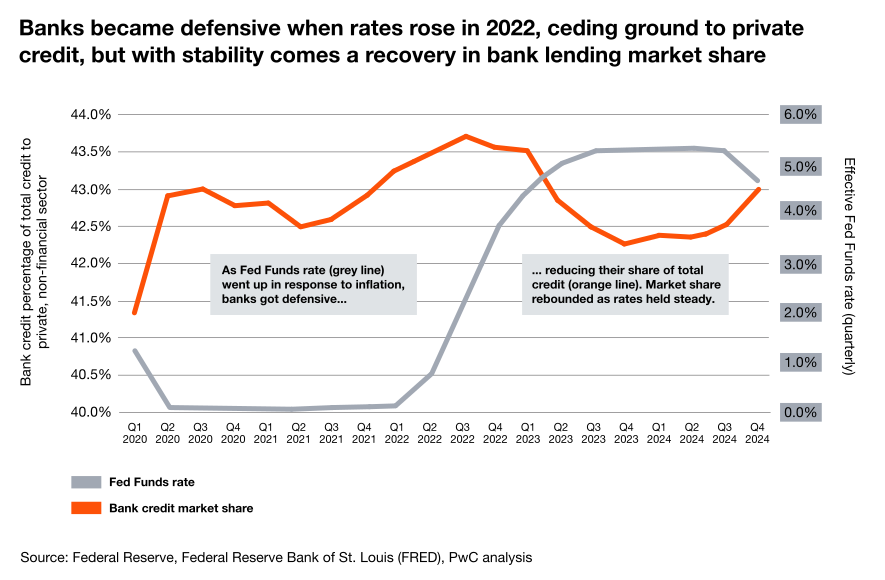
Private credit’s lending market share was supercharged starting in 2022 when an inflationary shock and banking industry turmoil prompted banks to become defensive and lend less. That was a critical opportunity for private credit to demonstrate how its flexible terms, quick decision-making and long-term funding model enable a reliable solution when economic conditions and credit markets are strained. To make matters even more complicated for traditional banks, a looming overhaul to bank capital rules threatened to increase the competitiveness of nonbank lenders, prompting many to believe that unbridled growth in private credit’s market share would continue.
Credit markets are now more competitive than ever as banks go on the offensive, giving borrowers a wider set of financing options.
Fast forward to today, bank lending is staging a comeback: commercial loan books are growing, US regulators have reversed course on the implementation of more stringent bank capital rules, and historically tight corporate bond spreads are making traditional debt capital markets attractive to corporate borrowers. On the private credit side, years of aggressive fundraising and new entrants have left firms with a mountain of capital, or dry powder, that needs to be productively deployed. As a result, private debt fundraising for North American lending seems to be taking a pause. All this to say that credit markets are more competitive than ever as banks go on the offensive, giving borrowers a wider set of financing options.
If today’s “normalized” conditions persist, is private credit still a runaway train destined to replace the role of traditional bank lenders? Or, is the credit industry heading for a new equilibrium where private credit and traditional bank lenders are both successful in their respective domains and find symbiotic ways of working together?
What is at stake for banks in competition with private credit? At least $70 billion in annualized bank corporate lending revenue and the opportunity to refinance $3.2 trillion of corporate debt maturing in the next two years.
Our perspective is the latter. But it will require banks to make meaningful improvements to operating models and expand capabilities to effectively grow and to mitigate the profitability pressures of a more competitive lending market. It’s also not as simple as “if you can’t beat them, join them” —meaning banks will need to do more than simply provide financing to private credit funds. What’s at stake? At least $70 billion in annualized bank corporate lending revenue plus the revenue from refinancing $3.2 trillion of corporate debt maturing in the next two years plus an unknowable amount of growth potential from financing opportunities in building infrastructure, reshoring and backing M&A deals to name a few. The banks most likely to win share will be ones that prioritize investments in digital capabilities and solutions and marry that with a relentless focus on execution. But, before we talk about that, let’s first take stock of current market conditions.
Private credit managers face a double-barreled set of challenges at the moment: The supply of private capital is increasing at a time when demand for traditional credit solutions is rebounding. Meanwhile, macroeconomic uncertainty, including tariffs and tax regimes, is constraining corporate desire for new financing.
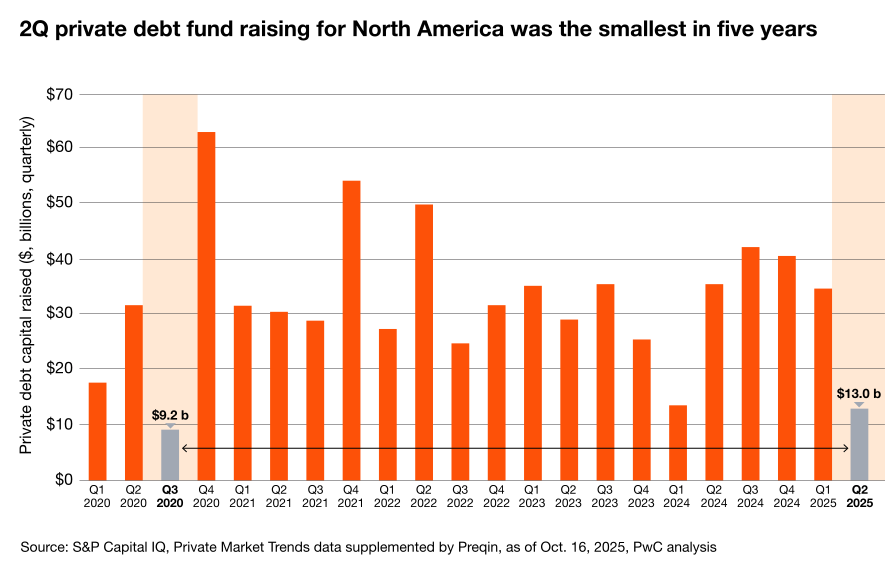
Fundraising in private credit appears to be downshifting this year. Only $13 bn in private debt capital was raised in the second quarter for use in North America, according to S&P Capital IQ, Preqin data. That was the smallest quarterly fundraise in five years.
Fundraising in the first two quarters of 2025 totaled $47.7 bn, the weakest start to a year since 2019 when $30.3 bn was collected.
To be clear, fundraising declines do not mean investor appetite is cooling. Rather, private credit funds may be shifting focus to deploying capital rather than continuing to grow capital. Private credit growth in investment vehicles not classified as private debt funds may also lead to reported declines in fundraising for traditional private credit funds.
Meanwhile, dry powder remains elevated. North America-oriented private debt funds are sitting on $280.8 bn as of October, according to S&P Capital IQ, Preqin data. This year could set a new post-pandemic high. Only in 2022, when bank lending retreated, did private credit dry powder decrease year over year.
Commercial and industrial lending (C&I) is arguably the loan type most affected by private credit’s growth. Banks faced several storms starting in 2022 when the Federal Reserve began quickly raising rates to combat inflation, heightening fears of an economic slowdown or recession. Corporate bond spreads over Treasuries widened. The ICE BofA US Corporate Index option-adjusted spread rose by about 70 basis points during 2022, according to St. Louis Fed data—making it clear investors were nervous about credit. Amid that market stress, tighter lending standards prevailed, and banks’ share of total credit contracted. Late 2023 and early 2024 saw C&I lending shrink year-on-year amid macroeconomic headwinds. Fast forward to 2025, and banks are accelerating their C&I lending, evidence that they’re aggressively going after credit market share and successfully winning business.
Also making credit markets more competitive is the resurgence of corporate bond markets. Issuance of investment grade, high-yield, and convertible bonds is surging this year after a strong 2024 as corporate bond spreads tighten. Today’s booming market follows multiple years of depressed issuance when rapidly widening spreads and economic uncertainty cooled both corporate demand for new financing and investor appetite.
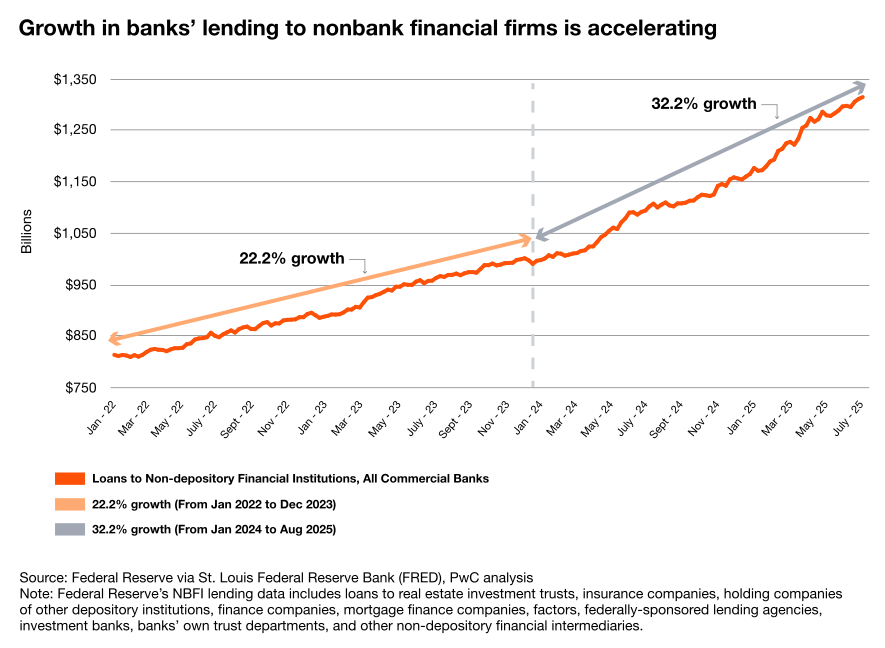
Many banks are pursuing a hybrid strategy that involves growing C&I while also lending to private credit funds or other nonbank financing vehicles. The strong growth in lending to nonbank financial institutions that occurred over the past few years accelerated from the beginning of 2024 to the end of Q2 2025. These loans are often senior in the credit stack and garner a lower risk-weight compared with lending to an individual company, meaning banks can hold less capital against these loans per bank regulatory capital rules. Therefore, a lower risk-weight can help generate a higher return on capital. Financing private credit funds has other benefits, such as operating cost efficiencies and maintaining access to the private market sponsor community, which can be lucrative for banks.
The types of banks that lend to private credit are broadening. Historically, US global systemically important banks (GSIBs)—the largest and most complex financial institutions in the US—represented nearly 80% of lending to nonbank financial institutions, according to data provided by S&P Capital IQ. As of Q2 2025, that figure decreased to about 70% as non-GSIBs, including large regional banks, have established businesses lending to private credit.
Perhaps the most uninspiring but plausible answer to what happens next is that banks and private credit firms both win in the credit markets of tomorrow. Private credit clearly has a place in offering bespoke, premium solutions and has increased its competitiveness in asset classes traditionally served by banks or public markets. Further, private credit will continue to play a critical role in illiquid markets where banks are generally constrained. But we believe there will always be a place in credit markets for what you might call “plain-vanilla” credit solutions, ones that are standardized, efficient, and relatively cheap.
The questions then for banks are not existential, but strategic:
Have you fully evaluated which markets you have access to?
Have you assessed where your bank is strong in the face of this new competition?
Have you reviewed where you need to improve lending capabilities to be more flexible and technology-enabled?
Have you considered which businesses or assets you need to jettison to free up balance sheet capacity and prioritize areas where you have the “right to win”?
Banking executives should use the private credit challenge as motivation to push for a leap forward in digitization, data management, and AI adoption. The endpoint is not creating a bank that’s a private credit killer. The goal is to create a stronger, smarter, more efficient bank that’s an integral partner in the financial health of its customers.
What's the best strategy for banks to succeed in today’s rewired credit market? The likely answer is a hybrid of:
Direct lending by banks in industries and specializations where their advantages in relationships, geography, and trust are competitive
Forming partnerships with private credit firms that enable symbiotic benefits
Providing solutions including financing to private credit funds and business development companies (BDCs) that can be used to dial up or down exposures in response to evolving economic conditions, regulation, and market demand
A hybrid approach moves a bank toward a diversified business model rather than optimizing for one that may be subject to the whims of economic conditions (just as C&I and commercial real estate lending experienced the past few years). For example, debt capital markets or corporate advisory businesses may need to re-architect themselves to advise companies on the best way to use private credit deals versus directing them to traditional bank-enabled offerings. These same banks can also retain exposure to credit markets or relationships in the sponsor community via lending directly to private credit firms or forming partnerships. Banks that do well will have several levers to pull, helping them compete and grow regardless of the macro environment.
Of course, strategic options have both advantages and disadvantages, each subject to uncertainty. A cohesive strategy is one that carefully considers the options and charts a path best suited for the bank’s capabilities and competitive position.
Compete directly with private credit?
Lend to private credit funds?
Form distinct partnerships?
Provide financial services tailored to private credit’s operating needs?
While the largest banks may choose a combination of these options, success for many depends on prioritizing investments to establish the right mix of offerings that can be scaled up and down as the opportunities change.
Improve direct lending capabilities to better compete with private credit offerings.
| Examples | Advantages | Disadvantages |
|
|
|
Lend to private credit funds by originating capital call lines, NAV lines, etc.
| Examples | Advantages | Disadvantages |
|
|
|
Establish forward-flow arrangements or new vehicles where banks and nonbanks collaborate to provide integrated solutions to borrowers, PE sponsors, etc.
| Examples | Advantages | Disadvantages |
|
|
|
Tailor services for private credit firms.
| Examples | Advantages | Disadvantages |
|
|
|
*Source: PwC
The opportunity for improving bank lending lies across three dimensions—capabilities, technology, and talent. The goal of these changes is to offer a faster, more flexible experience akin to what private credit firms provide. Of course, investing in these changes must be rooted in a strategy that prioritizes markets where banks have the greatest access and can leverage their advantages in client trust and geographic proximity.
Streamline credit processes for standard credit offerings: Banks must simplify and speed up loan origination and approval processes. This could include reducing the number of committee layers, setting fast-track approval routes for certain deal types or updating credit policies to allow more discretion for experienced underwriters. Many banks still suffer from slow, fragmented loan processes that frustrate bankers and clients. Streamlining (e.g., concurrent underwriting and legal review, rather than sequential) can cut weeks from deal timelines. Automating using AI to accelerate loan decisions is probably an essential step if a bank is going to stay abreast of its rivals. (see PwC’s How Gen AI is impacting hyperautomation in banking article for a deeper discussion of this topic).
Offer tailored solutions and flexibility: Banks should expand their menu of lending products and allow more customization for clients, mirroring what private lenders offer and delivering what many corporate clients demand. This might mean developing specialized offerings like higher-leverage cash flow loans, asset-based loans, mezzanine or second-lien loans, and other structures traditionally associated with private credit lenders. By catering to each borrower’s needs, banks can compete on deals that previously would have likely gone to private credit. As noted above, however, this requires a shift in process, automation, and incentives.
Expand the credit toolkit: Banks have an increased number of tools at their disposal to distribute credit and offload risk without sacrificing the client relationship. Synthetic risk transfers such as credit-linked notes enable banks to free up RWA and therefore expand balance sheet capacity. Further, establishing partnerships or off-balance sheet vehicles to source private capital may enable new offerings to underserved clients, in turn creating opportunities to provide other banking services. The key is having a coherent strategy that clearly directs bankers on the “rules of the road” when marketing and deploying credit solutions. Banks that establish private credit partnerships without the right internal operating model risk confusing both clients and bankers.
Enhance relationship management and advisory: Banks’ wide-ranging client relationships and trust provide an inherent advantage; they can leverage this by adopting a more consultative, solution-driven approach. Bankers should proactively work with clients (and even their private equity sponsors, if applicable) to craft financing packages that meet their needs. For example, if a client’s growth plan doesn’t fit the bank’s normal debt service coverage requirements, the bank could propose a structure with interest reserves or performance triggers, showing willingness to adjust. Strengthening the bank-client dialogue and providing quicker feedback can replicate the high-touch service private lenders are known for. It’s also wise for banks to coordinate internally to present clients with a holistic, banking relationship (lending, treasury services, capital markets advisory, etc.) versus the purely transactional interaction with a direct lender.
Invest in automation and AI for underwriting and fulfillment: Advanced loan origination systems and AI-driven underwriting tools can drastically reduce the time needed to analyze a credit, make a decision, and move the deal through fulfillment. By automating repetitive and time-consuming tasks (e.g., spreading financial statements, risk rating calculations, document processing, compliance checks, loan boarding, collateral management), banks can streamline both credit analysis and middle-office operations. This frees up talent to focus on deal judgment, structuring, and client engagement. In short, technology can augment assessment and fulfillment efficiency, allowing banks to make smarter credit decisions and complete transactions faster.
Leverage data analytics for decision-making: Banks sit on vast amounts of data—from customer transactions to industry trends—which, if harnessed, can provide sharper credit insights and early warning signals (See PwC’s Cloud-powered banking article). For example, a bank could use data feeds to track a borrower’s sector health or commodity prices and proactively adjust lending strategies. This data-driven approach helps in pricing risk more dynamically and in identifying opportunities faster. Importantly, robust data analytics support portfolio management and covenant monitoring, enabling banks to be as hands-on as private credit firms in managing risk throughout the life of the client relationship.
Upgrade client interface and experience: Part of the allure of private credit is the relatively smooth, relationship-driven process for the borrower. Banks know they should enhance their client experience, and the rise of private credit should act as a catalyst for a leap forward. This progress can include user-friendly loan application portals, secure document exchange platforms, and real-time application status tracking. If a midsized business can log into a bank’s platform and see what information is needed, upload financial data seamlessly and even integrate their accounting system for data sharing, it reduces friction and speeds up underwriting. Moreover, a polished digital interface signals to clients that the bank is modern and efficient.
Integrate fintech solutions and partnerships: Banks that can’t build it in-house can gain turnkey access to cutting-edge tech by partnering, which likely requires more expansive API integrations and cloud-based systems. Ultimately, the banks that effectively marry their human expertise with digital power will deliver the dual strengths of relationship banking and fintech speed—a combination that can outshine pure private credit competitors.
Build specialized credit talent: Banks should invest in hiring and developing professionals with strong credit structuring and risk skills, including those with experience in private credit or leveraged finance. In fact, many large banks have started recruiting seasoned underwriters from private debt funds, ratings agencies, and private equity—people adept in cash-flow lending, complex modeling, and creative deal-making. By bolstering teams with such expertise, banks can better evaluate unconventional deals and compete head-on with direct lenders.
Foster an agile and commercial culture: A cultural shift may be needed so that bank lending teams act with both urgency and creativity. This means empowering front-line relationship managers and credit officers to think like investors— balancing prudent risk management with innovative solutions. Banks can encourage a “yes, if…” mindset (finding ways to safely do a deal) rather than a “no, unless…” mindset. Internally, breaking down silos between the sales and risk is key; cross-functional deal teams can work together from the outset to craft structures that both win the client and satisfy risk criteria (see PwC's Managing conflicts at deal speed article for a deeper discussion of this topic).
Align incentives and training: To reinforce these new behaviors, banks should align compensation and performance metrics with success in responsive, flexible lending. At the same time, provide training on new financing techniques and market trends—for example, educating commercial bankers on unitranche loans, EBITDA add-backs, or asset-based lending structures. Equipping staff with knowledge and rewarding adaptable thinking will nurture a workforce ready to compete with private credit.
With a global value of roughly $1.7 trillion, according to Preqin, private credit loans are still a small slice of the total lending and financing market. Yet that doesn't dim private credit’s potential for further encroachment on bank lending, and bank executives should be assessing how their institution can mesh with this growth market.
There are, of course, risks with lending to private credit funds or establishing partnerships. Banks pursuing those avenues need an ability to evaluate the underlying credit risk just as they would when dealing with any business. Banks should be paying special attention to bespoke terms and complex investment structures, verifying that they fully understand the exposure. Lending directly into private credit funds or other investment vehicles will require banks to adapt existing tools such as early warning indicators, collateral monitoring and concentration limits. Lending agreements should be meticulously evaluated, particularly with respect to collateral rights in the wake of recent cases of “Liability Management Exercises” and mismanagement of collateral pledging. Private credit exposures need to be adequately captured in liquidity and capital stress tests which includes analyzing how unexpected credit losses impacting interconnected private credit funds could result in declining market confidence and induce a liquidity event.
Banks should also have a proactive approach to monitoring regulatory sentiment on bank and non-bank interconnectedness to ensure expectations are understood and met. Regulators are clearly wrestling with the question, “How interconnected is private credit to the wider world?” The Federal Reserve proposed Y14 reporting revisions to collect more information on bank lending to non-depository financial institutions, and the FDIC now requires banks with $10bn or more in assets to disclose more details in quarterly Call Report filings about lending to non-depository financial institutions.
Beefed up credit monitoring by banks, for all of the growing pains it may cause, is needed to be ready for the rewiring of credit markets. In the near future, a mix of players will likely be sizeable credit-creation players, including multistrategy asset managers, specialized private credit funds, traditional bank lenders, plus a robust public market. There will be times where companies may obtain credit from several of those providers at once.
In such a competitive market, borrowers will likely be the ultimate winners as competition should help keep loan margins relatively low. Bankers that do not heed the call to create better client experiences, reduce operating costs, and capitalize on opportunities to benefit from such growth likely will be unable to compete with their peers and could lose share in the rewired credit markets of tomorrow.
{{item.text}}
{{item.text}}