






{{item.videoDuration}}
{{item.title}}
{{item.text}}

{{item.videoDuration}}
{{item.text}}
As the use of algorithms and automation continues to accelerate, many consumers and business customers still yearn for the human element—and they seek out simplicity and value. PwC’s 2025 Customer Experience Survey found that 52% of consumers stopped using or buying from a brand because they had a bad experience with its products or services, while 29% stopped due to poor customer experience either online or in-person.
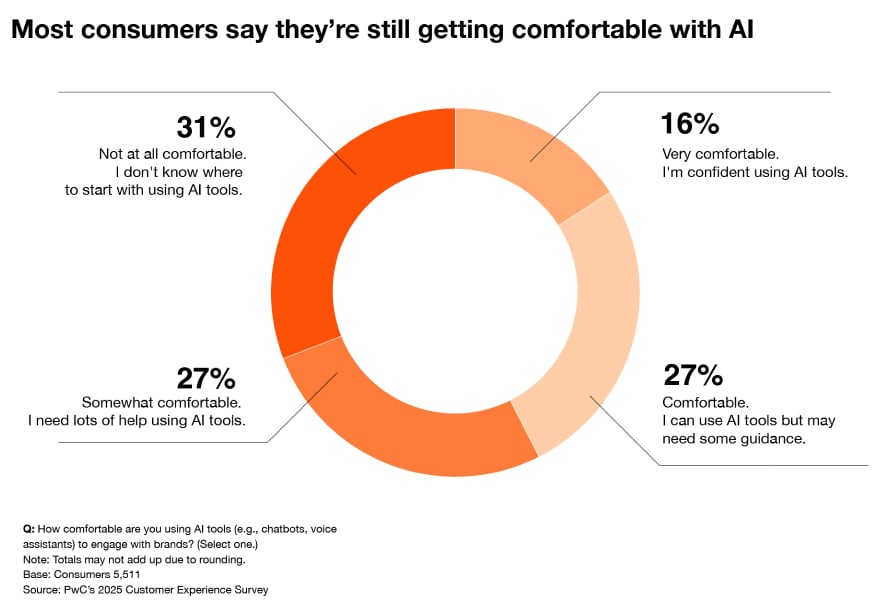
That’s a real problem, and many companies are struggling to respond. We also found that 70% of executives say that customer expectations are evolving faster than their company can adapt. As new ways to engage customers emerge, new pain points can appear. For instance, 58% of consumers say they’re only somewhat, or not at all, comfortable using AI tools to engage with brands.
Clearly, many consumers remain cautious about AI and don’t know how to use it well. At the same time, many organizations are struggling to align their CX strategies with broader business goals and metrics. In many cases, the problem can be a single overall issue: The right data isn’t available at the right time and in the right place. This can make it hard for businesses to get an end-to-end view of customers.
Addressing this challenge requires an integrated business and IT framework capable of delivering personalized customer journeys, advanced audience segmentation, and unified data. The framework also should provide a 360-degree customer view, real-time engagement, cross-channel marketing, and AI-enabled insights. By connecting marketing, sales, service, and loyalty, your business can build trust and win long-term customer engagement.
When considering an AI transformation model focused specifically on CX, it helps to visualize a racetrack with five core components: discover, evaluate and try, buy, adopt and use, and expand and renew. By connecting customer interactions in a holistic way, you can increase your odds of reducing churn and forging lasting relationships.
In an AI-driven world, intelligent tools and agents can help companies find new customers, understand their needs, guide sales, suggest relevant add-ons, and automate renewals. With all these elements in sync, the racetrack becomes a true growth engine.
Our CX survey found that while many companies turn to AI for internal tasks such as design, automated testing, and talent acquisition, only about 45% use it to manage CX-related tasks spread across the racetrack. In addition to marketing and sales components, this includes using AI for customer service and support through chatbots and virtual assistants.
For many organizations, this is a missed opportunity. Although the racetrack isn’t a new concept—it’s a good CX practice in any era—AI fundamentally changes the equation. It enables a more dynamic framework for linking diverse sets of data, obtaining broader and deeper insights, and improving engagement throughout each step of the customer journey.
As you dive deeper into AI, it’s important to avoid the temptation to simply automate tasks without rethinking and reinventing processes. While automation can trim costs and drive efficiency, it can’t solve the range of CX challenges by itself. The real value of AI lies in smarter and better insights, anticipating customer needs, streamlining the buying process, and expanding relationships.
When you create frictionless experiences, your customers spend less time dealing with tedious and unnecessary interactions—and your enterprise evolves from reactive to proactive. AI allows you to better anticipate consumer desires and sentiment, and it also can change the way your company promotes and sells products. You might, for example, find it’s suddenly possible to connect related items from catalogs and websites and build dynamic bundling and pricing models that can fuel higher profit margins.
And the data backs it up. In our latest CX survey, Oracle marketing automation platform users were 1.6 times as likely (26% vs. 16% non-users) to see loyalty mainly as a trust and advocacy driver. AI-enabled CRM and pricing also help them improve sales and lead generation, reinforcing how pivotal AI can be in unlocking revenue transformation.
Almost every organization now taps into AI to improve customer experience. The biggest winners are those that achieve digital integration throughout their organization.
When we asked executives whether AI improves CX, Oracle users were more likely than non-users to say yes. Most significantly, they see AI improving personalized content or offers (89% vs. 78%), targeted ads (92% vs. 81%), and product recommendations (92% vs. 81%).
But the benefits extend beyond marketing and sales. High-performing CX also builds trust by protecting customer data more effectively, reducing fraud, and creating an insight engine that fuels AI-driven personalization, security, and loyalty.
A few key factors can help you take your company’s CX performance to a higher level.
Companies that put data at the center of relationships can build loyalty through trust. They reimagine workflows and automate renewals, shifting the emphasis from efficiency and cost-cutting to growth. In this framework, AI emerges as a true CX accelerator. Enduring connections, happier customers, and sustained business growth follow.
There’s one last element, however. Realizing the full potential of AI means meeting customers on their terms. Everyone’s comfort level with AI is different.
The numbers above illustrate a clear gap. While people may be open to using AI, many struggle to use it effortlessly and effectively. Closing this gap requires more than new digital tools and more advanced AI. You need simple processes, smooth interactions, and a strong foundation of trust.
The race to AI is underway. Leading companies understand that connecting CX data across the enterprise is vital for success. The racetrack model helps organizations sprint across the finish line with a clear advantage by boosting customer loyalty, promoting growth, and forging lasting relationships built on trust.
{{item.text}}
{{item.text}}


