{{item.videoDuration}}
{{item.title}}
{{item.text}}

{{item.videoDuration}}
{{item.text}}
Many of today’s AI conversations in marketing start—and stall—at efficiency. Faster content. Leaner teams. Smaller budgets. But most marketing organizations are stuck in a trap, running AI pilots that focus on individual tasks while ignoring the underlying decision architecture.
We call this the experimentation treadmill. Companies invest in AI tools and run proofs of concept across insight generation, content production, media buying, or campaign analytics. But they struggle to scale results because they just automate broken decision processes. Approval chains are still bloated. Planning cycles are still annual. Data flows still dead-end in little-used dashboards.
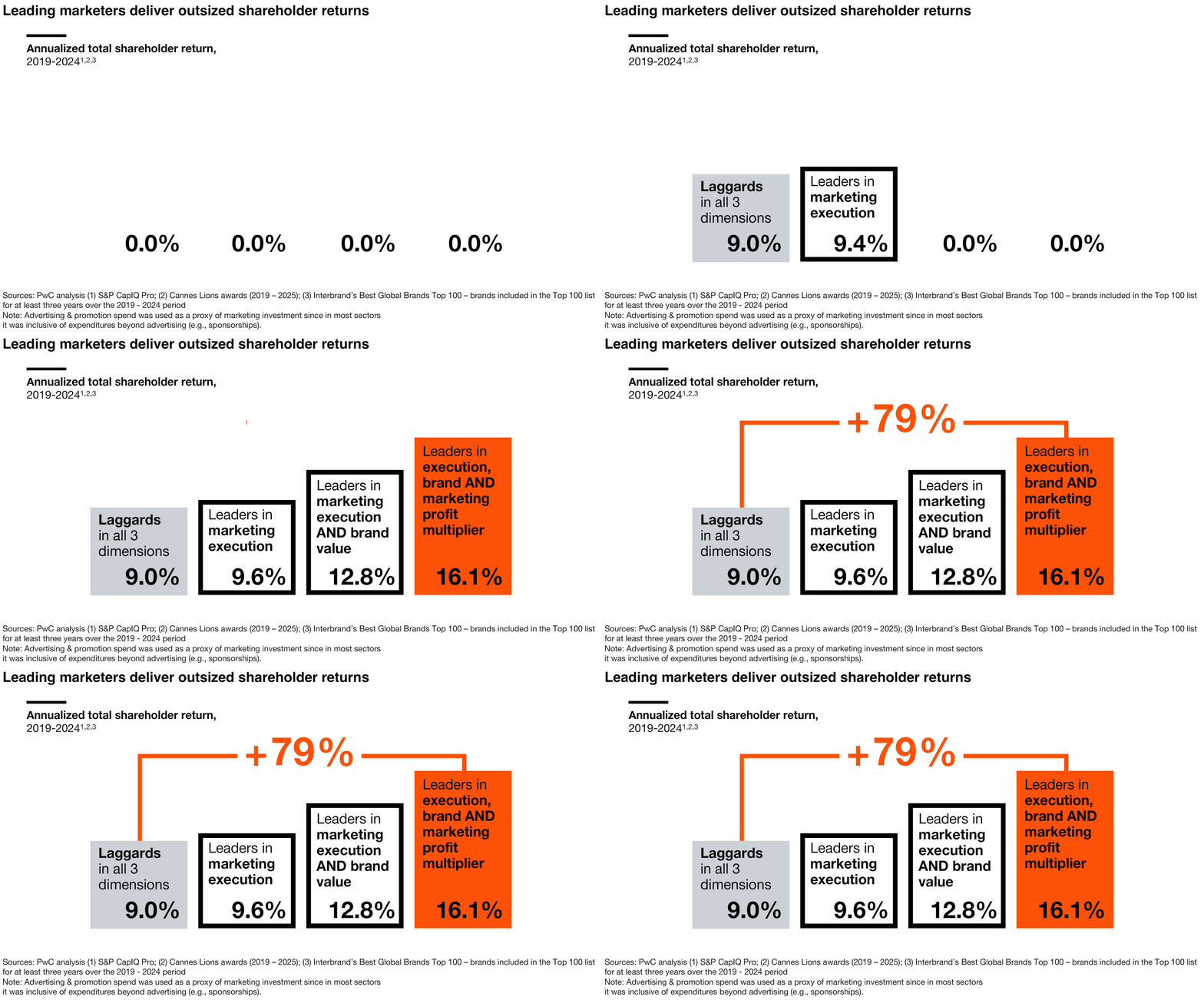
Our research with the Association of National Advertisers (ANA) shows that companies with leading marketers deliver significantly greater total shareholder value than their peers. What separates them isn’t AI adoption. It’s leaders who fix decision architecture first, then apply AI to that redesigned system. Those who do this in reverse wonder why the pilots don’t scale.
AI doesn’t just change how fast marketing works. It changes marketing decisions and who (or what) makes them. When a conversational AI layer can provide immediate insight across marketing, sales, and service data, the issue isn’t data. It’s having the decision rights, organizational structure, and operating model to act on it in time. Making AI a catalyst for decision redesign is the difference between using AI to matter more versus just cost less.
Three shifts can determine whether your marketing teams capture that difference.
When you reimagine how planning, content creation, campaign execution, and performance management work together, you can uncover constraints that automation alone won’t resolve. Reassessing core processes allows you to explore how each would operate differently with AI embedded from the start. Eliminated handoffs? Tightened timelines? Continuous adjustment based on real-time signals, not fixed cycles? All that is possible with an end-to-end mindset.
The content supply chain offers a clear illustration of this shift. Traditional models rely on linear workflows, manual reviews, and rigid distribution systems that struggle to scale personalization. In an AI-enabled model, ideation, creation, compliance, and distribution become interconnected and adaptive, with content assembled dynamically and deployed across channels with greater speed and relevance.
Roles would evolve as well. Production-heavy functions can give way to orchestration and oversight, where your teams focus on guiding systems, improving quality, and aligning content to strategic objectives. The result is a content engine that scales without proportional increases in cost or complexity.
Marketing planning and resource allocation are undergoing a similar evolution. Annual planning cycles and fixed budgets are increasingly misaligned with a dynamic market environment. AI can improve scenario modeling and enable near real-time reallocation of spend, allowing continuous review of investments based on performance, demand signals, and external conditions.
Sources: (1) Interviews with 30 CMOs and CFOs; (2) PwC client experience; (3) ANA AI database
What success looks like: A global e-commerce retailer’s ability to respond to shifting customer demand might be limited by disconnected planning, content production bottlenecks, and rigid campaign calendars. AI embedded across workflows—dynamic content assembly, automated approvals, and real-time budget reallocation—could enable continuous campaign optimization. Teams would focus on orchestration and strategy, not execution, resulting in faster time to market, more relevant customer experiences, and measurable gains in conversion and marketing efficiency.
Many marketing organizations still measure AI success with automation-era KPIs: cost per asset, time saved, headcount reduced, etc. That incentivizes the wrong behavior by rewarding the experimentation treadmill. Instead, consider three emerging KPI categories that we’ve seen leading companies use.
The days of analysts building dashboards and reviewing performance on fixed reporting cycles are numbered. Slow and fragmented reporting is giving way to new models in which AI sits directly on top of enterprise data, enabling conversational access to insight and automating much of the analytical process. Think of querying your data in natural language and receiving synthesized, context-rich responses that span marketing, sales, and service.
Reducing lag between signal and action can enable your teams to identify root causes automatically instead of through manual analysis, embed recommendations within insights to accelerate action, and integrate data from across functions into a single view of performance. Suppose you ask, “What’s driving conversion decline among segment X?” and receive an answer that connects campaign performance, sales trends, and service interactions, as well as suggested actions. AI agents could then orchestrate multi-step workflows—systems that gather data, synthesize insights across sources, and initiate actions, creating a more autonomous marketing environment.
Talent also would be affected. As dashboards become less central, the role of analytics shifts to interpretation, validation, and strategic guidance. Analysts will increasingly focus on ensuring model integrity, translating insights into business decisions, and shaping experimentation strategies. This elevates analytical capability, and reinvesting time saved from manual reporting into advanced modeling and innovation is critical.
What success looks like: At a leading consumer packaged goods company, marketing teams were constrained by static quarterly reporting cycles, fragmented data, and time-intensive analysis that delayed decision-making and limited responsiveness. Teams spent more time gathering data and building reports than acting on insights, reinforcing a reactive planning mindset. To address this, the company implemented AI-enabled decisioning and redesigned its operating model, shifting roles, governance, and workflows to support real-time insight and action. Teams now use conversational AI to evaluate recommendations, prioritize opportunities, and make faster, more strategic campaign decisions, with a clear bias toward action over analysis.
As AI reshapes how people engage with brands, customer experiences are increasingly initiated and shaped by conversational interfaces, digital assistants, and generative platforms. Customer content should be structured, modular, and machine-readable so it can be interpreted by AI. Relying on traditional SEO won’t account for how AI models retrieve and present information.
At the same time, AI is accelerating the emergence of the unified front office. CX isn’t owned by a single function, and AI can better connect touchpoints across the entire customer life cycle, creating more seamless and personalized journeys. This requires coordinated change across multiple dimensions.
These changes move organizations beyond incremental gains toward integrated execution and greater impact. Faster insight often leads to better decisions, better decisions help improve experiences, and better experiences help drive growth in a continuous cycle.
What success looks like: Consider a national hotel chain. Disconnected marketing and booking systems can create disjointed guest experiences and missed revenue opportunities. Reimagining its front office with AI-enabled journey orchestration and conversational interfaces could make content more modular and machine-readable, allowing digital assistants to dynamically assemble and deliver personalized recommendations. In addition, integrated teams would manage the end-to-end guest journey, using real-time signals to adapt offers and experiences—resulting in more intuitive trip planning, higher conversion rates, and stronger guest loyalty.
Efficiency is great. But if you want your marketing to outpace the competition, treat efficiency gains as opportunities to reinvest in initiatives that help drive growth, innovation, and differentiation. Here’s how to start.
In the ongoing AI revolution, the nature and magnitude of meaningful business impact and change are still being defined. It’s not just a matter of doing more with less. It’s about doing more of what matters to customers, in ways that will keep your competitors scrambling to keep up.
{{item.text}}
{{item.text}}