



Transformation Risk insights series

A practical use case for transformation risk in M&A

  • 6 minute read
  • January 06, 2026

This series explores how taking a portfolio-wide approach can help organizations align transformation efforts, reduce risk, and drive meaningful outcomes across business, tech, and controls.

M&A deals can simultaneously drive growth, scale, and transformation—even in a volatile economic environment. Recent PwC data shows the number of billion-dollar deals is projected to rise 17% year over year in 2025—and 31% for mega-deals valued over $5 billion. But the same transactions that create opportunity can also create transformation risk, stress-testing governance, risk, and compliance in ways few other events can.

When you acquire a company, you inherit more than its capabilities and scale. You take on its control and compliance gaps, its data and platform debt, and its regulatory obligations. As you accelerate toward the deal close, your organization faces compressed timelines for establishing purchase accounting, balance sheet readiness, internal controls over financial reporting (ICFR), Sarbanes-Oxley (SOX) Act requirements, and segregation-of-duties reviews—all under the scrutiny of auditors, regulators, and investors.

When not managed proactively, transformation risk can produce downstream challenges that dilute value—regulatory notices, data integrity issues, control deficiencies, reputational damage, publicly disclosed material weaknesses. By proactively understanding the acquired risk profile, you can map and remediate issues before they surface in the audit or erode deal value.

“A deal is the ultimate stress test for governance, risk, and controls.”

Brandon Laws,Digital Assurance & Transparency, PwC US

What are the biggest transformation risks in M&A?

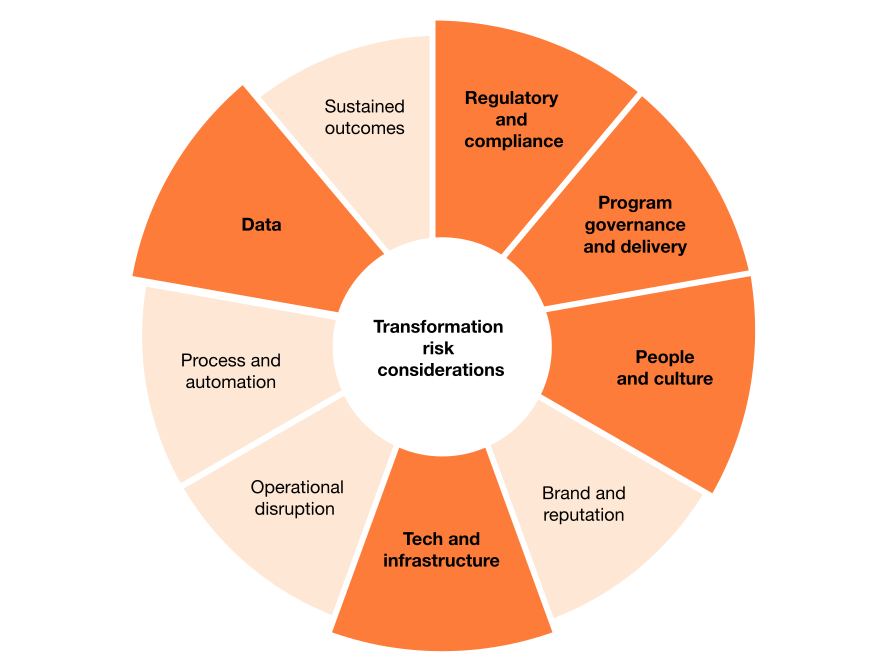
So where should you focus to create the greatest impact? Across various industries, we see several recurring categories of transformation risk that often drive audit issues and value leakage—areas where disciplined preparation delivers outsized returns.

Deals inherently operate under the regulatory microscope. Entities entering the public market or acquiring new businesses should set controls and reporting structures to comply with SOX, any system and organizational controls (SOC) reporting requirements, ICFR, and other statutory requirements. Integration of—potentially very different—governance mindsets and processes, control testing, and documentation often lag behind financial and operational integration. In addition, compressed deal timelines frequently lead to unvalidated control designs, incomplete documentation, or missed regulatory disclosures. Without early focus on governance and control readiness, regulatory and audit risks can become structural issues that increase costs, delay synergy realization, and erode stakeholder confidence.

Example: Your publicly traded company acquires a private target with less governance structure. Its business quickly becomes material to the consolidated entity, but its lack of ICFR and SOX readiness leads to control failures, audit issues, and regulatory sanctions or costly remediation. While there are many ways that differing compliance postures can hurt value generation, this simple case is one of the more common.

A company’s data and technology can be a—if not the—key selling point when it comes to deal value. But it’s also a source of hidden complexity. Variations in system configurations, chart of accounts, and posting hierarchies can undermine the integrity of financial data and reporting. Legacy or unsupported systems and data structures often impede and significantly delay migration and make it difficult to establish a single source of truth. And weak access governance or conflicting role definitions across environments can lead to segregation-of-duties (SoD) violations and sensitive-access exposure.

Example: You’re integrating a tech-forward, mid-market firm into your global retail operations. What looked like a simple identity and access management (IAM) merger reveals critical gaps. Privileged accounts were shared across business units, users had access to data that they shouldn’t have, and multi-factor authentication wasn’t consistently enforced. Your security team now faces the urgent need to rapidly close vulnerabilities while contending with elevated risk exposure, all under the pressure of a looming audit window and investor scrutiny.

Integration is more than a technical challenge. It’s a governance and oversight challenge as well. Governance clarity is a foundational component of control confidence. Without defined project plans, stakeholder alignment, roles, and accountability, even well-designed processes can fail under pressure.

Example: Your organization is acquired by another large, regional company. During the rush to hit the proposed merger timeline, the two didn’t align on Day One plans—specifically, risk and compliance reporting requirements. Months later, inconsistent interpretations of regulatory obligations trigger conflicting guidance to the business, ultimately leading to audit findings and avoidable regulatory attention.

Remember, every transformation is—in part—ultimately a people transformation. Merging teams, changing responsibilities and processes? Eventually, it comes down to people executing a strategy. Without careful planning, you may find yourself with too many people with one skill or too few with another. And without clear, transparent leadership throughout your transformation, extracting the value you’re aiming for can become increasingly difficult.

Example: Having recently closed on an acquisition, you’re put in charge of a newly consolidated accounting team. After integration, however, the team is stretched thin. The function operates capably enough through your stub period, but it quickly becomes apparent that early integration control designs and resourcing underestimated how important certain accounting expertise and legacy ERP knowledge would be. Work bottlenecks in too few experienced hands and audit deficiencies mount, resulting in a potential material weakness.

How to tackle transformation risks in M&A

We know there’s pressure to close quickly, but if you want to protect deal value, meet regulatory requirements, and stay audit ready, prioritize governance and control-critical work. Anticipate audit expectations, regulatory scrutiny, and control requirements—and embed them in your M&A plan, Day One/Day 100 milestones, and integration workstreams.

Being thorough up-front saves multiples in remediation time and effort on the back end. Organizations that invest in pre-close audit readiness and post-close risk management realize higher audit confidence, risk-aware growth, stronger stakeholder and regulatory trust, and future-ready operations that support ongoing transformation.

Start with these nine pre-close and pre-integration priorities.

Align audit scope, risk assessment, and materiality thresholds to reflect transaction complexity and integration scope, including any stub period audit requirements as well as any nonfinancial reporting obligations such as sustainability reporting.

Design interim controls for key processes (financial reporting, ICFR, SOC, SOX, etc.) and develop documentation ready for immediate auditor review.

Refresh risk appetite and oversight structures to reflect the combined entity’s scale and complexity. Involve your risk function in integration planning and key changes to maintain a clear view through that lens.

Support pre-close filings, disclosure controls, and audit evidence for smooth regulatory and investor communications.

Assess data quality and establish governance frameworks for systems and process convergence.

Confirm fair value assumptions, reconcile acquired balances, and assess supporting control documentation so you can have holistic and precise financial reporting starting on Day One.

Gauge internal and external security and resiliency posture and set out clear guidelines for integration and beyond.

Understand whether any transition services agreements (TSA) are needed to cover how operations can be maintained through integration and who’s responsible for each facet, including risk management.

Conduct a holistic assessment of your transaction management office (TMO) to strengthen risk, controls, governance rigor, and risk-reporting structures—clarifying roles and responsibilities and enabling accountable, audit-ready execution of the deal plan.

Post-close, you can integrate effectively, sustain audit confidence, and build a control environment that scales with your company’s growth and transformation plans. A future-ready, resilient organization can maintain audit integrity by continuing to invest in audit readiness prior to transformations, post-close, but pre-implementation. This can mean achieving synergies faster and embedding a sustainable culture of control discipline, compliance, and trust across your enterprise.

Here’s what you can do to get the results your deal was designed to produce.

Standardize your control environments, SoD matrices, and compliance frameworks across legacy entities to create a single, consistent governance structure.

Align systems and applications, strengthen access controls, and harmonize governance, risk, and compliance tools with your ERP to support continuous compliance and clear visibility across the enterprise.

Establish dashboards and key metrics to track required and voluntary compliance—including TSA oversight, as well as ICFR—and enable proactive issue identification and resolution. Pay close attention to data transformation strategy and migration. Integrate enterprise systems for reporting, workflow automation, and risk analytics to enhance assurance and decision-making.

Realign your finance, legal, risk, and compliance functions to your new business structure and growth initiatives. Clarify accountability and ownership, oversight, and how you can assess this design against those goals.

Prepare control and data environments to help meet evolving audit, assurance, and sustainability reporting requirements.

Equip business and finance teams with the skills, awareness, and ownership mindset to sustain audit discipline, compliance, and control performance post-integration. Build a culture that promotes continuous improvement, transparency, and shared ownership of governance and controls.

How can PwC help?

Think about the outcomes that matter to you in M&A, things like deal value, deal speed, and regulatory compliance. A future-ready business that maintains audit integrity throughout its transformations can achieve synergies faster and can embed within itself a sustainable culture of control discipline, compliance, and trust. PwC’s pre-close and post-close readiness assessments can help you anticipate and mitigate control risks before transaction close and prior to transformations occurring in post-close—so you can close confidently and transform sustainably.

Transformation risk consideration Pre-integration assessments Post-close assessments
Regulatory and compliance readiness
  • Audit and reporting readiness
  • Day One controls identification
  • Regulatory readiness
  • Purchase accounting and opening balance sheet validation
  • SOX and SOC monitoring and reporting
  • Sustainability integration
Data, tech, and infrastructure readiness
  • Data migration planning
  • Cyber exposure and framework alignment
  • Technology integration and access management
Program governance and delivery risk oversight
  • Governance and risk alignment
  • TSA planning
  • Policy, process, and control harmonization
  • Operating model design
People and culture readiness
  • TMO assessment
  • Skill, organizational design, and communication plan analysis
  • Change management and training

What risks do your M&A deals face?

Contact us

Helena Yoon

Helena Yoon

Partner, PwC US

Brandon Laws

Brandon Laws

Partner, PwC US

Michael Oliveri

Michael Oliveri

Partner, PwC US

Follow us