







{{item.videoDuration}}
{{item.title}}
{{item.text}}

{{item.videoDuration}}
{{item.text}}
If AI is on your agenda, then data is likely top of mind: How to give AI, quickly and cost effectively, the right data to deliver your business priorities. But most companies today are falling into one of two traps. Some aim to modernize data first, then add AI. But that can keep you waiting months or even years, and it typically produces data sets that may be modern, but don’t match business needs. Others try to run AI fast, then patch data. That may produce isolated small wins. But they almost never compound.
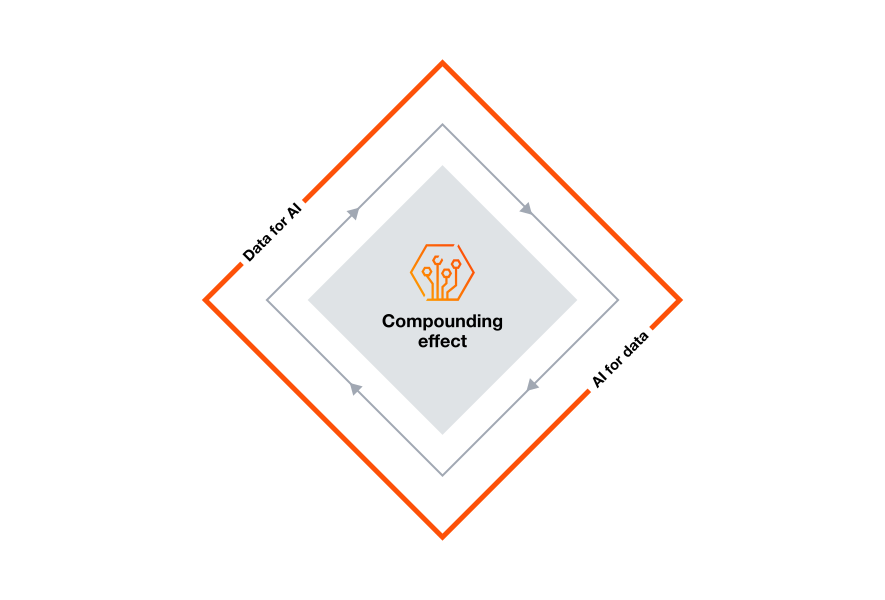
There’s a better way: Build a data-for-AI and AI-for-data “flywheel” that avoids both traps as you advance on two fronts at once. Starting with a few high-stakes areas, you give each AI use case the precise data it needs to deliver business value. At the same time, in the background, AI continuously transforms data for enterprise enablement too. With reusable assets, each new deployment builds on what came before. Delivery keeps accelerating. Your data environment becomes self-improving. And you can spot new ways to rationalize systems and cut technical debt.
The result can be quick wins that deliver big value and a sustainable foundation for high-impact AI strategy. According to PwC’s 2026 AI Performance Survey, the top AI performers (20% of the survey sample) capture nearly three quarters (74%) of AI-driven value. What sets winners apart is often data. If you’re a CEO, CIO, or another senior leader, here’s what you need to know.
Two investment logics dominate AI, but there’s no need to choose. You can bet on both. For high-value use cases, you quickly unify the data that AI needs. At the same time, you gradually build a platform of scalable, governed data products. To drive lower costs and faster outcomes, both approaches share an activation layer. Over time, the paths converge. You get past vendor dependency and own the key parts.
It starts with a deliberate strategy for investing in two approaches, side by side.
For cross-domain decisions with an enterprise impact, such as how to grow revenue across business lines, address risk across functions, or manage supply chains, financial closes, or post-merger integrations, AI can change the game.
If you select the right decisions, you can identify the precise data needed and unify it across domains through a shared ontology (a common definition of business concepts and their relationships) and semantic layer that applies these definitions consistently across systems. You can then have more up-to-date insights, reliable forecasts, and realistic scenario modeling for complex decisions. AI can automate (under human oversight) simpler ones.
Benefits can be vast. At one global manufacturer we assisted with AI decision intelligence for supply chain management, first year savings from reduced on-time-in-full (“OTIF”) fees have been roughly US$700 million. These and other benefits can keep growing and scaling. But it’s important to make the right decisions:
How to get scalable, dependable, “industrial-grade” AI? It starts with governed, reusable data products that have clear ownership, lineage, security, and standards. But creating these products can be a lot of work: reconciling data models and master data, and reskilling people.
But modern tools, powered by agents, can help. You can move domain by domain, creating value at each step. You can usually use your current hyperscaler platform. And the more you do, the better the economics can get, as more teams and agents consume the same data products.
At one global technology company, we helped stand up reusable data ingestion pipelines, curated data layers, reporting foundations, and a common data model with built-in governance. In eight months, the company cut its legacy table footprint 73% and rolled out over 500 gold-layer reporting tables. With reusable tools and patterns, this firm’s data modernization is still accelerating. But with the “platform bet” too, it's wise to start where certain conditions are met:
A single, reusable activation layer can power both your unification and platform bets, improving consistency and lowering the cost of scale. It contains AI agents, modular skills, connectors, and human-in-the-loop gates, and it offers major benefits:
Since this layer can work on existing systems, its assets are reusable, and its agents can help with data quality, lineage, migration, and workflow execution, ROI can come quickly. At one national retailer we assisted, agents now unify fragmented signals from store operations, conduct root-cause analysis, and recommend actions for district and store leaders. The company estimates over $20 million in annual value, with indirect benefits (such as time savings for senior personnel) adding up too.
When you combine a dual investment model with a shared activation layer, benefits compound. At one global healthcare company we assisted, the unification bet connected previously silo-ed trial and patient data to drive better care decisions and research. With the activation layer’s help, the platform bet then scaled that same data into governed assets that over 50 domains are now using. Care teams can now get critical analytics in half the time, enabling better patient outcomes. The company is expecting new value of over $50 million annually.
4 steps can get you started on this path of compounding AI and data value:
Together, these four steps can start the AI data flywheel spinning: As unification delivers early wins and momentum, your platform strengthens your data foundation. Governed data products spread. Costs drop. Decision speed and quality rise. New AI-enhanced decisions and data, with your chosen governance built in, come faster and faster. Soon, you won’t just have a data platform. You can have a decision factory in which you own the control plane and value keeps compounding. Your strategic unit can then shift from functions to decisions which cross functions.
This AI data flywheel is not only possible, it’s the necessary foundation for bi-modal transformation and an agentic enterprise, and you can start building it today.
{{item.text}}
{{item.text}}