




Key findings
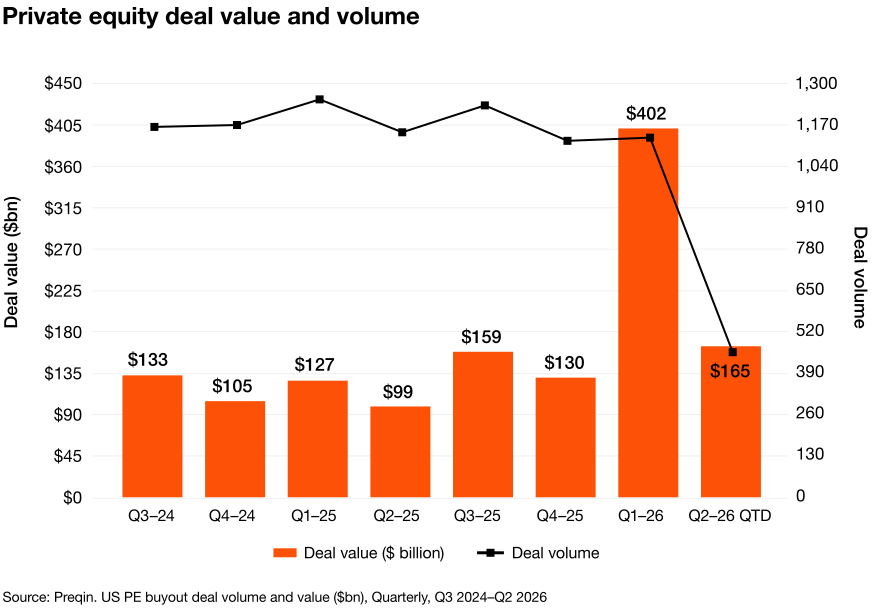
Deal volume in H1 2026 declined 34%, while average deal size rose nearly 4 times compared to H1 2025, as capital concentrated in higher-conviction bets.
Fundraising bifurcation sharpened: top-DPI performers raised quickly, while others struggled to first close. DPI becoming the more watched metric than IRR.
Exit activity remains suppressed, and continuation vehicles and secondaries are now the primary release valve.
LPs demand realized returns over paper marks, with DPI the defining fundraising metric of 2026.
AI is simultaneously disrupting legacy software assets and unlocking new value creation levers across the portfolio.
The first half of 2026 produced 67% fewer PE transactions overall than 2025—but those deals that did close skewed larger, with aggregate deal value increasing nearly 10%. A signal that sponsors are concentrating firepower on higher-conviction opportunities rather than deploying broadly. Megadeals continued in sectors with clear strategic tailwinds, while the middle market saw hesitation driven by valuation gaps that neither buyers nor sellers are willing to bridge.
The fundraising environment tells a clear story. Aggregate dollars raised actually increased 9% in H1 2026 relative to H1 2025, despite a slight decline in the number of funds raised, due to a shrinking number of established managers capturing a growing share of commitments. Firms demonstrating strong distributions to paid-in capital (DPI) raised quickly. Others faced extended timelines, reduced targets, and increasingly skeptical LP investment committees. This reflects a structural recalibration of how LPs allocate in an environment where unreturned capital has compounded for years.
The exit bottleneck that defined 2025 has not meaningfully cleared. IPO windows remain narrow, strategic buyer appetite is selective, and sponsor-to-sponsor transactions face ongoing valuation scrutiny. In response, continuation vehicles and GP-led secondaries have become the primary liquidity mechanism. These are functional but imperfect, and increasingly subject to LP skepticism around conflicts of interest.
Across portfolio sectors, the experience diverges sharply. Healthcare remains the most resilient for PE deployment, with take-privates and platform roll-ups proceeding at pace. Technology, long PE’s highest-returning sector, faces a more complex environment as AI disrupts the economics of legacy software holdings, making exits harder even as it unlocks new value creation levers for forward-looking sponsors. PE remains selective in consumer markets amid margin compression, focusing on large CPG carve-outs and retail take-privates where buyers see room for operational improvement. Industrials activity is dominated by strategic acquirers, with PE focused on mid-market buy-and-build platforms. Energy sees PE largely on the sell side, monetizing into strategic demand driven by AI-fueled power needs.
The firms navigating this environment most effectively share a common trait: they are proving value creation, not simply claiming it. In a market where LP patience is finite and alternatives are abundant, the gap between demonstrated operators and financial engineers will only continue to widen.
What private equity dealmakers should watch in H2 2026
Two dynamics will define the second half: the LP liquidity imperative and the AI repricing of portfolio value.
On liquidity: limited partners are no longer willing to accept paper marks as evidence of performance. The denominator effect has subsided, but the cumulative impact of years without meaningful distributions has permanently shifted LP expectations. GPs approaching market for new funds without credible DPI will face an existential fundraising challenge. This is already driving decision-making—some sponsors are accepting lower exit valuations simply to generate the realized returns needed to raise their next vehicle.
On AI: disruption is no longer theoretical. Private credit managers are openly discussing “SaaS-pocalypse” scenarios where AI-native alternatives erode the recurring revenue models that underpin the majority of PE-backed software valuations. For sponsors holding legacy tech assets, the exit window may be narrowing faster than expected. Conversely, firms deploying AI as an operational lever within portfolio companies are finding that this capability is becoming a genuine differentiator in both fundraising and exit conversations.
The path forward requires honesty about what has changed. The PE model is not broken, but the assumptions that sustained it through a decade of low rates and multiple expansion no longer hold. Sponsors who adapt, by demonstrating operational value creation, maintaining LP trust through transparency, and accepting that the old exit playbook needs rewriting, will emerge stronger. Those who wait for the cycle to revert may find that it never does.
“The firms winning today aren’t waiting for markets to normalize. They’re creating their own exit opportunities through value creation, operational transformation and AI enablement.”
Josh Smigel,Partner, PwC US DealsThe bottom line: what private equity dealmakers should watch
The bottom line for PE dealmakers: the market is not uniformly slow, it is selectively rewarding. Sponsors with strong DPI, credible value creation narratives, and the ability to demonstrate AI-driven operational improvement will continue to raise capital and find exits. Those relying on multiple expansion and financial engineering face an increasingly unforgiving LP base. The bifurcation is structural, not cyclical, and the firms that acknowledge this reality earliest will be best positioned for the next chapter of private equity.
FAQs


