




The future of banking
Bold leaders are re-engineering how banks win, catalyzing a new era of competition
After a decade defined by low interest rates, heightened regulation, and persistent liquidity uncertainty, the banking industry now faces a rare moment of opportunity. Rate normalization and regulatory recalibration are opening a window for renewal—one that executives should press their leadership teams to seize before it closes. At the same time, investors’ expectations for profitability have risen, rewarding those banks with business models capable of sustainable growth.

Yet beyond this window, storm clouds are forming. Banks and their corporate clients are contending with a multi-shock environment where market signals transmit value instantly, capital flows shift dynamically, and financial intermediaries converge, disintermediate, and reintermediate capital formation at unprecedented speed.
Amid this turbulence, both investors and banking CEOs are turning to generative AI as a new source of value creation. Investors are focused on the efficiency upside: banking’s process-heavy operations and compensation-intensive cost structures make it well suited for productivity gains. Through straightforward, deterministic modeling, investors can already see that a bank with mid-tier profitability today, if it fails to reengineer workflows with AI solutions, risks falling to the bottom quartile. Leading CEOs, meanwhile, aspire to harness AI as a catalyst for capacity—an enabler of growth and adaptability as clients and markets adjust to continual shocks.

Executives should use this period of rate and regulatory reprieve to redefine operating models for lasting earnings power—encompassing both profitability and sustainable growth. They should seek ambitious leaders ready to reimagine their institutions around today’s realities and technologies. The old playbooks—written for an era of low rates and rising regulatory complexity—no longer apply. AI’s broad availability has leveled the competitive field: those that transform first will attract customers and investor capital, leaving slower peers behind. To begin, firms need to prioritize integrating AI into strategy and capacity planning—linking technology, talent, and operating discipline to deliver sustained performance.
New Leaders, new competition, new payoffs
Bank leaders work with boards to set long-term strategic direction — a task made harder by the volatility and intensity of today’s multi-shock world. Investors, recognizing that some institutions adapt faster than others, are quick to reallocate capital toward those better positioned to create shareholder value despite heightened market uncertainty.
In this environment, executives should understand how customer needs evolve when uncertainty rises — and how rapidly their bank’s operating model adjusts to those shifts. They should seek out management teams with the ambition and capability to reengineer their institutions, recognizing that the past decade’s playbook, forged in an era of low rates and high capital requirements, no longer applies.
Historically, banking profitability and return on equity were tied to scale. Bigger was often better because it enabled sustained, capital-intensive investments in digitization, fee-based businesses, and artificial intelligence initiatives.
We expect ambitious bank leaders to view agentic AI as the catalyst for a new kind of operating model: customer-obsessed, adaptive, and self-funding.
Scale may still confer first-mover advantages in the era of AI, but it no longer guarantees leadership. Today, banks of all sizes have access to AI capabilities that can structurally elevate profitability. Cost efficiencies can now fund growth without proportionally expanding headcount. This shift reframes technology from a cost-efficiency tool into a growth engine — one that enables banks to reallocate savings toward innovation and client success. As AI broadens the pool of institutions capable of self-funding transformation, scale becomes a less decisive factor.
We expect ambitious bank leaders to view agentic AI as the catalyst for a new kind of operating model — one that is customer-obsessed, adaptive, and self-funding. By embedding intelligence into processes, these leaders can de-risk transformation and unlock a step-change in value creation. In this new landscape, AI becomes a performance lever independent of size, positioning reengineered banks to redefine competition across financial services.
PwC’s financial services industry survey 2025 shows bank leaders are aware of the acknowledgement-ambition gap in their organizations. Financial performance and investor risk keep 58% of bank leaders up at night, the highest among any sector in the FS industry.
Toss out the old playbook: Scale wins until the cost curve breaks; then speed eats size
Bank executives are no longer battling the same profit constraints as their predecessors. In the past, persistently low interest rates and higher capital requirements compressed margins. To keep returns above the cost of equity, many pursued scale or built capital-light, fee-based businesses. Both strategies had a downside: keeping in place aging technology. Decisionmakers chose to support earnings, but investors seldom gave them credit for it by lifting company valuations.
Scale still confers advantages, particularly in generating the earnings needed when the cost of buying new capabilities is high. Yet across the banking sector, compensation remains the dominant share of operating expenses. The democratization of AI is now poised to break the cost curve of transformation—reducing the premium on scale and resetting expectations of what every bank can achieve.
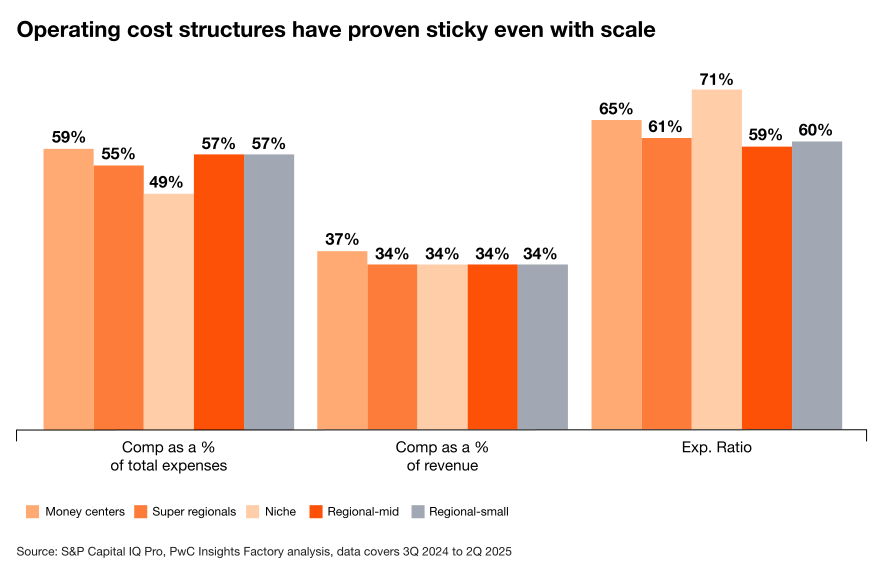
AI agents offer a less expensive path through challenges that once required massive capital outlays. Challenges that bedeviled banks, such as merging fragmented data, making incompatible architectures mesh together, and slow decisioning, can be more easily solved. By “speaking” the native language of disparate systems and translating data into actionable insight, AI agents make speed—not size—the defining competitive metric. With broad access to AI, banks of any scale can accelerate relevance, reduce operational risk, and compete on responsiveness rather than resources.
To be sure, scale remains an advantage in supporting earnings growth, but speed now defines leadership. The most valuable banks will likely be those that rapidly generate new products, insights, and capital pathways to help clients—and themselves—adapt to constant disruption. Achieving this requires reengineering the business through a full transformation of capabilities long patched or underfunded in the age of scale.
As investors look for institutions better positioned to harness AI’s general-purpose potential, those that reengineer around agentic intelligence will be re-rated first. These banks won’t just lower costs—they’ll out-serve clients navigating continual shocks.
The tipping point is near: banks that align boards, CEOs, and line managers around urgency and adaptability will become the sector’s next generation of value compounders.
Reengineering the bank: Three questions to build capacity for growth
Bank leaders overwhelmingly agree that new capabilities are essential for success. Yet PwC’s research reveals an urgent need to rethink strategic and capacity planning in the age of AI. According to PwC’s financial services industry survey 2025, executives are acutely aware of the stakes: 90% believe the most successful financial services firms in 2030 will be those investing most heavily in capabilities they don’t yet possess; and 96% say the industry’s survival will depend on deeper collaboration between traditional and non-traditional players.
Despite this awareness, far fewer leaders are addressing how to create the capacity required for growth. Only 25% of bank executives identify workforce and skills reinvention as the most significant strategic change needed over the next three years to remain competitive. The playbook for creating capacity begins with a deeper understanding of the workforce itself.
"We took AI and data out of [the] technology [department]. It's too important and technology does a great job and a deep partner. But we put AI at the management table... There will be no job, no process, no function that won't be affected by AI, mostly for the positive. It's about getting all of the people who run these businesses to understand the power of it."
“At Bank of New York Mellon, AI is for everyone, everywhere, and for everything... By putting AI in the hands of everyone at Bank of New York Mellon, we intend to develop fluency and create capacity for our people to focus on higher value work.”
Executives can move from ambition to action with three straight forward questions. A CEO’s AI playbook begins by scoping the opportunity—identifying functions and roles where internal data and benchmarks reveal tasks that can be measurably made more efficient or effective. Leaders should then assess the workflows within those target areas to select the most relevant AI solutions and deployment models. Finally, executives need a strategy to reskill and realign their workforce—both to fill new roles and to unlock the full potential of AI-enabled capabilities.

The leadership multiplier: Aligning purpose, people, and performance
The current period of rate and regulatory reprieve gives executives a narrow but vital window to redefine their banks for lasting earnings power—balancing profitability with sustainable growth. The task demands more than incremental planning; it requires ambitious leaders who can reimagine institutions around today’s realities and technologies. The old playbooks—built for low rates, high capital buffers, and slower change—no longer apply. Leadership should set a new vision for how AI, talent, and operating discipline combine to drive durable performance.
That vision should be matched by stewardship. Trust, governance, and accountability are now strategic assets, not compliance obligations. As AI becomes embedded in decision-making, boards should enable transparency and ethical oversight at every level. Organizational redesign will follow—breaking silos, connecting data and workflows, and building the agility to execute enterprise-wide. Yet success will hinge on people. A workforce that understands and relies AI can multiply its impact; one that fears it resists change. Investment in skills, culture, and empowerment is therefore not discretionary—it is the differentiator.
To sustain advantage, leaders should scale with discipline. Early wins in AI adoption can build confidence, but long-term value depends on clear roadmaps, strong governance, and measurable outcomes. The banks that move first—linking technology, talent, and purpose—likely will attract customers, capital, and trust. Those that wait risk being left behind as the industry resets its performance frontier. Technology may accelerate progress, but it is people and leadership that will define who prospers in the next era of banking.

Contact us