





{{item.videoDuration}}
{{item.title}}
{{item.text}}

{{item.videoDuration}}
{{item.text}}
M&A deal value in the US energy sector reached record levels in 2023 and 2024, with most concentrated in upstream oil and gas. Although future transactions are likely to focus on midstream and oilfield services, efforts to grow upstream via acquisition will likely continue for a couple of reasons.
First, investors show little appetite for large-scale or risky new exploration programs, and operators’ capital allocations and personnel decisions have reflected that preference. Second, the maturing of shale basins like the Permian means that organic growth via development will be difficult to maintain.1 That reinforces the segment’s focus on wringing capital and operational efficiencies in the face of potentially flat or declining production, as Tier 1 drilling locations give way to Tiers 2-3.
With M&A taking center stage, how can upstream companies streamline integration and realize deal synergies more quickly? We see several key areas that can determine the success or failure of upstream acquisitions.
We also look at how upstream companies can, like their counterparts in other sectors, realize significant G&A synergies via acquisition.
Reservoir characterization is the process of analyzing and integrating geological, geophysical, petrophysical, and engineering data to create detailed and reliable subsurface reservoir models. Understanding the reservoir’s structure, rock and fluid properties, porosity, permeability, pressure, and saturation are key parts of the process. The goal is to predict reservoir behavior, enhance hydrocarbon recovery, and support effective field development and management.
Reservoir characterization is critical for valuing upstream assets, and companies naturally spend considerable time and money developing these (often proprietary) models. Reservoir characterization is also critical for enhancing hydrocarbon recovery while reducing costs. Because of the vast amounts of seismic data, well logs, and drilling data involved, artificial intelligence (AI) models can be useful for detecting patterns in the data, and they can inform important reservoir management decisions such as well placement, injection rates, and so on. Post-acquisition, the best-case scenario may be achieving the same production levels with fewer rigs and fewer frac crews.
Following mergers and acquisitions, upstream companies tend to concentrate on portfolio rationalization—establishing core positions (both operated and non-operated) in the areas they’re active in and divesting non-core or non-strategic assets. As with reservoir characterization, in portfolio rationalization companies can leverage advanced analytics to get a picture of their current holdings, adjacent leases and owners, counterparties, and so on— in service of driving better portfolio decisions.
One variant of portfolio rationalization is unitization, where two or more operators combine their interests in a single unit across multiple tracts to increase effective resource recovery. Like reservoir characterization, managing the reservoir as a single unit helps the acquiring company reduce costs. Unitization can also greatly simplify fragmented ownership and can mitigate royalty or ownership-related risks.
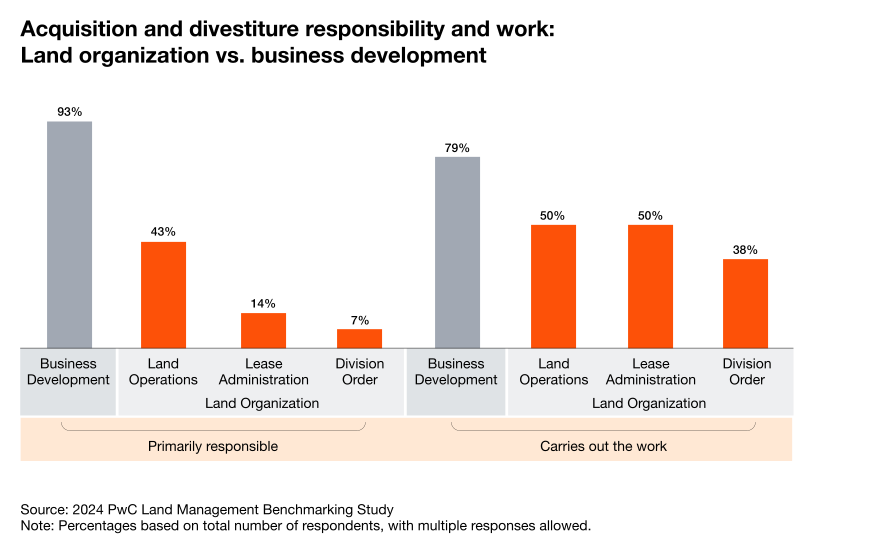
Land organizations—a critical data and communications nexus between operations and accounting—can provide an important, if seldom recognized, role in streamlining M&A integration. Other functions rely on the land organization as an important source of regulatory, operational, and financial obligations compliance—and deals require that each of those compliance areas be newly reviewed, understood, and acted upon.
During purchase and sale agreement (PSA) negotiations, the knowledge of land personnel is key in assessing title defects, representations and warranties, assumed obligations, and indemnifications. Before closing, land personnel conduct detailed title and lease analyses to confirm mineral ownership by depth, evaluate permitting and surface rights, and determine valuations based on reliable acreage and restrictions—critical steps to confirm that drilling can proceed. Post-deal, land teams manage system transitions, software upgrades, defect reviews, and customizations, making sure that data is quickly consolidated and accessible for functions like accounting and operations.
Asset deals vary in complexity. New basin acquisitions require significant involvement from the land team due to unfamiliarity with relevant property law and its interpretation, while bolt-on (within basin) deals are typically smoother and may even be led by land. In divestitures, land plays a key role by providing critical data to the buyer.
Data is at the heart of what makes the land function successful. Accounting and operations rely on quality data from the land department to calculate royalty payments or understand lease compliance.
With an M&A transaction, there are several data-related challenges that land should manage throughout the integration process.
To meet those land-related challenges head, companies should:
In summary, devoting careful attention to the land-related data and potential land-related risks in a transaction can streamline integration and avoid costly, manual effort and drilling delays.
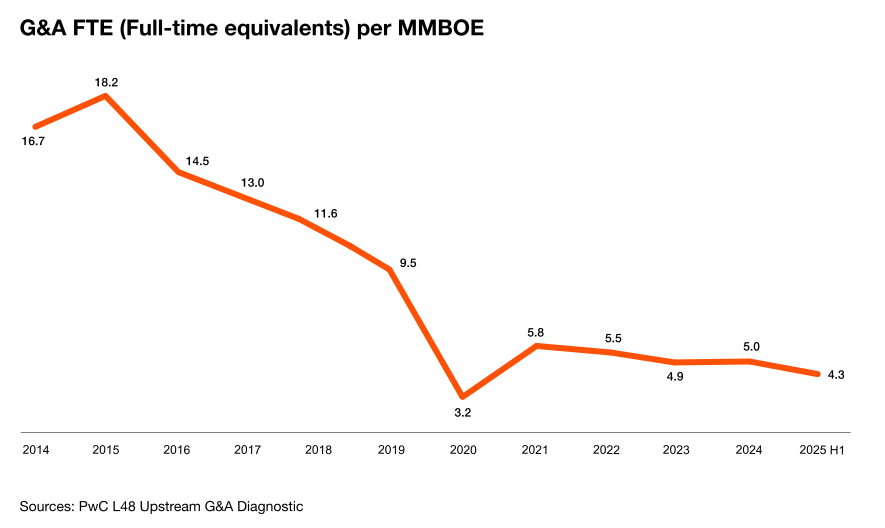
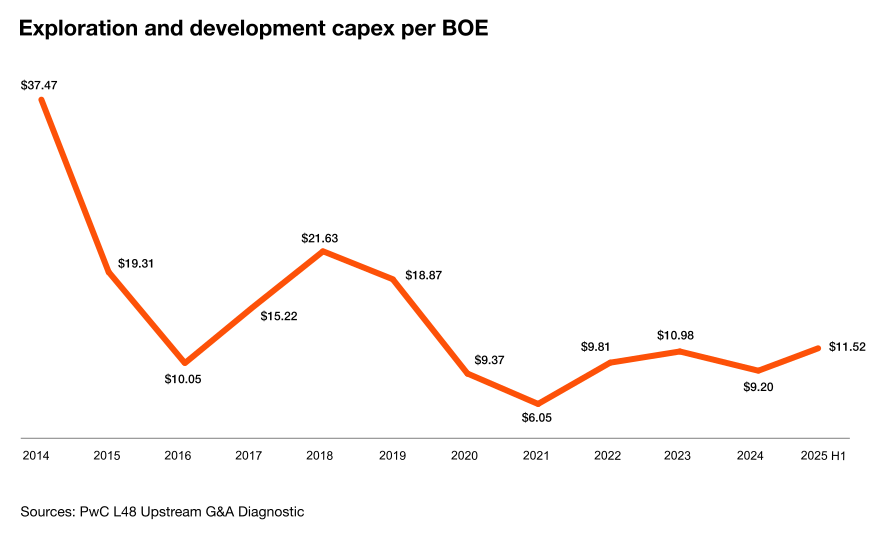
Since 2014, upstream G&A and capex costs have declined based on production—due to many factors, including labor reductions, drilling and completions advances, longer laterals, increased use of multi-well pads, advanced data/analytics, and, to some extent, consolidation. Unlike periods prior to 2014, those costs remained low even when commodity prices rose, as they did post-pandemic.
In dollar terms, upstream G&A deal synergies usually pale in comparison to capital and operational improvements. Yet despite the recent declines, G&A cost can still represent a significant source for potential post-merger savings.
The short answer is to do the things other sectors (such as financial services) have done—reduce redundant technology and professional personnel, standardize processes, and enhance fixed assets. One important step your company can take to be deal-ready and realize G&A synergies post-deal is to focus attention on talent architecture.
Many companies struggle to identify, compare, and standardize jobs across business units, geographies, and assets. These struggles are often exacerbated by a lack of data integration among finance, HR, and IT systems. The purpose of a global talent architecture framework is to, in effect, create a consistent framework for jobs in the organization and better enable talent management processes through defined responsibilities, career paths, and skills. Outcomes of that approach may include:
Standardized jobs and workforce planning, including consistency in job titles and descriptions
Standardized career framework
Organizational model design (for core businesses and other functions)
Implementation of HR systems (if necessary)
Global salary structure, including long-term incentives
Enhanced connections between Finance, HR, and IT systems
Post-acquisition, the talent architecture framework can be applied to the acquired asset or company and can streamline the important process of assessing potential redundancies.
For upstream companies looking to enhance integration synergies, we suggest they focus on three critical areas: Reservoir characterization, portfolio rationalization and unitization, and land. Although upstream companies spend a a considerable amount of time and resources addressing the first two areas, they are generally less likely to focus attention on land-related integration issues prior to the deal. But those issues are no less critical. G&A synergies should also not be overlooked. With effort put to talent architecture pre- and post-deal, the savings can be significant.
{{item.text}}
{{item.text}}