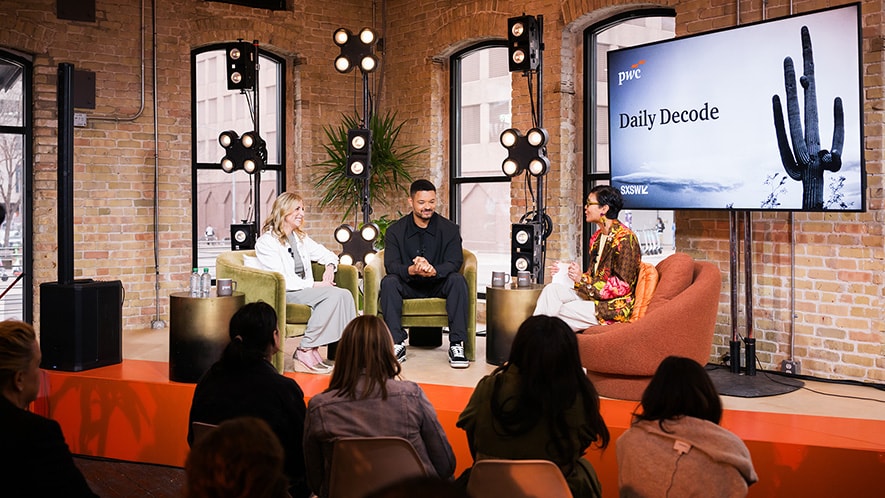
In March, more than 300,000 people converged on Austin for South by Southwest (SXSW)—an annual gathering focused on the intersection of business strategy, technology, entertainment and culture. It’s part innovation conference, part film festival, part music showcase, and part something harder to name: a one-of-a-kind opportunity to listen, learn, and think out loud among strangers.
This year, one theme echoed across sessions: AI is already reshaping how customers discover, decide, and engage, and the companies pulling ahead are using this moment to rethink how their businesses operate and grow.
Inside PwC's Daily Decode series at SXSW: Adapt now or fall behind
For four consecutive mornings, PwC hosted Daily Decode panel discussions at the Innovation Clubhouse in Brazos Hall. On stage, Stephanie Mehta, CEO and chief content officer of Mansueto Ventures, publisher of Fast Company and Inc., moderated conversations with PwC leaders and Steven Bartlett, who is an entrepreneur, an investor, and host of The Diary of a CEO podcast. The Daily Decode series built on itself each day, moving from how AI is reshaping commerce, to who is doing the shopping, to what organizations might look like in the future, to what it all means at a broader societal level. Here’s some of what stood out from the four-part series.
Agentic commerce: When AI becomes the new storefront
The series opened with a session on the rise of agentic commerce, featuring PwC's US Commerce Leader Eric Shea alongside Bartlett. They discussed how AI assistants are already changing how people find, compare, and choose products. Instead of browsing pages or typing keywords, consumers are increasingly asking AI what to buy—and the balance of power among brands, platforms, and algorithms is shifting as a result.
Bartlett described shopping for a backyard umbrella for his home in California by typing a few words into an AI agent. The agent quickly found photos of his home from an old listing, compared options, and delivered what felt like a perfectly tailored recommendation in mere seconds—with no scrolling through dozens of options and no decision fatigue.
That's the seismic shift. In the old era of search, brands could optimize keywords or buy their way to the top of results. But AI looks broadly across the internet, pulling from reviews, forums, third-party sources, and signals that brands don't directly control. That means the companies most likely to show up are the ones that have genuinely earned it: through product quality, customer experience, and reputation built over time. So reputation alone isn't enough. Companies need a strong technical foundation that enables AI agents to find and interpret their products: structured, machine-readable data and direct integrations with the platforms driving purchasing decisions. The coming wave of personal agents, Shea and Bartlett argued, could fundamentally redefine how consumers shop. The question every brand needs to be asking is: When an AI is doing the searching, are you discoverable?
“Brands have to act now. This is the worst AI will ever be, and if your company isn't taking advantage of that, you may lose to a competitor who is.”
Meet Gen Alpha, the youngest chief influence officers
PwC's US Consumer Markets Industry Leader Ali Furman joined Mehta and Bartlett to discuss the firm's research on Gen Alpha and, more specifically, how kids between the ages of 7 and 14 are influencing household spending. The findings were striking. These kids average 3.6 hours of recreational screen time daily, 89% have their own smartphone by age 14, and they're already influencing family spending, running side businesses, and placing delivery orders on weekday afternoons—sometimes without parents realizing it.
Furman put it plainly. "I like to say they're the most commercially fluent generation we have ever seen. They're earning their own money, they understand commerce at a very deep level.” With nearly 40% of Gen Alpha already using AI tools recreationally every day, they're the first true AI natives. "These kids aren't waiting for purchasing power," Furman said. "They already have it."
“It's easy to focus the narrative on Gen Alpha as screen-addicted and easily distracted, but if you focus there, you could miss the outsized impact they're having on household spending."
2035: Designing the human role in an AI world
PwC’s US Technology, Media, and Telecommunications Industry Leader Dallas Dolen joined Mehta and Bartlett to look a decade ahead. Dolen was clear-eyed about where most large organizations sit right now: attaching AI to old operating models the way early factories attached electric motors to steam-powered ropes and pulleys, then wondering why nothing fundamentally changed. “Companies need to do something different," he said. "You need people to accept that they fell short at something and move on.”
Bartlett pushed the idea further. The skill that will matter most in the coming decade, he argued, isn't technical fluency—it's psychological flexibility. "The psychology of someone who's going to survive in this era," he said, "is about being a romantic about the future, but non-attached to the how.”
“What's remarkable about entrepreneurs today is that they want to disrupt themselves. All leaders can do that—you just have to have a willingness to be adaptive.”
SXSW signals: What it means for commercial platforms
The series closed with CJ Bangah, a principal in PwC's customer transformation practice, who saw a meaningful shift in tone from 2025. Last year's festival brimmed with optimism. Sessions touched on everything from sending brain cells to space to AI as creative collaborator and scientific innovator. This year, the conversation matured. "We know so much more about the benefits," Bangah said, "but also the consequences."
AI’s ability to remove friction is real, but it comes with a cost: Overuse can make it easier to disengage from relationships and communities. Instead, the goal should be to use AI deliberately and human-first. That kind of thinking, Bangah noted, is exactly what cross-disciplinary gatherings like SXSW make possible. This is an opportunity for a media executive, a neuroscientist, and a journalist, for example, to push each other’s assumptions in the same room. For business leaders, the implication is the same: the best AI strategies won't come from inside a single function or discipline. They'll come from teams willing to think across boundaries.
“The diversity of thought and the caliber of framing here, that's what's really special."
Implications for business leaders
SXSW 2026 made it clear that we’re in the middle of something that demands honest answers about consequences, readiness, and what only humans should do. Consumer brands know that communities are where trust is built now—and younger consumers can have sharp instincts for when a brand is performing authentically rather than living it. The humans who will likely thrive are those who bring psychology, curiosity, and range to the work of orchestrating AI, not just technical proficiency.
Beyond PwC’s Daily Decode series, this theme was echoed at other sessions, including one with Emma Grede, serial entrepreneur and philanthropist, who joined a keynote conversation with PwC’s Ali Furman and Brooke DiPalma, senior reporter at Yahoo Finance that cut to the heart of the weekend's central tension: How do brands stay emotionally resonant in an increasingly automated world? Asked how AI is used to help empower teams, the panelists focused on identifying what should stay human. Design and creativity, for example, and the intangible qualities that make a customer feel something are still beyond the reach of technology tools. As AI-generated content floods every platform, consumers are likely to continue gravitating not toward the most optimized brands but toward the most authentic ones.
Similarly, PwC’s Dallas Dolen joined Julie Uhrman, CEO and co-founder of Angel City Football Club, and Shibani Joshi at the Fast Company Grill for a conversation on tech and sports, and similar themes rang out. The conversation explored how AI is reshaping everything from player scouting to fan engagement—and how the real competitive edge isn't the newest stadium or the flashiest screen, but the ability to make every single fan feel seen. As Uhrman put it, “How do I make everyone feel special?” Dolen suggested that technology's job is to enable personalization at scale, and all three speakers agreed that sports is about community, belonging, and human connection. The tools just help you get there.
The early signals from Austin during SXSW point to a clear set of priorities for leaders heading into the rest of 2026:
Redesign how demand is shaped. In an agentic world, the old tools of discovery—paid search, keyword optimization, algorithmic shortcuts—are losing their grip. Now, machine-readable data and an emphasis on trust are critical for success. The questions every leader needs to answer now are: How can we make sure our products are discoverable by AI tools, and how do we continue building trust with our customers?
Rebuild business strategies for an AI-native consumer. Gen Alpha is already in the marketplace and arriving with sharp instincts. Strategies built around old assumptions about who the customer is and how they make decisions could soon become obsolete.
Reinvent operating models to make agility real. Attaching AI to legacy structures produces legacy results. The organizations that will lead are those willing to close the talent gap by bringing in new perspectives while evolving existing capabilities, building communities that genuinely reflect their consumers and disrupting their own assumptions before someone else does.
Turning AI momentum into measurable ROI requires all three. The roadmap, for the first time, is starting to come into focus. And the companies that emerge strongest will likely be those that build for a generation that’s already here—and still coming of age.

Ready for what’s next?
PwC's full SXSW 2026 Insights Report is now available.
See what this means for you
Gen Alpha and agentic commerce are already reshaping how customers shop. Let's talk about what that means for your business.