
{{item.videoDuration}}
{{item.title}}
{{item.text}}

{{item.videoDuration}}
{{item.text}}
Gen Z has become a riddle that many retailers can’t quite crack. Their arrival in the consumer marketplace coincided with the explosion of smartphones and social media — and with economic headwinds like inflation, rising interest rates, a tough job market and the resumption of student loan payments.
The result is a generation defined by contradictions. Gen Z is digitally native, yet drawn back to physical stores. Fiercely brand-aware, yet ready to abandon brands for private labels. Cautious with money, yet quick to spend when the purchase carries emotional weight.
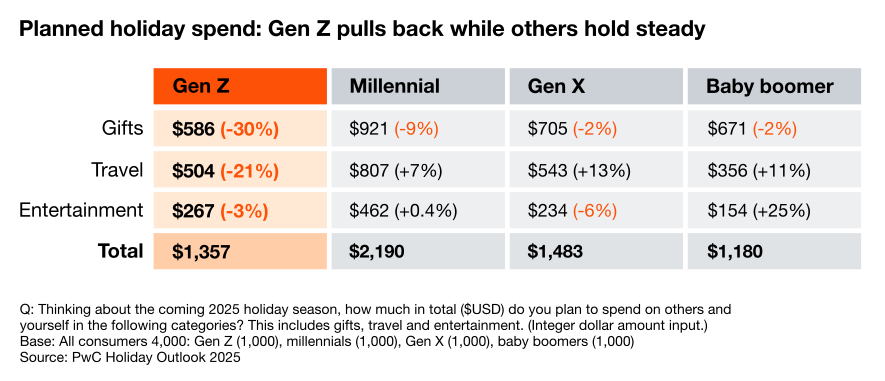
According to PwC’s analysis of nearly a million consumer transactions, Gen Z cut overall spending by 13% between January and April 2025 — particularly in categories like apparel, accessories and electronics. And in PwC’s 2025 Holiday Outlook survey, they reported plans to slash holiday spending by 23% this year, after expecting to boost spend by 37% in 2024. Even so, Gen Z still plans to spend an average of $1,357 this season. Understanding this shift is important, considering that Gen Z’s spending power is expected to grow to $12 trillion by 2030, according to NielsenIQ and GfK in collaboration with World Data Lab projects.
While Gen Z’s pullback may look like a simple case of belt-tightening at first glance, it actually reveals something more complex. It’s a generational shift in how value is defined and where money feels worth spending.
It turns out Gen Z isn’t just price-conscious. They’re value-conscious, with an emphasis on emotional and social value, not just discounts. PwC's five-year view of Gen Z indicates that more than 79% wait for products to go on sale, and only 21% regularly pay full price. Deal hunting is rising — searching for discount codes is up 14%, browsing up 17% — but this is less about frugality than intentionality. Increasingly, as Gen Z also turns to AI tools for help finding deals, whether it’s asking for the “best value-for-money mascara” or more tailored recommendations, their path to purchase could become more algorithmically curated. To stay ahead, retailers need to start thinking about optimizing discoverability within AI-driven environments now.
With all this in mind, the answer to the Gen Z riddle appears to be about offering affordable affluence. This is like the lipstick effect, something that appeared in the aftermath of 9/11 and again in 2008, updated for the social media era. Micro luxuries like a pricey matcha, a resale sneaker drop or cosmetics that double as skincare can telegraph cultural relevance without breaking the bank. But to stay in the “must-buy” category, these items need more than aesthetic appeal. They need to feel smart — endorsed by creators, justified by value transparency and surfaced through algorithmically tailored feeds.
Timing also matters. A trending item can rise and fall within days — and for retailers, converting interest means meeting Gen Z expectations for social-to-shelf speed. The window for “what’s worth it” is short. While this generation is saving for big milestones and managing tight budgets, they still want purchases that spark joy, earn social currency and align with their own sense of identity.
Gen Z isn’t spending less across the board. They’re reallocating — trading down on everyday expenses in order to afford meaningful indulgences.
Gen Z’s selectivity doesn’t stop at products — it extends to brands themselves. This generation isn’t inherently brand loyal. They’re brand agnostic until given a reason to commit. For example, according to PwC’s analysis, more than half of Gen Z (59%) still prefer known brands but nearly half (41%) are willing to buy less expensive, private-label alternatives and 49% want customized products. For the holidays, according to our Holiday Outlook survey, 82% of Gen Z say they plan to purchase less expensive alternatives (commonly known as “dupes”) and 63% plan to shop for vintage or upcycled products. These choices aren't just about saving. They reflect a generation that rewards relevance over recognition and expects brands to keep up.
When asked where they’d cut back over the next six months, Gen Z pointed to restaurants and takeout (51%), clothes (33%), and alcohol (29%). But fewer said they’d trim “high-value” items this year compared to last. What emerges is not across-the-board austerity, but selectivity. They’re willing to trade down — or trade out — on everyday expenses in order to afford meaningful indulgences.
For years, the assumption was that Gen Z would live entirely online. But that assumption is already outdated. PwC’s analysis shows that 61% of Gen Z now prefers to discover new products in-store, a reversal that speaks volumes about what this generation wants: experience.
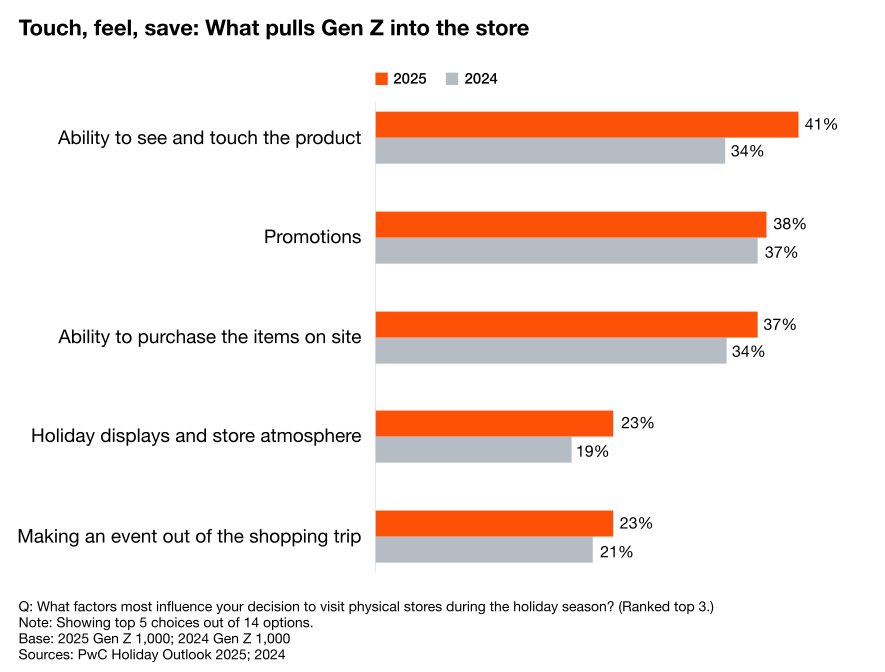
Why? Because shopping has become an event. Our 2025 Holiday Outlook survey shows a 10-point rise in how many Gen Z consumers plan to shop in-store more frequently than usual this holiday season — up from 27% in 2024 to 37% this year. Their preferred reasons are to touch and see products (41%, up from 34% last year), to experience holiday displays and store atmospheres and, yes, to chase promotions.
43% of Gen Z expect to use social media to discover gifts this holiday, compared to 30% overall. They’ll also use it to research (39% vs 27%) and compare items before purchasing (32% vs. 22%).
At the same time, Gen Z’s digital behaviors remain intense, but the path to purchase is no longer linear. They might, for instance, discover a product on social media, price compare in-app and transact in-store. This expectation of instant gratification — from social scroll to in-store shelf — is likely to increasingly shape omnichannel merchandising and inventory strategies.
Buy-now-pay-later (BNPL), which accounts for 1.5% to 2.5% of all transactions, has become another Gen Z paradox. According to LendingTree, 64% have tried it at least once, and BNPL loans surpassed credit card use during peak holiday periods. But beneath convenience lies risk. More than 40% have made a late payment, up seven points from a year earlier. And according to PwC’s Holiday Outlook, 11% say it’s one of their top three preferred payment methods this holiday season, up from 5% in 2024.
The trend may signal a revealing tension: Gen Z’s desire to keep spending, while flirting with fragility. Retailers who offer BNPL may find opportunity, but they also inherit responsibility — to make payment options easy to understand, rather than fueling debt cycles.
There’s no universal decoder ring for Gen Z, but there are patterns in what they choose to buy and in the experiences they gravitate toward. For a generation fluent in self-curation, and sensitive to economic uncertainty, budgeting and discernment are critical filters. To sell something with a premium price tag, it needs a story of sustainability, exclusivity, craftsmanship and social validation. And if something isn’t showing up on social media, in group chats or through influencer drop culture, it may not feel worth the stretch.
Retailers once wary of private labels and dupes can now lean into them, not as fallback options but as creative options. Gen Z doesn’t see “affordable” as generic. They see it as smart. They want curated alternatives that feel personal, not mass-produced. Limited drops, house-brand collabs and design-led value options offer novelty without overextending inventory. The win isn’t in cutting cost alone. It’s in delivering value that feels intentional, not leftover.
But speed is the real unlock. Spotting a trend isn’t enough if you can’t act on it. Relevance now depends on turning consumer signals into shelf decisions quickly and at scale. That takes more than instinct. It takes merchandising models that flex weekly, forecasting that adapts in real time and pricing strategies grounded in what Gen Z actually values: the thrill of a smart find.
Gen Z’s behavior isn’t just a puzzle. It’s a preview. Their emphasis on value, experience and novelty may be the early signal of where consumer psychology is heading. Retailers that study Gen Z aren’t just preparing for one cohort. They’re future-proofing. What Gen Z demands today, other generations may begin expecting tomorrow.
{{item.text}}
{{item.text}}