





The US business landscape is undergoing a business realignment not seen in decades. This magnitude of change is due to a convergence of forces including geopolitical uncertainty, evolving tariff regimes and a renewed emphasis on developing energy sources and domestic manufacturing. This convergence sets the stage for a wave of growth and innovation. Some US manufacturers are seizing the opportunity to reimagine their operations, reshoring some of their production capacity and embedding artificial intelligence (AI) and other technologies to drive new ways of working. Demand for data and compute power are soaring, along with the energy needed to run massive data centers. Meanwhile, federal and state incentives and new financing sources are emerging to provide the capital companies need to build new facilities and revamp their operating models.
Plotting long-term strategy amid such change can be tough. This is your inflection point, with opportunities if you plan holistically and think through the issues in a coherent way — and risks for those without a connected approach. It’s also about the longer-term. Getting through the current disruption is critical, but you also need to look down the road and build agility into your strategy so you can handle any other turbulence that may come. Getting the first step right is critical.
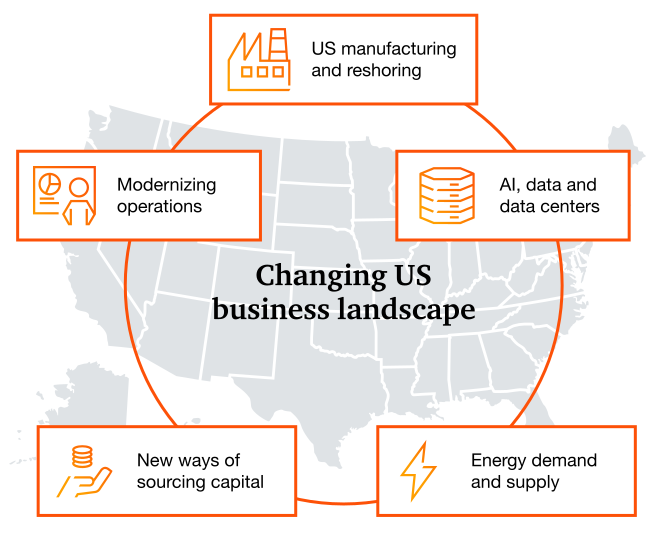
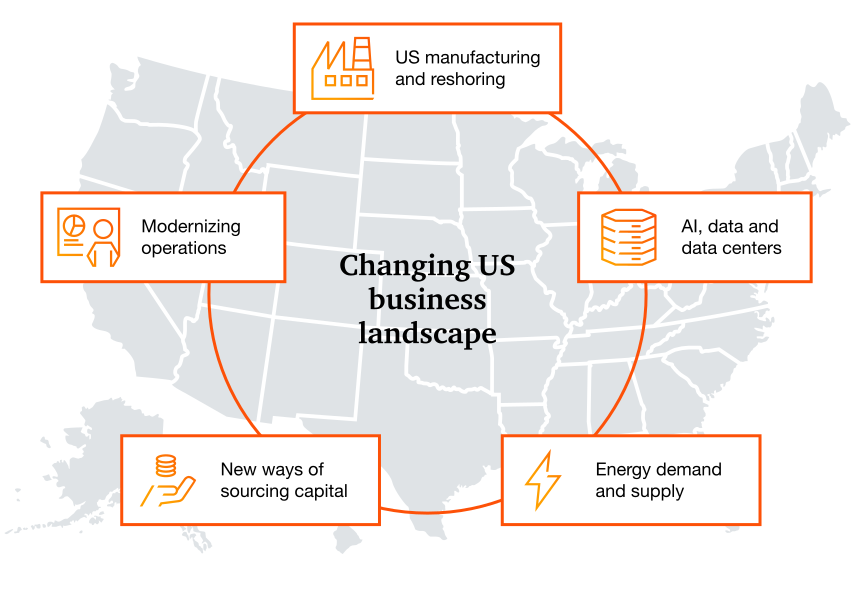
To make sense of this environment, you should consider five strategic pillars.
AI, data and data centers
AI and cloud were already accelerating demand for data. High-performance computing capabilities — once the exclusive realm of early adopters like institutional investors doing high-frequency trading — are now expanding more broadly to healthcare, supply chain, finance and insurance. Reshoring and the forecasted growth in domestic production will only add to the data demand boom.
As a result, data centers are starting to go up across the country, and not just in select tier one markets. Cumulative capital spending on related infrastructure could be as much as $2.35 trillion by 2030, according to the Center for Strategic and International Studies — underscoring the scale of growth and investment ahead. These projects bring together ecosystems that promote economic development: hyperscalers that provide AI and cloud-based services to enterprise customers, utilities and energy providers, real estate firms, finance players and infrastructure providers. Data centers also hold massive potential to create new jobs and local tax revenue from direct employment and from related jobs (such as at stores, schools and housing) in the communities where they’re based.
Data centers require a rigorous site-selection process, with a focus on reliable and high-capacity power, network connectivity and water. Some companies are building their own energy supply alongside the data center. This can help remove grid risks and lower exposure to a wide-scale outage. You’ll need to size the market and model demand to determine the right location and capacity. Your capitalization pathway is just as important. How will you finance the project? How should the legal entity be structured? What are the tax implications for each option? How will you support the extensive supply chain network to keep the facility up and running in peak condition?

Building smarter: power and performance in one move
A private equity-owned data center developer needed more than capacity — it needed more control. We helped it pivot into energy, designing a co-located power plant to support the data center itself. The company conducted market studies to identify where power constraints made this model most viable. Then we helped shape a new organization focused on providing energy exclusively to the data center company.
Our tax team quantified the economic contribution to GDP and local taxes, capturing both direct, indirect and induced jobs. Our sustainability specialists modeled the project’s carbon impact to help meet the parent company’s sustainability goals. Now we’re helping bring both projects — the data center and the power generation facility — online. From business case to permitting to construction scheduling to operational risk management. Plan, build, operate. End to end.
US manufacturing and reshoring
After decades of manufacturing offshoring to lower-cost countries, US manufacturers are considering making the strategic decision to reshore operations — to gain greater control over production, mitigate geopolitical risk and uncertainty, reduce exposure to tariffs, enhance supply chain resilience and build speed to market. But reshoring is a big decision that’s part of a longer-term strategy. One hurdle? Many large manufacturers haven’t opened a US plant in decades, if ever. Making the decision to do so demands critical analysis and a thorough understanding of cost structures, supply chain agility, market dynamics, new US tax incentives for domestic production and other federal and state policies, geopolitical risk factors — the list goes on — looking at the present and into the future. Scenario analysis should anticipate diverse geopolitical, economic and supply chain dynamics as the global economy shifts toward a more multipolar structure with power, trade and innovation increasingly dispersed across regions.
Market and financial analysis is the first step. You should understand the potential market size and whether you can increase your share of the US customer base through better service or other factors. You should also build a business case that models out the potential ramifications of this shift and considers the flexibility of your operating model to support the business.
Once the case for reshoring is clear, the next step is site selection. This is critical. You’ll need access to labor, infrastructure and energy, everything from electricity, water, natural gas, fiber-optic lines and power supply. That’s just the baseline. You should also consider access to raw materials in the upstream supply chain and distribution to customers downstream. On top of all that, you should negotiate for the maximum possible incentives with a clear understanding of how they will impact the economics. Some financial incentives are federal — such as tariffs and tax incentives for domestic production. Others vary by state and even county. Global tax implications vary too. That’s why the smartest site selections consider everything together — not in isolation. They also require accurate data, which itself can be difficult to source. The result? A strategic model and business plan based on accurate data, designed for the CEO, senior leadership team and the board.
Once ground is broken, timing and coordination become everything. Managing the construction process, developing plans to mitigate delivery risks across vendors and staying ahead of delays are critical.
Powering growth, starting with site strategy
Energy demand and supply
US energy demand is projected to increase between 15% and 20% by 2030 due to data centers and electrification. Data centers alone could double their energy use, accounting for up to 9% of consumption. Reshored manufacturing will add another layer.
The challenge is infrastructure. The US energy grid is aging. It needs major upgrades to remain resilient and to protect against more frequent and intense weather-related events. Investments to upgrade the grid are currently falling short — raising the odds of future outages.
These trends require new approaches to power generation and delivery. We’re seeing innovation in both areas. Utilities and energy providers are investing to increase power supply as well as to squeeze more capacity out of the existing energy system. This once-in-a-generation demand growth will require multiple technologies, particularly leveraging the US abundance of natural gas. Innovations in gas delivery already contribute to our near-term needs. In the medium term, utilities and energy providers are looking at innovations like small modular reactors (SMRs), nuclear plant designs that can be faster to build and get online. Renewables still have a role in the energy mix, but shifting incentives are changing the economics of those projects. On the horizon are bigger innovations such as fusion that could upend traditional generation models. Regarding delivery, notable innovations include self-healing grids, stability monitoring and other factors intended to shore up resilience.
Some enterprise customers are exploring distributed generation or micro-grid options to meet their own needs. And, as noted above, some are building their own power-generation facilities to sidestep interconnection delays, aging infrastructure and complex permitting processes.
These innovations in energy generation and delivery can help close the gap in the long term. In the short term, the challenge is clear. Secure reliable (and affordable) power, when and where you need it.

The challenges of nuclear construction
Nuclear construction programs are highly complex, requiring advanced engineering, cutting-edge technology and strict adherence to safety and environmental standards over decades-long timelines. These projects operate under both domestic and international regulatory scrutiny that demands precise compliance and extensive documentation. At the same time, the scale of infrastructure and the need for specialized materials and highly skilled labor can often lead to cost overruns and schedule delays.
A US utility set out to build two nuclear reactors, the first in the country in more than 30 years. With cost pressures, schedule uncertainty and close scrutiny from regulators and co-owners, the company wanted to increase transparency into the contractor and subcontractors’ construction performance. The company also wanted to shift to a more proactive, data-driven model from a reactive oversight-focused approach. We provided hands-on execution and advisory support across a range of services including schedule and risk management, performance analysis and quantitative risk analysis.
New ways of sourcing capital
Big projects need big capital, and traditional financing routes aren’t always enough. New data centers, grid upgrades and reshored facilities all require significant investment. Capital rules and changing regulations can make traditional sources like bank lending harder to secure. IPO markets are starting to open, but only for companies with solid track records of strong financial performance.
Because of these constraints, nontraditional sources of capital have started to emerge. Private capital and private credit are stepping in. These investors can have massive amounts of dry powder that they need to put to work. They’re willing to finance capital projects using debt, equity or a combination of both.
Next-gen securitization is an increasingly available option as well, when companies securitize a component of their business to raise capital. Data centers or fiber-optic companies, for example, can sell streams of future cash flows allowing them to accelerate access to capital to scale faster and fund capital projects. This can mean faster builds and shorter timelines — and a chance to capture market share ahead of the competition.
In a capital-constrained environment, speed is an advantage. The companies that move first to lock in market share or get a new factory up and running to reduce tariff implications can gain an edge. For companies in fast-growing sectors, that edge can make a big difference in determining who wins and who loses in this market.
It’s also important to factor in any federal and state incentives when structuring financing, as they can help reduce costs and improve the economics of the project.
Modernizing operations
Reshoring is an opportunity to rethink all of your operations. The right investment in AI and digitization can mean far more efficient, innovative and productive facilities. That can mean lower labor costs, better quality, more transparency along the supply chain and faster distribution to customers. Greater agility end to end.
This doesn't mean thinking about one single plant. It’s about the full value chain — upstream inputs, downstream delivery and all the links in between. It requires a cohesive, wide-lens approach. Anticipating shortages in key inputs and taking steps to reroute supplies from redundant sources can help reduce stockouts. Faster service to end customers can increase revenue. Predictive maintenance solutions for plant equipment can reduce downtime. When you zoom out and look at the whole picture, the ROI on your capex investments grows.
The top operations are ready for the future. With adaptive designs, companies can upgrade over time to incorporate new technology and innovation as it emerges. This builds in flexibility for whatever technology comes next. AI and digital twins can help model changes to a plant footprint, shifts in product flows within a facility or how a climate-related disruption would impact inventory. It’s a smarter way to design for agility and build a stronger foundation for long-term growth.
Three cross-cutting elements: talent, sustainability and cybersecurity
Alongside the five strategic pillars, three foundational forces, talent, sustainability and cybersecurity, play a critical role in the coming period of growth and innovation.
Connecting all the dots
The convergence of AI demand, reshoring, energy needs, modernized operations and new capital models marks a strategic turning point. You and your executive team should understand how these issues influence one another. Each decision about where to build, how to power your operations or how to fund new projects are linked. Treating them in isolation risks missing critical interdependencies.
Innovation runs through it all. Breakthroughs in AI, cloud and energy technologies are creating new demand while also enabling greater efficiencies. Innovation is both the engine of expansion and key to managing its complexity.
Companies that can plan holistically and adapt repeatedly over time can be better positioned to capture opportunities. Those that don’t risk falling behind.
America in motion: Discover how companies can power growth and innovation


