





Amazon Q Developer fuels enterprise modernization
Modernizing legacy systems is crucial for business success. Yet as organizations strive for cloud-native status they often encounter a complex challenge: technical debt. Outdated code, obsolete libraries and inefficient development practices choke agility, limit flexibility and stall progress.
Amazon Q Developer directly addresses this challenge. The generative AI assistant fuels modernization — and broader digital transformation efforts. It helps organizations build, migrate, and maintain software by directly connecting to an integrated development environment (IDE). Amazon Q provides code completions, contextual recommendations, and real-time guidance within a developer’s normal workflow.
We recently piloted Amazon Q Developer with a financial services client to accelerate modernization of .NET and Python applications, uncovering compelling technical and financial outcomes.
The case for Amazon Q
Amazon Q is more than a productivity tool; it’s a state-of-the-art modernization engine. The platform delivers three core capabilities:
Smarter coding through AI assistance. Amazon Q Developer is adept at real-time code completion. It provides line and full function recommendations through commonly used IDEs like Visual Studio Code. Amazon Q Developer’s ability to analyze code and software patterns translates directly into higher quality output. For example, Q Developer Transform (now AWS Transform) helped refactor legacy .NET 4 services to .NET 8 by identifying deprecated APIs and suggesting cross-platform implementations, reducing the need for OS-specific dependencies. In other words, developers work faster but also better.
Enterprise-grade language support. It’s one thing for a generative AI tool to accommodate Python and JavaScript, but Amazon Q Developer handles a broader array of languages, including Java and .NET. This allows organizations to move faster and scale development efforts — including refactoring, updating, and extending critical systems across a broad range of use cases.
Seamless IDE integration. Because Amazon Q integrates tightly with AWS IDEs (VS Code, Visual Studio, IntelliJ IDEA, Eclipse, and Command Line Interface), developers can access its features directly within their work environment. As a result, developers save time and improve code accuracy because they don’t have to constantly switch between tools, tabs and documents. Features like intelligent autocomplete, inline refactoring suggestions through specialized Amazon Q agents and live feedback simplify tasks while generating consistent output. It’s also possible to onboard teams faster. New developers can quickly get up to speed with new codebases or APIs all within an IDE without any previous documentation available.
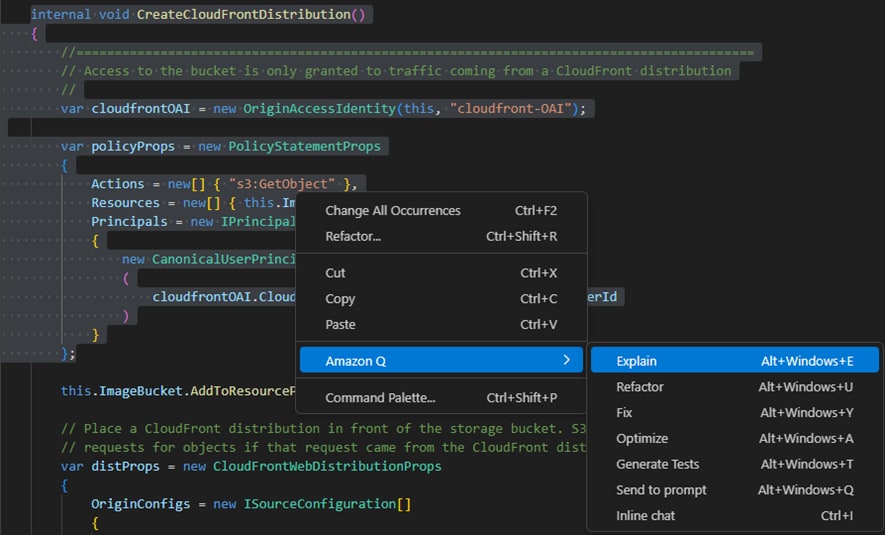
(Leveraging the explain Amazon Q agent to generate understanding of AWS sample code)
In our pilot, Amazon Q Developer reduced time spent on documentation tasks, such as code comprehension and README file generation, by over 50% on average. Additional efficiency gains came from inline assistance during Python Lambda runtime upgrades, which shortened each upgrade task by approximately 10 minutes. Applied across 1,000+ functions, this translated into hundreds of developer hours saved and thousands of dollars in labor cost reductions, freeing teams to focus on higher-impact engineering work.

(Amazon Q Chat interface generating unit tests)
Amazon Q equals financial and operational value
It isn’t unusual for organizations to face out-of-control development costs — fueled by a constant need to train developers or bring in contractors. The result? Bloated budgets and stalled modernization efforts. Amazon Q Developer changes the equation in three key ways:
Lower costs, higher output. With institutional knowledge and a code transformation strategy that’s built directly into the IDE and functions across teams, there’s less dependency on external resources and outside support. What’s more, Amazon Q simplifies and speeds the transition to new projects. In our pilot, Amazon Q accelerated project ramp-up and refactoring efforts, yielding a 37% reduction in development hours, from 600 to 378, for a single test application. A detailed cost analysis showed that saving just 10 minutes of developer time per month offsets the cost of an Amazon Q Developer license, underscoring its strong return on investment.
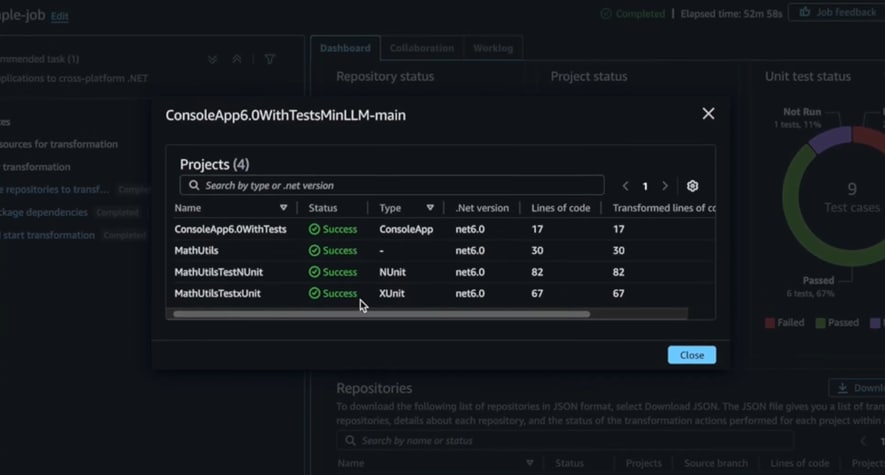
(AWS Transform: screenshot from AWS Transform in process of upgrading .NET code)
Faster developer throughput. Amazon Q allows organizations to travel the shortest route between objectives and actual code development. Teams using Amazon Q typically report 20-40% or greater gains in the time spent developing specific features. This advance is possible because Amazon Q offers faster prototyping, automated boilerplate generation and smart debugging. Through our testing, developers reduced bug fix cycle times by approximately 40%, thanks to Amazon Q’s autogenerated unit tests and clearer error resolutions.
Accelerated modernization cycles. Legacy systems are notoriously difficult to modernize. Projects can take months, or even years to complete. With Amazon Q, (recently rebranded to AWS Transform) it’s possible to compress cycles and supercharge output. Developers can make sense of old code, map refactoring tasks to modern frameworks such as .NET 8 or Spring Boot and generate infrastructure-as-code templates with nearly zero manual involvement.
Putting Amazon Q into motion
Powerful technology cannot do the job alone. It’s important to have a strategy in place before deploying Amazon Q Developer. Success hinges on three core factors:
A phased rollout. A leading practice approach begins with pilot teams that focus on high-impact applications and tasks. These early adopters collect feedback, close process gaps and track time savings. This fine-tuning process illuminates a path to organization-wide scaling. An added benefit: it can identify adoption and training strategies that benefit other groups.
A focus on change management. A successful modernization strategy requires a shift in the way teams work. Critical elements at this stage of the modernization effort include onboarding sessions that illustrate Amazon Q’s advantages, documented success stories backed by metrics, internal champions who can promote and showcase success stories, and a team that analyzes metrics, including usage patterns, code adoption velocity, resolutions time, and overall return on investment (ROI).
Understanding the use case. Before deploying Amazon Q, it’s important to take time to understand how different development teams can interact with it. Usage patterns, team structures and project goals vary greatly. One approach — single-account enablement — delivers a centralized tooling framework that typically leads to simplified governance, auditing and cost controls — but with limited flexibility. On the other hand, a multi-account or sandboxed deployment dials up flexibility and provides greater code and project isolation — but often at a higher cost. Not surprisingly, many organizations opt for a hybrid model that addresses the needs of a particular DevOps team.
How Amazon Q boosts development IQ
Amazon Q Developer delivers real-world efficiency where it matters most. For example, it’s up to the task of rapidly modernizing .NET Framework applications to .NET 6 or 8 with AWS Transform. Amazon Q Developer can suggest migration paths, flag depreciated APIs, and refactor code snippets automatically. The result? What once took weeks or months of manual effort occurs in hours or a few days. Developers can focus on more innovation and other strategic tasks.
Another of Amazon Q's strengths is its ability to simplify basic software tasks — and stamp out bugs and other problems that frequently appear. Amazon Q Developer generates clean and consistent code for RESTful APIs and Lamda functions; produces infrastructure-as-code templates that developers can build on for mapping and converting languages; and it manages permissions that may be used for identity access management (IAM) and policy enforcement.
Finally, organizations can auto-generate documentation from existing codebases and view unfamiliar code segments in plain language. These features aid veteran developers but they’re also valuable for new team members who should get up-to-speed quickly. For example, a developer can ask: “What does this function do?” and instantly receive a clear, concise explanation.
Elevate development to a new level
Amazon Q Developer rewrites the rules of enterprise software development. Organizations that adopt the platform empower developers by speeding coding and debugging, improving code quality and accelerating time-to-market. Amazon Q unlocks enterprise modernization and serves as a catalyst for business transformation. Development teams work faster, code smarter and, in the end, produce measurably better applications.


