
















{{item.videoDuration}}
{{item.title}}
{{item.text}}

{{item.videoDuration}}
{{item.text}}
Exceptional boards don’t happen by accident. They’re driven by leaders — board chairs, lead directors and committee chairs — who combine strategic foresight, emotional intelligence and an unrelenting commitment to the organization’s long-term health. These leaders unite directors into a high-impact team, work towards a shared vision, challenge and coach the CEO in equal measure, refresh talent relentlessly and stay unflappable when crises hit. When leadership falters — signaled by groupthink, a poor relationship with the CEO or underperforming directors — they act fast: commissioning frank evaluations, rotating roles, clarifying responsibilities and, if needed, making a change. Outstanding board leaders treat governance as a living system, adapting structures and processes to match strategy and turning oversight into an engine for value creation. By embracing these principles, board leaders can move from “good enough” to game-changing, steering their companies into the future with confidence and purpose.
A company’s health and success rely on the effectiveness of the CEO as a leader and manager as well as the effectiveness and independence of board leadership. Given the average tenure of CEOs is relatively short, it is in fact the board of directors as the governing body that is ultimately responsible for the long-term health of the organization. Considering the many disruptive challenges companies face, the board’s role is more demanding than ever. Charged with setting direction, overseeing risk, aligning incentives and holding management accountable, boards must balance short-term performance with long-term goals — adapting to evolving market conditions and stakeholder expectations along the way.
In this context, effective leaders cultivate a board and board culture with distinct attributes, practices and responsibilities.
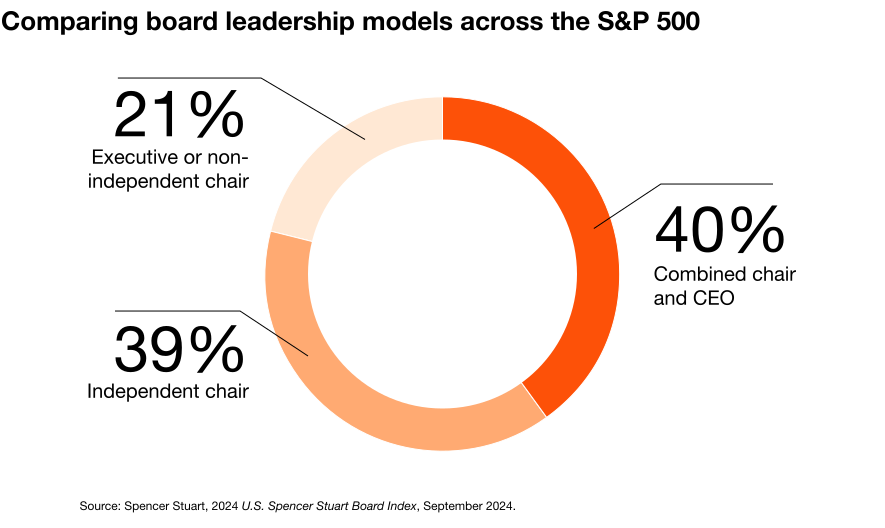
There are several different leadership models that boards may choose to employ. Whether authority is combined in a single chair/CEO role, separated through a non-executive or independent chair, or balanced via a lead director, the board leader must prioritize governance and the board’s fiduciary responsibilities, even when balancing executive responsibilities.
Unlike a C-suite executive, a board chair or lead director guides a team of peers without traditional hierarchical structure, steering the board toward shared goals through influence and collaboration. Elected by fellow directors and accountable to both shareholders and stakeholders, he or she must inspire trust, foster engagement and navigate complex group dynamics in the boardroom and with the management team. Success requires sound judgment, emotional intelligence and the ability to lead candid, constructive dialogue while supporting management and safeguarding the board’s independence and effectiveness. It also requires dedicating significantly more time compared to other directors. He or she must maintain flexibility in scheduling and personal responsibilities to proactively keep in touch with the board and to effectively respond to unpredictable events or crises.
Combining the roles of chair and CEO places significant demands on the individual, who must stay conscious of wearing two distinct hats — sometimes simultaneously — and be clear about which role is being exercised at any given moment. In this context, the lead director must remain vigilant and unambiguous, ready to step in and fulfill many of the leadership functions described here.
In our experience, eight attributes define outstanding board leadership.
Leader of leaders - Demonstrates strong personal leadership and the ability to cultivate collective leadership
Strategic vision and focus - Prioritizes strategic clarity and future orientation
Proactive engagement and alignment with the CEO - Communicates openly with the CEO, balancing support and challenge to enhance impact and foster the CEO’s development as a leader
Culture of trust and collaboration - Builds a learning mindset characterized by openness and mutual respect
Pragmatic and responsive - Establishes situationally relevant agendas, enables constructive dialogue and mediates conflict
Fosters a high-performing team - Shapes the board’s talent, structure, practices and succession planning to amplify performance
Stakeholder awareness - Champions strong stakeholder engagement as a shared responsibility of both board and management
Cool in a crisis - Guides the board confidently through uncertainty
Whether serving as board chair, lead director or even committee chair, these attributes are essential to fulfilling the responsibilities of the role with distinction.
Mayree Clark
Board Leader
Faculty, Stanford Leading-Edge Stewardship
Linda Riefler
Board Leader
Faculty, Stanford Leading-Edge Stewardship
{{item.text}}
{{item.text}}