





{{item.videoDuration}}
{{item.title}}
{{item.text}}

{{item.videoDuration}}
{{item.text}}
Performance management is broken. While HR teams and leaders often think their programs work well, many employees don’t. According to PwC’s Workforce Radar study, 97% of HR leaders believe their organizations effectively grow and develop talent, but only 50% of business leaders and 30% of employees agree.
This disconnect exists because each person experiences performance management differently. Employees see a box-checking exercise. HR views it as a development tool. Business leaders use it to manage pay and accountability. The result? Confusing signals, lost trust, and stalled growth in the very capabilities organizations need to compete.
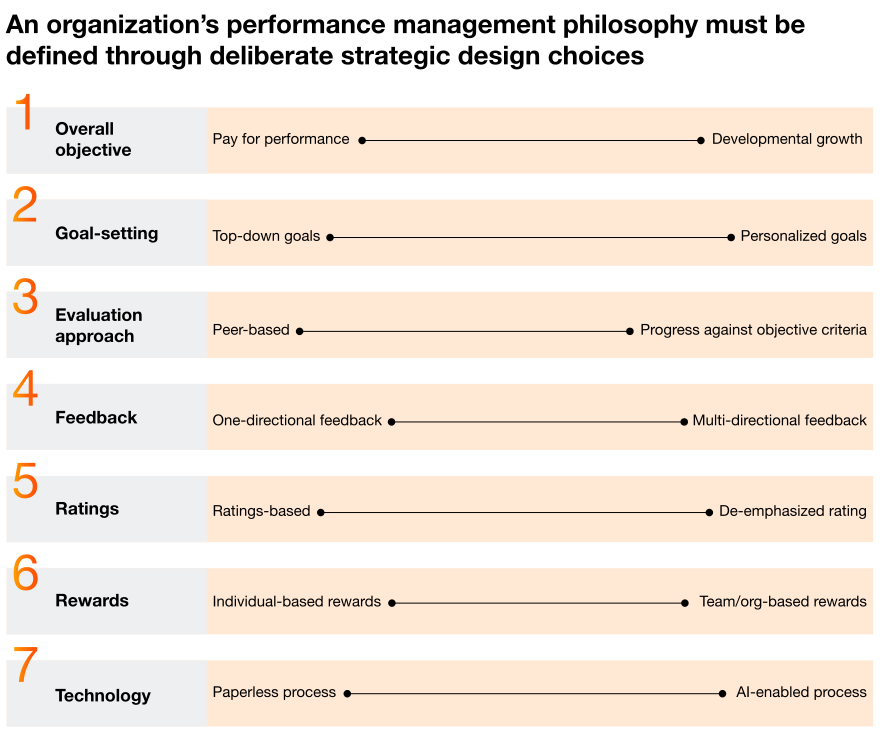
To close the gap, organizations should make seven clear choices that align purpose, process, and experience—turning performance management into something that truly drives value for both people and the business.
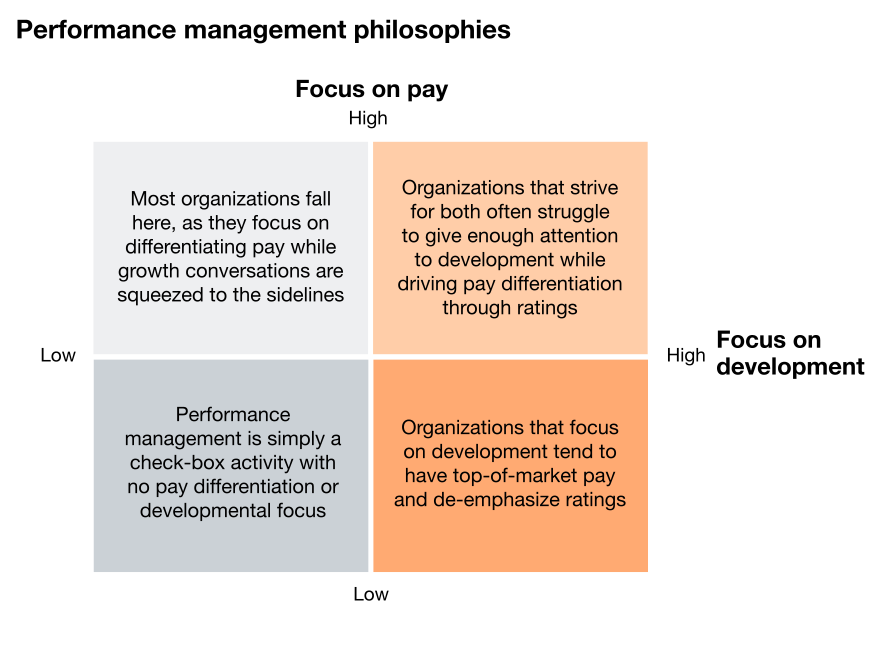
Start by asking yourself, “Why do we do performance management, and should we keep doing it the same way?” Being clear about purpose matters because every choice comes with trade-offs. For many, performance management exists mainly to determine bonuses and reduce legal risk by documenting performance. Others want it to be a tool for development and feedback. Some succeed in striking that balance, but many don’t.
Too often, organizations tell employees that performance management is about growth and career advancement, yet the process tells a different story. The biggest event—the year-end review—tends to focus almost entirely on compensation decisions, leaving little room for meaningful conversations about development or future potential.
This tension sits at the heart of the problem. When performance management tries to serve both development and pay-for-performance, one almost always overshadows the other. The moment pay and risk dominate the discussion, honesty fades, ratings become political, and genuine coaching gets pushed to the sidelines.
A better approach is to view performance management as one part of a broader talent ecosystem—a process that, when designed with purpose, can help people grow and fuel the organization’s success.
There’s no one right answer for a company’s performance management objective. Many successful companies sit on either side of the philosophical spectrum, and neither is better than the other. For instance, a financial institution may run its process based on a classic pay-for-performance structure, while a tech firm de-emphasizes ratings to focus on growth.
What you should do: Align every performance management message, metric, ritual, and technology to the fundamental design choice of the performance management objective.
Performance depends on the goals that guide it, and goal setting itself is a critical design choice. Should goals flow top-down for clarity or bottom-up for ownership? When objectives come directly from the C-suite, employees gain a clear line of sight to the strategy, but they can also feel like they’re simply carrying out orders.
On the other hand, when employees help shape or update their own goals, engagement rises. In fact, 60% of employees who can’t revise their goals say they want that flexibility, pointing to shifting priorities as the reason.
The right balance combines both: Leadership sets direction, and employees help define how to get there—creating alignment, accountability, and shared commitment to results.
What you should do: Develop cross-silo, co-authored goals to hit the sweet spot of aligning to strategy and unlocking collaboration dividends.
How you measure performance helps shape culture. Some organizations rely on relative, peer-based evaluations that stack employees against one another, often within a forced ranking. This makes it easier to calibrate bonuses and maintain a tight pay hierarchy. It also provides clarity on “who’s best” when rewards or promotion slots are limited. But it can intensify competition and weaken collaboration, causing motivation to learn and improve to fade.
Others take an absolute, progress-based approach, assessing employees against clear role expectations or their own past performance. This fosters autonomy, learning, and a growth mindset. Employees see that improving on yesterday’s results matters more than outperforming peers. Yet it requires careful goal-setting and strong evidence of progress, and it can frustrate rewards teams that need clearer differentiation when budgets are constrained.
The choice between these models isn’t just about fairness or simplicity. It’s about the kind of performance culture your company wants to build.
Companies typically use one or a combination of these criteria to determine promotion decisions.
| Tenure | A basic eligibility gate that is often used as a threshold, but depending on the nature of work, not necessarily a guarantee for advancement. |
| Readiness | Sufficient evidence (e.g., skills, leadership behaviors, stretch assignments) that the employee can thrive at the next career level. |
| Individual performance | The employee’s track record such as goals, feedback, and ratings. |
| Workforce planning | Company-wide profit and turnover often determine the slots available at each career level, meaning there may not be enough roles to promote all who are eligible or vice versa. |
What you should do: Decide first which reference point best serves the overall performance management objective—differentiating pay, fueling development, or both—and then build around that choice.
Feedback is where the performance story can either come to life or fall apart. Our Workforce Radar study found a 30-point gap between leaders who believe their organization develops talent effectively (92%) and employees who agree (62%). That’s because most feedback systems miss the mark.
The first decision is simple. What kind of feedback do you really want to drive? Some rely on structured, quarterly-based check-ins—formal reviews with ratings and rankings that anchor compensation and performance decisions. Others lean on informal, development-driven coaching, favoring frequent, forward-looking conversations focused on growth. A growing number take a hybrid approach—“clarify and grow”—that blends structured quarterly touchpoints with ongoing, informal feedback.
The trend is clear: Feedback is moving from “once a year” to “always on.” Employees who have quarterly progress reviews report significantly higher engagement, yet more than half still wait a full year for formal discussions.
How feedback is gathered also matters. Multi-source feedback—drawing on input from peers, customers, and project data—reduces bias and provides a richer picture of performance. By contrast, single-source reviews, typically based only on a manager’s view, still account for two-thirds of evaluations.
Finally, feedback shouldn’t stop at the individual level. Team reflections—group debriefs on project outcomes or client wins—help uncover systemic barriers and celebrate shared success. These can not only boost team productivity but also strengthen the culture of collective accountability and learning.
What you should do: Decide whether feedback exists to judge or coach. Annual ratings serve pay and risk needs, but quarterly, multi-source coaching sparks higher engagement.
Few topics spark more debate in performance management than ratings. Most organizations still use them to allocate bonuses, identify successors, and track high-potential talent. Others have moved away from ratings, arguing that reducing performance to a single number stifles development and collaboration.
But removing ratings doesn’t make performance judgments disappear—it just moves them behind closed doors. Without clear criteria, managers can spend hours in hidden calibration meetings, recreating informal “shadow ratings” to make pay and promotion decisions. Still, some organizations have learned to make these calibration sessions work—using them to facilitate transparent discussions about who delivers the most impact and why.
For those that keep ratings, the challenge is to make them meaningful. Ratings should guide clear, evidence-based talent decisions while still leaving space for honest dialogue about growth and development.
Ratings best practices
| Declare a definitive purpose | State openly that the rating exists to inform pay, risk, and talent decisions. |
| Clearly define the scale | Clear, behavior-anchored definitions tighten consistency, speed calibration, and help limit challenges to pay-equity decisions. |
| Run evidence-based calibration | Require managers to bring specific goal evidence. Use bias-check prompts—standard questions that require evidence and surface common biases—and time-box the calibration debate with a fixed window per person so calibration stays fair, focused, and consistent. |
| Ensure frequent, structured check-ins | Coaching and developmental feedback help employees understand where their performance stands throughout the year. |
What you should do: Use behavior-anchored ratings for comparability and de-emphasize ratings when talent reviews are transparent. The muddled middle fails both aims.
Fair pay remains the ultimate benchmark of trust. In PwC’s 2024 Workforce Hopes & Fears survey, 82% of workers said being fairly paid for performance is extremely important, but fewer than 60% believe their employer delivers on that promise. That perception gap shapes how employees feel about their work, their leaders, and their future with the organization.
When it comes to rewards, organizations face three key design decisions.
What you should do: Make rewards simple, transparent, and balanced. Decide up front whether bonuses matter and split payouts visibly across company, team, and individuals.
Technology sits at the heart of modern performance management, and AI provides another layer of opportunity—but only when the foundation is ready. With a connected, trusted tech stack, AI can help predict skill gaps and prompt real-time coaching. Without it, AI simply adds noise.
The real power of technology comes from linking performance and skills data across HR, compensation, learning, and workforce planning systems. One user experience, one source of truth. This integration makes performance management more effective and connects it to the broader talent ecosystem. Once that foundation is in place, advanced analytics, AI agents, and consumer-grade mobile experiences can elevate the employee experience across other processes like talent acquisition and leadership development.
If your organization already runs a cloud-based human capital management platform, you likely have the foundation needed to layer AI effectively. These systems centralize people data and connect recruitment, onboarding, learning, and performance management. Many also include skills libraries, job architectures, and other features that enable a more dynamic and data-driven approach to managing performance.
With AI, the goal isn’t to replace human judgment but to enhance it. Use AI to summarize feedback, flag skill gaps, and suggest coaching actions while managers make the final call. Generative tools can capture coaching conversations, predictive analytics can identify stalled development plans, and recommendation engines can link feedback themes to learning paths. Just as with dashboards, AI should provide real-time insight that fuels transparent, human-led conversations and actionable next steps.
What you should do: Integrate a single, trusted tech core first—linking performance, skills, pay, and learning—then let AI act as a copilot that surfaces insights and prompts action.
Performance management is only one gear in an organization’s broader talent engine, but aligning its seven design choices—objective, goals, evaluation, feedback, ratings, rewards, and technology—turns that gear into a catalyst for growth. Take these actions to close the gap between HR, business leaders, and employees.
{{item.text}}
{{item.text}}


