






{{item.videoDuration}}
{{item.title}}
{{item.text}}

{{item.videoDuration}}
{{item.text}}
Businesses, industries and the economy as a whole run in cycles. Today, those cycles are increasingly shaped by rapid advances in technology and artificial intelligence, inflationary pressures, shifting tariff and regulatory policy, and geopolitical tensions. A company can quickly find itself susceptible to financial distress as these forces ripple through supply chains, capital markets and consumer behavior.
Different circumstances can send industries into downturns. In recent years, pandemic-driven demand swings and supply-chain issues led to shortages, then excess capacity, impacting automotive, retail and manufacturing sectors. Past interest rate hikes raised capital costs and exposed weak balance sheets across all high leverage and capital-intensive sectors such as commercial real estate, hospitality and leisure, and homebuilding. Recently, inflation and tariff implications have affected consumer products, restaurants, and most other sectors, as companies respond to changes in input costs, labor expenses, and shifting consumer buying patterns.
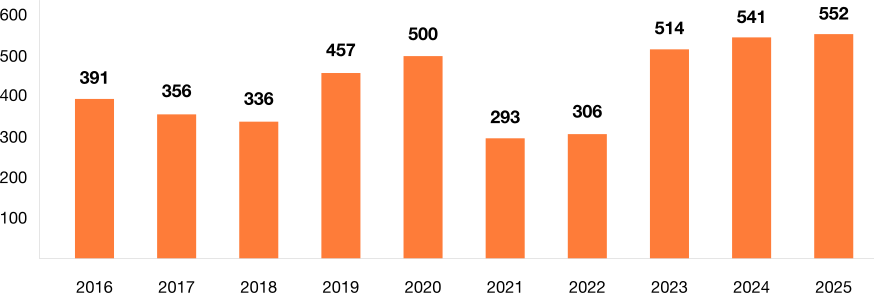
Bankruptcy filings increased for the fourth year in a row in 2025.
Source: © 2026 Octus Intelligence
Directors need to recognize that every company could at some point face financial losses, or even total insolvency. Directors and management must be prepared to deal with rapidly changing circumstances that could cause such distress.
Spotting the signs can be difficult for directors, especially since they aren’t managing the day-to-day operations at the company. Unless there are obvious fires to put out, executives may not want to admit to their board—or to themselves—that their company soon could be struggling.
What can boards do if an individual company—or the entire industry—is just beginning to experience signs of distress? Explore our guide below to find out.
{{item.text}}
{{item.text}}


