






{{item.videoDuration}}
{{item.title}}
{{item.text}}

{{item.videoDuration}}
{{item.text}}
Treasury teams are responding to heightened demands for cash visibility, cost efficiency and risk management by deepening their integration with business units and enabling faster, more informed decisions. Top-performing organizations are adopting in-house banks, real-time liquidity tools, AI-enhanced forecasting and centralized payment models to drive working capital efficiency and unlock trapped cash. As a result, treasury is increasingly recognized as a key enabler of resilience and agility.
The macroeconomic environment — including tariff policy changes, inflationary pressures and foreign exchange (FX) volatility — is accelerating the need for sophisticated cash and risk management frameworks. Treasurers are elevating their role by investing in scenario modeling, expanding their exposure visibility across global operations.
Technology and operating model shifts are at the heart of this transformation. While most organizations now have a treasury management system (TMS), few fully realize its potential. Those investing in modular ecosystems enabled by application programming interfaces (APIs) and managed services models are creating the flexibility required to scale, optimize and protect value in uncertain times.
The treasury function of the future will be defined not only by operational control but also by its ability to shape financial strategy and proactively steer the organization through uncertainty. Treasurers who embed digital capabilities, strategic risk management and cross-functional collaboration will lead the way and cement their shift from transactional custodian to strategic value architect.
Source: 2025 Global Treasury Survey
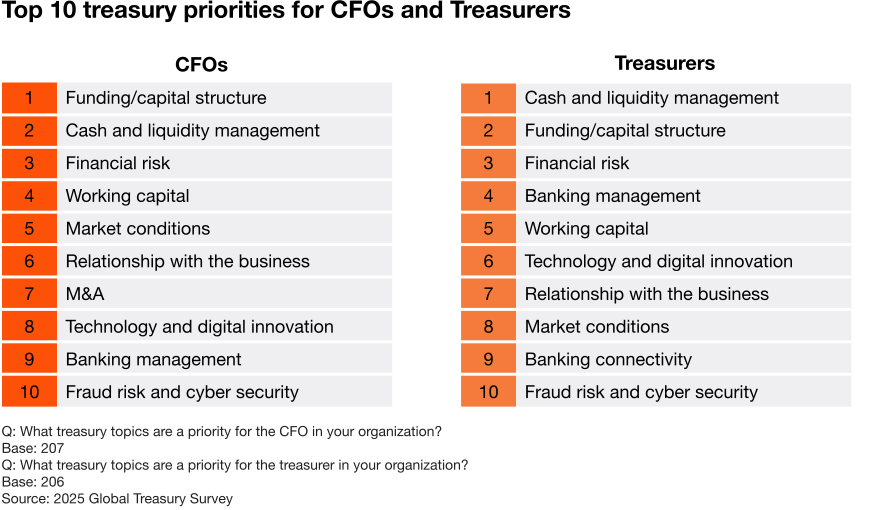
Amid rising costs, interest rate fluctuations and macroeconomic volatility, treasury's mandate to enhance cash efficiency has never been more critical. Both CFOs and treasurers ranked cash and liquidity management as a top priority, but the challenge remains clear: optimizing banking structures, cash management capabilities and forecasting processes is a constantly evolving imperative to set up treasury for success.
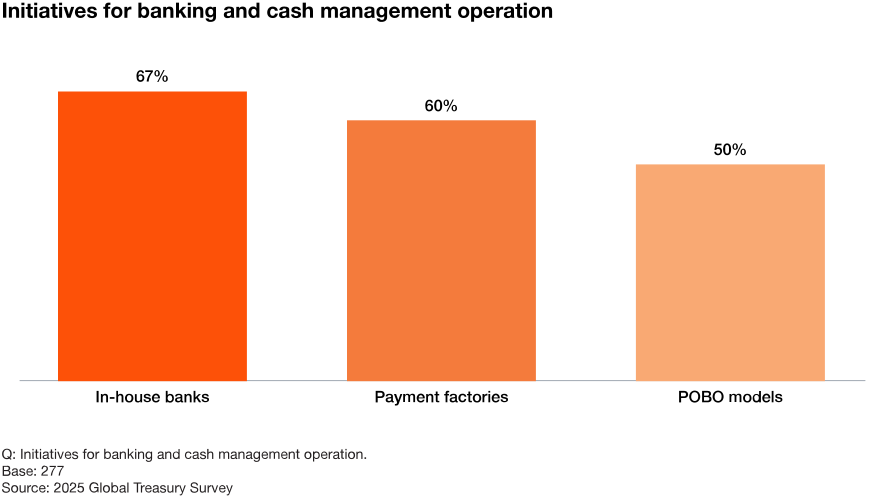
Treasury teams of large organizations — more than $10 billion in annual revenues — are investing in in-house banks (67% adoption), payment factories (60%) and payments on behalf of (POBO) models (50%) to consolidate flows, improve control and reduce costs. Additional initiatives such as virtual accounts, real-time payments and receipts on behalf of (ROBO) are also on the rise, enabling better alignment between cash flow and business activity. Treasurers must also continue to ensure close alignment with their tax organization around cash strategies to balance accessibility, return and taxation exposure.
Forecasting — both short- and long-term — continues to present significant challenges to corporates. A significant number of respondents (38% for companies with more than $10 billion of revenue, 52% for those between $1 billion and $10 billion) indicated they manually collect and consolidate forecasting data, contributing to responses indicating low satisfaction (average score of 2.9 on a 5-point scale). However, satisfaction scores remained average (3.3 out of 5) for respondents using integrated or system-based forecasting, suggesting the challenges of poor data quality (76%), lack of effective tools (53%) and limited incentives for business units to contribute (46%) are universal to treasury organizations and require collective and innovative solutioning. One of those potential solutions — incorporating AI support into the forecasting process — has become a key focus of leading treasury teams.
The implications are strategic. Better forecasting enables more efficient working capital deployment, optimized debt issuance, improved investor guidance and stronger financial risk management. Treasury teams that lead in this space embed automation, analytics and accountability into the forecasting process — and are often seen as internal consultants to the business.
Improving cash efficiency is no longer simply a tactical win — it’s a strategic imperative. As interest rates remain volatile and access to capital tightens, organizations that can see, move and optimize cash in real time will gain a competitive edge. Treasury has the opportunity — and increasingly the mandate — to invest in a “cash first” culture supported by analytics, governance and aligned incentives.
In today’s macroeconomic environment, a “cash first” operating model is no longer optional. Treasury must lead with forecasting accuracy, real-time visibility and centralized control.
Economic volatility has intensified the spotlight on financial risk, pushing it higher on the treasury agenda. FX risk was cited as the most critical economic exposure by 83% of respondents, followed by interest rate (72%) and commodity price exposures (39%). This reflects a reality in which treasury teams must manage increasingly complex portfolios across geographies, currencies, tariffs and fluctuating monetary policies.
Our data shows that more than half of surveyed organizations hedge financial and commercial balance sheet exposures, with 79% applying cash flow hedge accounting (up from 74% in the 2023 Global Treasury Survey) and 53% using fair value accounting. How that exposure is captured and hedged remains a fragmented process with only 57% of respondents using a TMS and 36% still incorporating some manual processes. The use of manual processes or in-house developed systems could hinder the timeliness, accuracy and auditability of risk insights.
Additional complexity can be compounded by the ultimate holder of FX exposure. About half (50%) of respondents indicated their organizations held exposures at the country level, while 35% reported a hybrid model with centralized purchasing entities holding the risk. As markets continue to process volatility, treasurers should pay additional attention to their current approach to exposure management.
In parallel, the rise in cyber-related threats — ranging from payment fraud to ransomware attacks — has further expanded the definition of financial risk. Treasury’s growing reliance on digital tools, combined with fragmented systems and decentralized data, elevates the importance of cyber resilience. Survey participants reflected this increased focus in their responses, with 81% noting they have implemented or plan to implement cybersecurity enhancements. Organizations must treat cybersecurity not only as an IT concern but also as a critical treasury risk with potential cash, compliance and reputational implications.
As volatility becomes the norm, risk management must evolve from reactive protection to proactive enablement. Leading treasury teams are building integrated frameworks that link cash-flow forecasting, exposure visibility, hedge effectiveness and scenario modeling. A leading global medical technology client recently achieved just this by consolidating data from multiple enterprise resource planning (ERP) systems into a single data lake and iteratively training an AI model to forecast FX exposures by parameters such as entity and currency. Layered on top of fit-for-purpose dashboarding, the company was able to build and proactively manage their hedging program to mitigate FX volatility. Investments in analytics, automation and data quality are proving critical in creating a single source of truth for financial risk — and informing smarter business decisions.
To manage rising uncertainty, treasury must shift from fragmented risk practices to integrated frameworks that link forecasting, hedging and exposure visibility across the enterprise.
AI adoption in treasury is shifting from experimental to essential, with 74% of respondents either expanding or actively using AI, with a specific focus on machine learning (71%) and predictive analytics (64%). Treasury functions noted use areas across liquidity management, exposure management and accounting. Common use cases seen in the market include predictive analytics and anomaly detection being increasingly embedded in areas such as fraud detection, forecasting and cash visibility, and robotic process automation (RPA) streamlining repetitive tasks like reconciliation, payments processing and exposure data gathering.
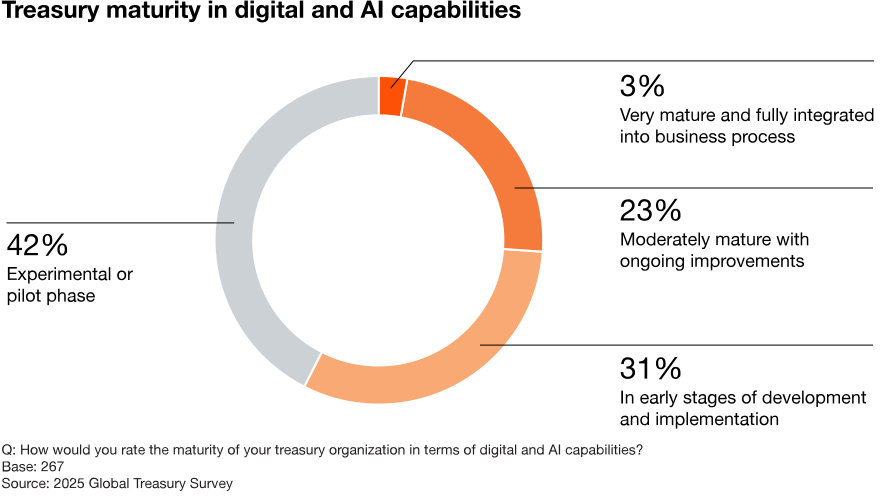
Despite this focus, only 26% of respondents rated their AI capabilities as moderately or very mature. The rest remain in the varying stages of adoption, either piloting (42%) or in early stages of development and implementation (32%). Key blockers included tactical components such as data quality and limited skills availability, along with visionary ones of lacking a mid- or long-term strategy and believing there are no use or business cases.
Organizations are grappling with how to overcome the limited skills availability in various ways. More than half (54%) of respondents rely on self-learning for AI adoption, with enterprise-wide training (30%) and external programs (17%) gaining minimal traction. Furthermore, just 8% of respondent organizations indicated they are hiring for AI-specific treasury roles, underscoring the need to strategically plan on a path to fill the skills gap.
The importance of bridging the skills gap was additionally highlighted by respondents’ plans to build out their AI capabilities, with 56% indicating initiatives would be built with a combination of external and in-house resources and 28% relying solely on in-house building. As AI becomes more essential, the focus must shift from tools to outcomes. Treasury teams that link AI investments to measurable gains in forecasting accuracy, working capital, fraud detection and process automation will further cement treasury as a strategic advisor and better position the organization to secure funding and cross-functional support.
As AI becomes ingrained into leading practice forecasting, risk management and operations, treasury teams must invest in talent, tools and strategy to move from experimentation to impact.
The 2025 survey confirms that treasury technology is no longer a siloed tool set — it’s the foundation for agility, control and insight to enable connected cash. Real-time access to cash, exposure and forecast data is now a necessity. As organizations navigate tariffs, interest rate shifts and supply disruptions, modular and cloud-based architectures are proving more adaptable.
In line with the 2023 Global Treasury Survey, an overwhelming 94% of respondents operate a dedicated TMS, with leading platforms including Kyriba, SAP Treasury and FIS Quantum. Adoption has become near-universal among organizations with more than $10 billion of revenue, reflecting the centrality of tech in managing scale and complexity.
However, adoption of full TMS functionality varies widely, with a notable number of respondents noting offline or homegrown systems are still used for short-term forecasting (22%), treasury reporting (20%) and financial risk management (16%). Coupling that with average TMS satisfaction ratings for those key treasury activities (short-term forecasting 3.4 out of 5, bank fee analysis 3.5 of out 5) suggests room to expand adoption or a need to layer technology with third-party or custom-built applications to cover gaps.
Connectivity is another cornerstone of a modern tech stack. APIs are rapidly gaining ground, with 65% of organizations planning to expand API use in the next few years. This shift enables real-time integration across ERPs, TMS platforms and banking networks. While SWIFT remains a backbone for payment and statement flows, many companies continue to use hybrid connectivity strategies — balancing host-to-host, EBICS (Electronic Banking Internet Communication Standard), and cloud-native interfaces to optimize cost, control and flexibility.
Successful treasury technology ecosystems share common traits:
Even with the measurable, direct benefits of an optimized technology stack, respondents still encountered expected challenges. Budget constraints (70%), limited technology skills (56%) and integration partner challenges (40%) continue to be key blockers to progress. Organizations that succeed often do so by aligning technology with business priorities, creating clear business cases and maintaining agile governance.
So, what does “good” look like? Seamless ERP-TMS-bank integration, scalable digital tools, cross-functional ownership, and a focus on business outcomes — not just system implementation — will continue to be hallmarks of positioning organizations to operate at peak effectiveness. To do so, treasury teams must act as both architects and stewards of a digital ecosystem that drives resilience, insight and enterprise value.
Treasury organizations that build modular, API-driven ecosystems with strong ERP-TMS integration will be best positioned to adapt and lead through disruption.
With resources stretched thin and complexity rising, managed services are gaining traction as a solution for scalability, cost efficiency and creating capacity for strategic work. Integrated managed service models go beyond traditional shared service centers through labor arbitrage, domain expertise, scalable platforms and process transformation capabilities. Treasury functions are increasingly co-sourcing end-to-end activities such as cash management, reconciliation and bank account administration while retaining strategic oversight.
Moreover, treasury teams cite rising demand from CFOs and boards to deliver against business resilience, risk mitigation and cost optimization goals. Managed services can offer a rapid path to maturity in areas like electronic bank account management (eBAM), POBO and ROBO models and payment fraud controls. In-house bank administration and cash positioning are also popular candidates for managed support, with success stories highlighting improved service-level agreements (SLAs), better controls and round-the-clock coverage.
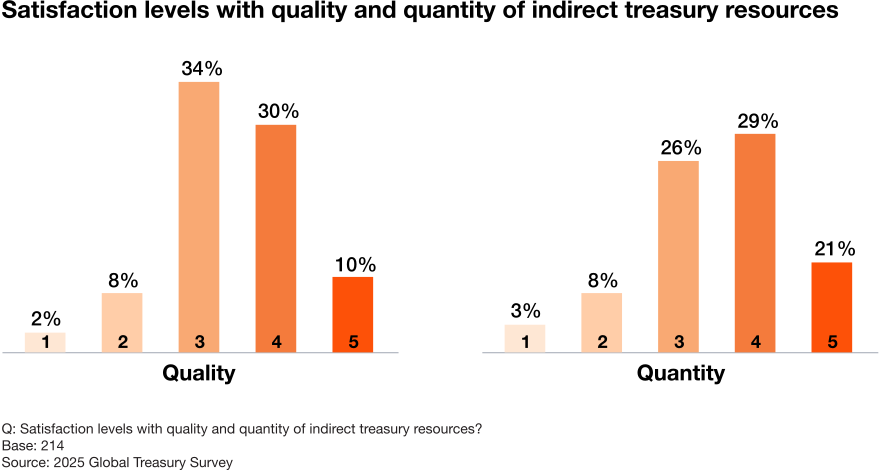
Aligning stakeholder buy-in to transition to managed services will require proper framing of its benefits over traditional shared service centers, demonstrating the ability to measure the quantifiable impact and positioning it as part of a broader operating model design update. Survey responses indicated the appetite is there to consider this update with satisfaction rates of indirect resources (i.e., shared service centers) at average levels — both quality (48% at 3 out of 5 or below) and quantity (37% at a 3 out 5 or below) — suggesting room for a different approach.
Going forward, leading treasury teams will treat managed services not as outsourcing but as an enabler of agility, digital capability and enterprise value. This requires robust vendor management, outcome-based key performance indicators (KPIs) and continuous alignment with business objectives. It also invites treasury to redefine its role as a strategic orchestrator of value across internal and external networks rather than just a process executor. Amid macroeconomic and geopolitical headwinds, this orchestrator role enables organizations to pivot rapidly while maintaining internal focus on value-added decision-making.
Managed services offer a fast track to resilience and scalability, enabling treasury to focus on strategic insights while outsourcing transactional tasks.
Made in collaboration with TMI.
Run effectively cash, liquidity and financial risk.
Revamp your finance function with trusted outcomes.
{{item.text}}
{{item.text}}