





Navigating VM-22: Insights and implementation challenges

  • August 27, 2025

The existing Valuation Manual (VM) 22 under statutory reporting specifies interest rate requirements for reserves on single premium immediate annuities (SPIA) and similar contracts. This will become VM-V starting in 2026. A new VM-22 framework has been established and has significantly broadened the scope of the regulation to serve as the Principle-Based Reserving (PBR) framework for all non-variable annuities (e.g., fixed indexed annuities (FIA), fixed deferred annuities (FDA), SPIA, pension risk transfer (PRT), etc.). While the framework draws on foundational elements from Life PBR (VM-20) and VM-21, it also includes unique provisions which are specific to the non-variable annuity business. These refinements aim to better align reserving practices with the underlying risks and product features.

VM-22 includes a three-year transition period, with an optional effective date of January 1, 2026, and a mandatory effective date of January 1, 2029. Currently, it is intended for prospective adoption only, but discussions are underway regarding the potential for retrospective adoption for business issued on or after January 1, 2017.

VM-22 Framework at a high level

VM-22 framework at a high level

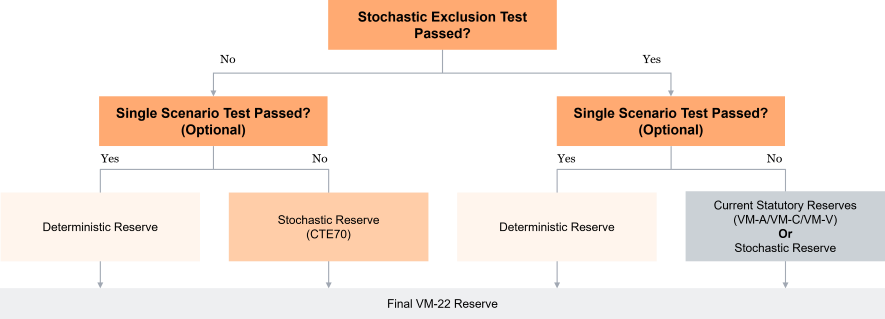
VM-22 calculation framework shares similarities with VM-20 and VM-21, such as the stochastic exclusion test, stochastic reserves, and deterministic reserves, but also introduces unique elements like single-scenario testing.

VM-22 Framework (Calculation components)

The final VM-22 reserve can be the deterministic reserve (DR), the stochastic reserve (SR), or the current statutory reserve methodology (Commissioners Annuity Reserve Valuation Method or CARVM), depending on the outcomes of the stochastic exclusion test (SET) and the single scenario test (SST), as illustrated above. The SST can be applied to blocks of business where contract holder behavior is not materially influenced by economic conditions (e.g., payout products without surrender benefits), allowing them to be valued under a DR if they pass the test. If a group of contracts fails both the SET and the SST, the SR should be calculated as the VM-22 reserve. Conversely, blocks of business that pass the SET have the option to continue valuing reserves under the current statutory framework. For year-end 2026 reporting, the standard projection amount (SPA) will be used solely for disclosure purposes and not as a minimum reserve floor for the SR and DR. For any given scenario, the reserve should not be less than the total applicable cash surrender value (CSV) at the valuation date. VM-22 permits aggregation across payout and accumulation products, enabling companies to achieve diversification benefits between these categories. To do so, companies should manage the risks associated with contracts in both categories through an integrated risk management process, where the contracts are managed within a single portfolio or across portfolios adhering to a consistent asset-liability management (ALM) strategy.

VM-22 Implementation challenges for companies

Implementing VM-22 presents a complex array of challenges for companies. By proactively planning for these difficulties, companies can help facilitate a smoother transition. Anticipating the potential operational, actuarial, and data-related obstacles outlined below allows companies to allocate resources more effectively and reduce the risk of costly delays.

Early challenges arise from understanding the evolving complexities of VM-22 guidance. These include navigating various tests to determine the reserve path, establishing requirements for actuarial and economic assumptions, addressing asset considerations and reinvestment guardrails, among other aspects. Companies will want to remain informed about the dynamic regulatory landscape throughout the implementation process. Those not currently involved in VM-20 or VM-21 may encounter additional hurdles, as some components and concepts are entirely new.

Companies can benefit from engaging in strategic planning to understand the VM-22 guidance and evaluate the current CARVM reserves as a starting point for transitioning to VM-22. The VM-22 adoption timeline offers flexibility, with a voluntary effective date of January 1, 2026, and a mandatory effective date of January 1, 2029, allowing companies to strategically decide when to adopt VM-22. Additionally, the Life Actuarial (A) Task Force (LATF) is exploring the potential for retroactive application of VM-22 to business issued on or after January 1, 2017, which could influence how companies approach early adoption and reserve planning.

During the assumption-setting process, companies are expected to focus on developing assumptions that incorporate both their own experience and current market trends. It’s also important to consider regulatory expectations and align with industry-leading practices. Additionally, there may be complications involved in defining business segments for mortality assumptions, establishing margins for various assumptions, and determining the appropriate sensitivities to confirm that assumptions are set at the conservative end of the plausible range.

As VM-22 continues to be updated and undergo enhancements, companies may face challenges in the model implementation process, specifically in the initial setup and configuration. This calls for companies to be flexible and responsive to new guidance to stay in compliance with regulatory requirements.

Following successful model implementation, companies should conduct model validation. While this stage may be complex and time-consuming, involving detailed testing on selected samples, effective planning can help confirm the accuracy and reliability of the models.

While CARVM does not consider asset projections, VM-22 accounts for the company’s ALM and asset composition. The initial asset portfolio used in VM-22 modeling is crucial for determining results, making optimization essential across all products. Companies are expected to allocate more time and resources to ALM and improve their in-force portfolios to enhance reserve outcomes while adhering to reinvestment guidelines.

The VM-31 report includes a thorough description of methodologies used for reserve calculations, the assumptions underlying these methodologies, and the processes followed during implementation. Additionally, it should cover the rationale for setting specific assumptions, any deviations from standard practices, and the expected impact of these assumptions on the reserve outcomes. The report should also address the integration of asset strategies with liability profiles and provide supporting rationale for the chosen approaches. As VM-22 evolves, the VM-31 report will need to reflect updates and new elements pertinent to these changes, enabling ongoing compliance with regulatory requirements.

Lessons learned from a VM-22 Case Study implementation

We conducted a case study on various products, including SPIA, PRT, multi-year guaranteed annuities (MYGA), FDA without guaranteed minimum withdrawal benefits (GMWB) and FIA with GMWB, featuring representative designs with a valuation date of December 31, 2024. The study results examine the relationship between different types of reserves, including the current CARVM, best estimate liabilities (BEL), and the components of the VM-22 reserves. Additionally, a detailed step-by-step attribution analysis illustrates the transition from CARVM to VM-22 reserve. Throughout this case study, several modeling lessons emerged:

There are additional complexities associated with integrating GOES into modeling software for VM-22. Scenarios are provided for the initial periods, but generating scenarios for future periods may require external subscription or services. Moreover, FIA products require a future volatility surface, which is not included in the generated scenarios. Additionally, complex assets should be mapped to the GOES scenarios and documented in the PBR report.

We observed a significant increase in runtime with stochastic runs, dependent on the number of scenarios performed. Consequently, products that credit interest based on a portfolio’s earned rate may require simplifying assumptions, such as consolidating asset model points or simplifying the reinvestment strategy, to help reduce the runtime associated with stochastic projections of large asset portfolios.

Data management for stochastic run results and validation will require adjustments to existing architecture. Furthermore, model validation for aggregate cash flows should be developed.

Due to the multifaceted and challenging nature of VM-22, performing vendor assessments to identify vendors better suited for VM-22 valuation, analysis, and pricing is especially helpful. This approach aims to confirm that companies have the necessary tools and data infrastructure to efficiently satisfy regulatory requirements.

In addition to current period analysis of valuation results, integration with financial planning and analysis in the form of forecasted reserves should also be considered. Data requirements should be identified and consolidated to support the creation of front-end dashboards. These dashboards can be used to support dynamic VM-22 analysis and comparisons, enabling proactive responses to regulatory expectations. Additionally, the development of roll-forward and analysis tools of new VM-22 regulations can be used by companies to manage the evolving nature of the data and regulation.

Succeeding in the VM-22 Era

VM-22 represents a pivotal shift in the reserving framework for non-variable annuities, offering a more dynamic and market-aligned approach to reserve requirements. While its principles aim to modernize outdated methodologies and enhance regulatory consistency, the path to implementation brings many challenges. From interpreting evolving guidance and establishing credible assumptions to navigating model validation, documentation, and asset and reserve optimization, each stage introduces its own set of technical and operational hurdles.

Successfully adopting VM-22 will require not only actuarial expertise, but also strategic planning, cross-functional collaboration, and a commitment to maintaining compliance. Those who invest early in readiness and infrastructure can be better positioned to manage the transition and realize the benefits of a more forward-looking reserving framework.

Gina Meng and Gary Ng contributed to this piece.

Insurance Modeling at PwC

Contact us

Quintin Li

Principal, Risk Modeling Services, PwC US

Ailen Okharedia

Principal, Risk Modeling Services, PwC US

April Shen

Director, Risk Modeling Services, PwC US

Follow us