


{{item.videoDuration}}
{{item.title}}
{{item.text}}

{{item.videoDuration}}
{{item.text}}
Executive overview
A pattern in the S&P 500 has emerged. Companies that once experimented with isolated AI use cases seem to be hitting a ceiling. The early wave of AI pilots and low-risk automations delivered small wins but little impact on the P&L. The new wave is different. Market leaders are deploying AI across functions, rewiring decision-layers, and scaling systems that unlock structural change.
The financial implications are unmistakable. AI foundation builders such as Alphabet, Microsoft, and NVIDIA—companies that create the models, platforms, chips, and other tools that organizations rely on to innovate—are thriving. But they are not alone. Enterprises that make sustained, enterprise-wide AI investments are also seeing outsized gains.
The market has been rising in a bull economy. But some are rising more than others. The difference is instructive. Between 2022 and 2025, S&P 500 companies (excluding AI foundation builders) that invested more than 0.5% of their revenue in AI outperformed their respective sector median TSR by 21%.* Those that invested less underperformed their sector median TSR by 2%. Markets are rewarding companies that treat AI as a growth lever and not a side experiment.
Our analysis aligns closely with what we see in the field. Working with clients across industries, we see the same pattern: The organizations that approach AI as strategic transformation rather than a technology deployment are the ones realizing measurable business impact. Beyond the numbers, the real differentiator is how deeply AI becomes embedded in the business.
No longer confined to optimizing processes, it begins to reengineer the very mechanics of the business, including how revenue is generated, how costs are controlled, and how productivity is unlocked.
We’re finding that the top sources of top-line AI value come from demand sensing and forecasting, hyper-personalization, and intelligent product and feature design. These capabilities are designed to help your company anticipate customer needs, tailor offerings with precision, and accelerate innovation cycles.
Consider healthcare, where a leading organization worked with PwC and Google Cloud to redefine how oncology data supports patient care. By building a scalable AI-ready data foundation, disconnected records turned into real-time insights. Now, care teams can match patients to clinical trials faster, compare treatment options at the point of care, and spot risks earlier. Researchers can identify more precise patient groups, while patients receive more personalized, timely support. All of this is supported by a data backbone designed to safely share privacy-protected health data. Together, these advances are projected to create more than $50 million in annual value.
This kind of transformation illustrates the larger shift underway. By embedding AI directly into commercial processes, organizations can unlock new sources of growth. AI can learn from customer behavior to tailor offers and experiences, lifting measurable gains in sales and service. It can also simulate demand, test features, and recommend launch strategies, shortening time-to-market and expanding reach through multilingual, 24/7 engagement without adding headcount.
From 2022 to 2025, S&P 500 firms (excluding AI foundation builders) that invested more than 0.5% of their revenue on average in AI achieved revenue growth exceeding their respective sector medians by 3%, compared to near flat performance relative to sector medians for others. The takeaway? Embedding AI into commercial models is already unlocking consistent revenue uplift.
The top sources of bottom-line AI value include process automation, vendor and contract management, and inventory optimization. When these capabilities are applied at scale, your enterprise can reshape cost structures and see errors reduced, risks managed more effectively, and resources redirected toward higher-value priorities. These gains are showing up across sectors as measurable savings and stronger performance.
Take our client, Cross Insurance, for example. Employees were transferring documents the agency’s partners generated into its sales management system—a process prone to inefficiencies and delays. By integrating AI into a document data extraction solution embedded within Salesforce, the sales process was streamlined. It saved time, improved accuracy, and enabled Cross Insurance to deliver quotes faster than ever. As a result of automatic data mapping, the agency saw cost savings of about 20%.
AI also enforces operational discipline. It can monitor vendors, ensure contract compliance, and reallocate resources in real time. By embedding governance into workflows, AI can cut delays, reduce risk, and free leadership to focus on growth.
From 2022 to 2025, S&P 500 firms (excluding AI foundation builders) that invested more than 0.5% of their revenue on average in AI achieved EBITDA growth exceeding their respective sector medians by 7%, compared to near flat performance relative to sector medians for others. The takeaway? Embedding AI into commercial models is driving stronger profitability and operational leverage.
Let’s take a look at one of the world’s largest retail companies. Its executives felt the urgency: They had to reinvent the business, and quickly. The company was on top—still is today—but nimble AI-native competitors are emerging. They know too that a pilot here and there is not enough. They need AI at scale, and they need a new organization to sync with new, AI-augmented ways of working.
The retailer’s executives engaged PwC to help them build an AI-powered organization, starting with a centralized hub to develop and deploy AI agents. This hub’s technology assets, human proficiency, and standardized frameworks help identify where AI agents can generate risk-managed value most quickly. It provides a sandbox for prototyping and testing. It offers tools and protocols for deployment and oversight.
The first initiative transformed software development. AI agents now enhance each aspect of the developers’ work from requirements and coding to testing and workflow orchestration, cutting cycle times by up to 60% and production errors in half.
But the transformation goes further. Leadership is reorganizing for AI, equipping employees with new skills, addressing fears of change by identifying new roles for people, and fostering a culture of continuous learning. The company’s leadership and PwC’s AI specialists are now refining human-agent collaboration across the enterprise, balancing automation with oversight and strengthening trust with validation, reporting, and an AI ethics committee.
One such agentic ecosystem, for example, is being developed to manage the company’s global supply chains. It’s designed to predict inventory shortages, negotiate supplier contracts, and so on. AI agents can deliver automation and data-driven insights, while people make strategic decisions and provide oversight.
This retailer is transforming the nature of its work to create value today and build a competitive edge that could last decades.
Before deploying AI agents, leaders should define the outcomes that matter and measure where they’re starting from. AI-led reinvention goes a lot further than just launching technology—it shifts baselines across four core dimensions of enterprise performance.
How fast and accurately can the process operate today? Improvements in quality, reliability, and cycle time are core to value creation.
What’s the current run cost of enterprise operations? This includes vendor spending, labor costs, and technology overhead, creating the foundation for measuring efficiency gains.
How much human effort does the process require? As AI takes on more legacy work, human capacity shifts toward higher-value activities such as managing exceptions, building relationships, and driving growth—rather than routine execution. Humans should move up the value chain, and leaders need to be intentional about where that effort is redeployed.
What’s the volume of legacy tasks becoming agentic? Workload may remain constant in the near term (for example, the number of customer contacts or HR hires), but agentic work increases as legacy tasks are transformed. You’ll still need to do those things but now AI agents will perform part of them. The “what” doesn’t change, the “who” does and over time, new types of agentic workloads will emerge that extend enterprise capability beyond traditional boundaries.
The reinvention of work with AI agents marks a fundamental economic shift. Workload remains constant but it will shift towards more agentic work as legacy human workloads and their costs decline. Once upon a time, people filled kerosene lanterns to light their homes. Then came electricity. We stopped calling customer service for every issue because online self-service made it faster and simpler. And in the near future, AI agents might even take care of that for us.
Work, as we know it, won’t just evolve—it will be reinvented.
Of course, investing more than 0.5% of your revenue into AI won’t magically enable you to outperform your peers. It’s the “how it’s invested” that matters.
For AI to deliver real, measurable results, you’ll need more than pilots and proofs of concept. An enterprise-grade operating model connects business priorities, technology, talent, and change management from day one.
When done right, the results are tangible—lower structural cost takeout, faster cycle times, higher throughput, and talent redeployed to the work that creates real advantage. ROI isn’t abstract. It’s measured continuously.
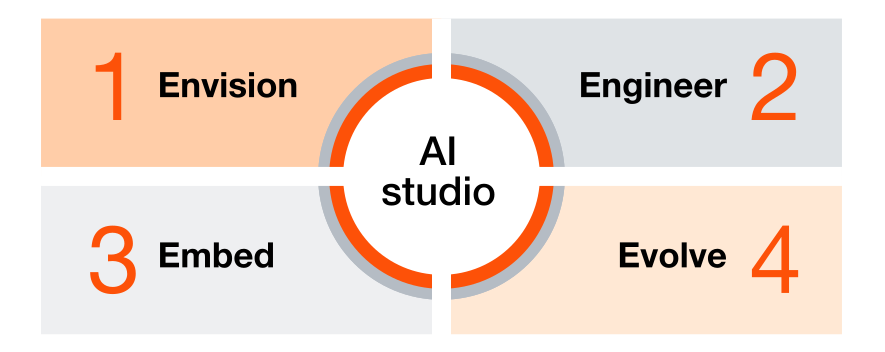
Our AI studio model provides an enterprise-wide operating framework linking strategic priorities to execution. By embedding structure, governance, and repeatable frameworks, companies can scale AI across business functions to help deliver measurable ROI.
Strong governance and program control must be embedded from day one to enable prioritization, accountability, and disciplined execution at scale.
This cycle delivers early value drops while compounding returns over time, moving beyond pilots to accelerate ROI and drive enterprise-wide reinvention.
An AI studio structures your efforts to move with purpose, scale quickly, and see results faster.
It brings oversight and execution power to turn bold AI ideas into operational reality. It helps you focus investments where they matter most, choose the use cases with the biggest impact, and build enterprise capability from day one.
The organizations that lead aren’t just speeding up—they’re working in completely new ways. With intelligent agents at the core, your employees can concentrate on judgment and creativity, while performance gets wired for ongoing reinvention.
The AI revolution is already underway. The real question is: Where will you begin?
{{item.text}}
{{item.text}}