





Telecom and tech leaders face a new imperative: navigate fast-moving trade shifts with agility and foresight. What once appeared as isolated policy decisions now signals a broader, systemic reordering. These disruptions are no longer just economic anomalies. They mark a pattern of geo-economic fragmentation reshaping how and where technology businesses operate.
In today’s volatile environment, long-held assumptions about globalization and supply chains are breaking down. We’re witnessing a fracturing world where geopolitical tensions, climate shocks and social instability converge. Telecom and tech companies — and the ecosystems they power — should rethink exposure, recalibrate their risk posture and act decisively. We’re already seeing much of this happening with 79% of the TMT leaders in PwC's May 2025 Pulse Survey saying they expect long-term business benefits from trade protectionism despite short-term challenges.
The shockwave Where tariffs hit telecoms and data centers
Despite their reputation for resilience, telecom and data center operators face intensifying pressure from shifting tariffs, regulatory restrictions and geopolitical rifts — including equipment bans targeting select Chinese manufacturers and a fast-changing tariff landscape that could reshape sourcing strategies. With supply chains tightly interwoven across global tech ecosystems, these disruptions cascade quickly — from raw materials and rare earths to chips and software — challenging business continuity and demanding faster, smarter response.
The US import/export profile in TMT-relevant categories reveals heavy reliance on foreign inputs of materials (like aluminum, steel, fiber optics, rare earths), semiconductor components and manufactured tech goods (network equipment, consumer devices), underscoring supply-side vulnerability. By contrast, the US runs a significant trade surplus in digital services and software, which aren’t currently in scope for proposed tariffs but could face risk if trade measures expand to include services — or if retaliatory tariffs target major US hyperscalers and software providers. Notably, only software preinstalled on foreign-made equipment or delivered via physical media is treated as a tradable good under current rules.
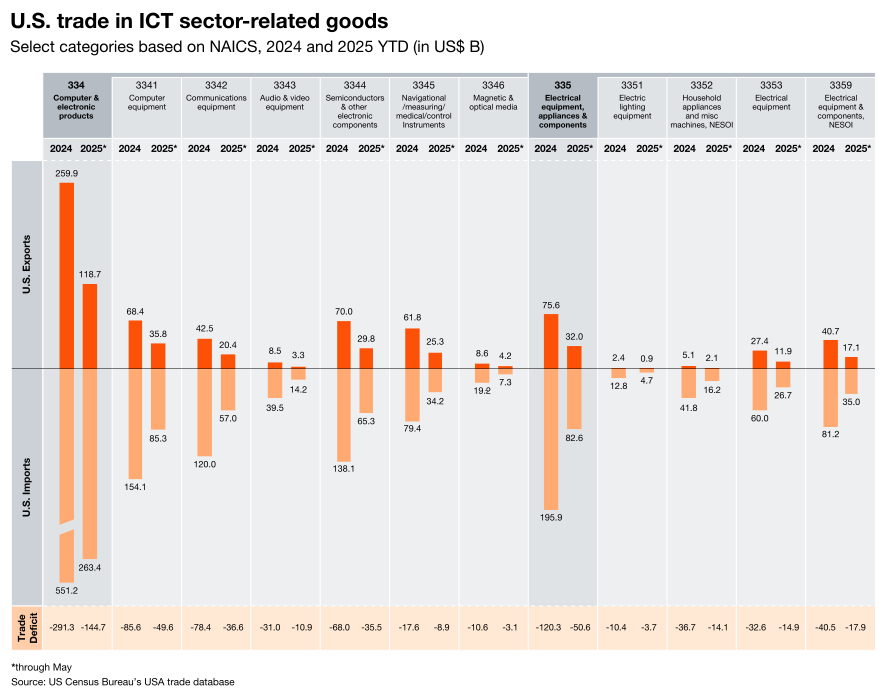
Moreover, key trading partners across North America, Europe and Asia are crucial not just as customers but as suppliers of essential materials and capabilities. The Americas, Europe and Asia each account for significant portions of US TMT imports and exports. This truly global network means tariff impacts can bottleneck supply chains at any point.

Many critical supply chains (like chip manufacture and assembly) are vulnerable to geopolitical rivalries and shocks. A single policy change or regional crisis can cascade from raw materials to finished tech products, as seen in April 2025 with semiconductor shortages and export bans. Components might cross several borders during production, with each crossing potentially triggering new duties and adding incremental costs that ultimately inflate the price of the final product.
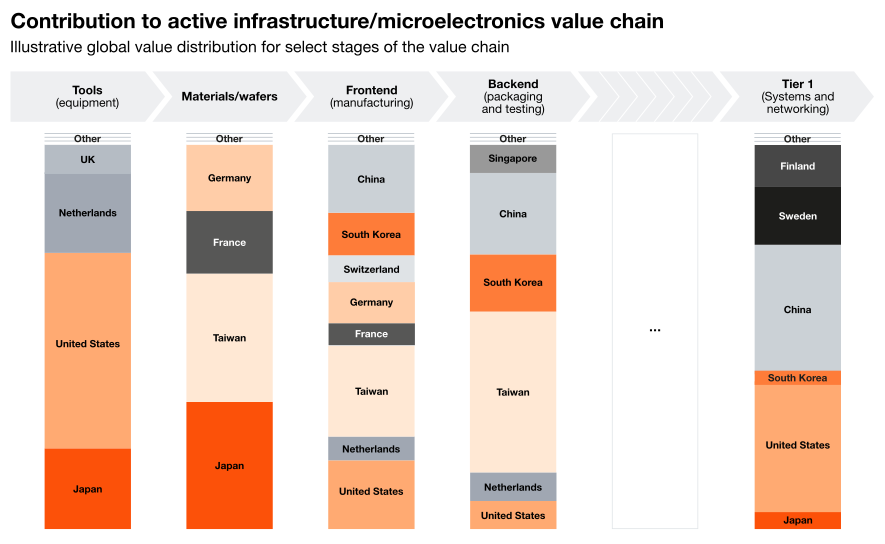
The financial stakes are high. PwC analysis indicates that proposed trade measures could mean tariff spikes for TMT industry. And countermeasures by other countries and the growing threat of digital service taxes — and US responses — further cloud the outlook. In today’s complex web of geopolitical tensions, tariffs have become a pivotal factor in reshaping pricing, strategic planning and operational efficiency. Supply chain leaders now rank trade conflict among top threats to growth. Thirty-two percent said it could inhibit their ability to sell products or services. Companies are already adapting. Supply chains have become a boardroom agenda item once again.
Many companies have begun friend-shoring or onshoring to reduce exposure to geopolitical risk. Apple recently announced that most of the devices coming into the US soon will come from India and Vietnam. Other tech companies are investing in US-based semiconductor manufacturing facilities. In a recent PwC Pulse Survey, 60% of COOs said they’re considering changes to their footprint — localizing or reshoring production and sourcing. Notably, even as regional blocs emerge to foster intra-bloc cooperation, this can increase regulatory complexity and limit diversification options.
The telecom and tech supply chains are in flux, and globalization is bending toward regionalization.
How tariffs are reshaping strategy across business functions
Tariffs and other geo-economic forces don’t just affect trade compliance or procurement — they ripple across every function from supply chain to product development, capital planning and infrastructure design, including both network architecture and large-scale data center buildouts. For data centers, this can mean higher costs for critical inputs like servers, storage hardware, cooling systems and backup power equipment, many of which rely on globally-sourced components now facing heightened trade scrutiny. These pressures significantly impact pricing, sourcing decisions and even long-term R&D and facility strategy. Leading companies recognize this and are taking a multidisciplinary approach to resilience, drawing insights across finance, engineering, supply chain, custom, tax and transfer pricing teams.
The strategic imperatives can be categorized into four key business domains.
- Strategic and financial planning
- Supply chain management
- Digital infrastructure build and operations
- Commercial operations
While distinct, these domains need to operate in concert to respond holistically.
1. Strategic and financial planning
Strategic domain |
Topic |
Core strategy question |
| Strategic and financial planning | Simulation | How can we use simulation tools to assess tariffs' impact across financial metrics and guide decisions? |
| Scenarios | How do we prepare for a range of geo-economic scenarios and embed these into planning? | |
| Spend management | How can we align spend management with tariff exposure to prioritize cost control? | |
| Sovereignty | Which assets are vulnerable to geopolitical risk, and how can we localize to increase sovereignty? |
2. Supply chain management
Strategic domain |
Topic |
Core strategy question |
| Supply chain management | Stockpiling | What strategic inventory levels will mitigate risk from tariff shocks and supply disruptions? |
| Smart shipping | Can we reconfigure logistics and routing to reduce tariff exposure and increase flexibility? | |
| substitution | Where are our supply dependencies, and how can we diversify and substitute suppliers or materials? | |
| Shore-shifting | Which sourcing and production processes should shift to allied or domestic regions? |
3. Infrastructure build and operations
Strategic domain |
Topic |
Core strategy question |
| Infrastructure build and operations | Spend sequencing | How do we phase infrastructure investments to minimize tariff lock-in and maximize agility? |
| Standards | How can adopting open standards reduce vendor lock-in and tariff risk? | |
| Software-defined transformation | How can SDN and virtualization reduce dependency on specific hardware subject to tariffs? | |
| Service-shifting (Operations) | Can we convert CapEx-heavy procurement into more flexible service-based models to manage tariff risk? |
4. Commercial operations
Strategic domain |
Topic |
Core strategy question |
| Commercial operations | Surcharges | Should we pass through tariff costs to customers, and how do we assess the impact on pricing and demand? |
| Substitution (Products) | How do we adapt our product mix and guide customers toward lower-tariff alternatives? | |
| Service-shifting (Business model) | Can we mitigate cost spikes through subscription models that spread tariff impacts over time? | |
| Sustainability | How can circular economy practices reduce import needs and create tariff-free supply buffers? |
What you can do now
Telecom and data center leaders need an interdisciplinary playbook for building resilience.
Here are five strategic actions to help you withstand disruption and lead, despite a fractured geo-economic landscape.
- Map exposure. Conduct a full-spectrum audit of your exposure across financials, supply chains, technologies and partnerships. Know where tariffs, sanctions or trade shifts would hit your P&L and operations — from specific product lines to key supplier relationships.
- Build scenario resilience. Establish response playbooks for plausible trade and geopolitical scenarios, including extreme ones like broad decoupling, new digital taxes or regional internet regulations. Practice tabletop simulations so your team can respond with agility under ambiguous, fast-changing conditions.
- Rethink vendor strategy. Evaluate all major vendor and partner relationships not just on cost and performance, but on geopolitical risk alignment. Consider diversity of supplier locations, ownership structures and their supply chain robustness. Prioritize partners who demonstrate resilience and shared commitment to navigating trade uncertainty.
- Embrace software-first design. Accelerate investments in software-defined, virtualized and cloud-based architectures that reduce dependency on specialized hardware. The more your business capabilities reside in software and cloud, the more you can mitigate physical supply chain disruptions and adapt quickly.
- Integrate sustainability into strategy. Treat sustainability and resilience as equals. By adopting circular models you can not only advance your sustainability goals but can also reduce reliance on new imports and provide a buffer against supply shocks. Align your green initiatives with your geo-economic risk strategy for compounded benefits.
Supply chains have become political terrain. Technology stacks increasingly require sovereign control. To thrive, telecoms and data center leaders need to continually simulate, stress-test and reinvent operations for volatility. Those who take proactive action — redefining supply routes, redesigning networks and rethinking partnerships— won’t just navigate the storm, they can position themselves to find opportunity in it.
Telecoms and tech are bracing for a fractured global economy
Our insights. Your choices.
Get started with PwC’s preference center
Contact us






Lori Driscoll
Technology, Media and Telecommunications US and Global Consulting Leader, PwC US


