








{{item.videoDuration}}
{{item.title}}
{{item.text}}

{{item.videoDuration}}
{{item.text}}
Through disciplined portfolio management, supply chain resilience, and accelerated electrification, automotive stakeholders can position themselves to find new growth opportunities today and beyond 2030.
This outlook delves into three core areas: market and sales dynamics; financial health and industry profitability, and M&A implications. Understanding the nuances within these interconnected pillars is vital for industry participants seeking to enhance investment, operational and strategic decisions.
New vehicle prices in the US and Europe have increased sharply—rising on average by 15–25% since 2020—driven by inflationary pressures, semiconductor scarcity, raw material cost surges, and supply chain constraints. The average transaction price (ATP) for new vehicles in these regions now consistently exceeds $45,000, pushing affordability beyond the reach of many consumers. Despite these price increases, OEMs are seeing margins compress back to pre-pandemic levels, suggesting little-to-no relief in sight for consumers. As a result, sales volumes in these mature markets are forecasted to flatten through 2030, reflecting a demand ceiling driven by constrained household incomes, tighter lending conditions, and macroeconomic uncertainty.
Consumer preferences have evolved as well, with many buyers favoring used cars, alternative transportation modes, or delaying purchases. Fuel price volatility and changing regulatory landscapes have also introduced complexities challenging ICE demand. The high transaction price environment has forced automakers to recalibrate expectations for volume growth, shifting emphasis toward margin preservation.
In stark contrast, China’s vehicle market displays a different trajectory. Aggressive domestic competition among a number of emerging OEMs and stringent government policies fostering new energy vehicles have combined to reduce average transaction prices, which hover near the $25,000 mark, roughly half that of the US or Europe. This affordability is underpinned by an integrated, mature supply chain ecosystem and battery cost leadership, stiff local competition, and competitive, low-cost labor for development and manufacturing.
China’s exports have grown rapidly, with Chinese manufacturers penetrating nearly all major global regions except the US—adding approximately three million vehicles in exports since 2020. This export surge targets primarily Europe, Latin America, and parts of Southeast Asia, where Chinese OEMs such as BYD and Chery offer quality vehicles at low cost. Localized production strategies and expanding EU dealerships support this growth.
The growing global footprint and cost advantages of Chinese OEMs present significant competitive pressure on incumbent global automakers.
Geopolitical uncertainty, tariff complexities, and supply chain risk concentration have compelled automakers to rethink production location strategies. The US government’s incentives related to reshoring, consumer proximity, and supply chain resilience imperatives underline the importance of maintaining the country’s status as a vital production base.
Current forecasts project North American vehicle production volumes will return to mid-2019 levels by 2030, driven by capacity expansions and reallocation toward BEV, HEV, and advanced ICE vehicles. Global players are investing heavily in expanding facilities in North America, while others are repurposing BEV capacity for flexible manufacturing lines that can adapt to evolving demand.
Battery electric vehicles continue to face fundamental hurdles limiting rapid mass adoption in several regions, particularly in North America, while China has seen much more rapid adoption.
In the US, BEVs carry a 15–20% higher transaction price on average than ICE vehicles. Meanwhile in China, BEVs have reached first-cost parity with ICE vehicles, mitigating the consumer facing economic hurdle toward large scale adoption.
Additionally, US product portfolios are misaligned with demand. Nearly half of US car buyers are looking for vehicles priced under $45,000, while only 16% of available BEV models serve this segment. Conversely, close to a third of BEVs are priced above $80,000, addressing less than 2% of the market. Globally, OEMs are rapidly increasing the number of available BEV models to drive more consumer choice in the market and help close these gaps.
Finally, deficits in public charging infrastructure hinder adoption. Without significant investment in charging infrastructure, US and EU adoption will struggle to grow at the pace we are seeing in China.
Assuming current trends continue, PwC projects BEVs in the US will become much more competitive with ICE vehicles broadly by 2028–2029. This inflection is expected to lead to a more organic uptake in BEV sales, particularly as consumer purchase decisions become more economic-driven, rather than subsidy-driven. According to Bloomberg1, battery pack prices, which have fallen dramatically since 2010, are forecast to continue their decline, driven by technological advances, economies of scale, and chemistry improvements such as the rise of lithium iron phosphate (LFP). Recent data suggests battery costs in China are approximately 30% lower per kWh than in the US and nearly 50% lower than in Europe, thanks to highly integrated supply chains and localized mineral refining.
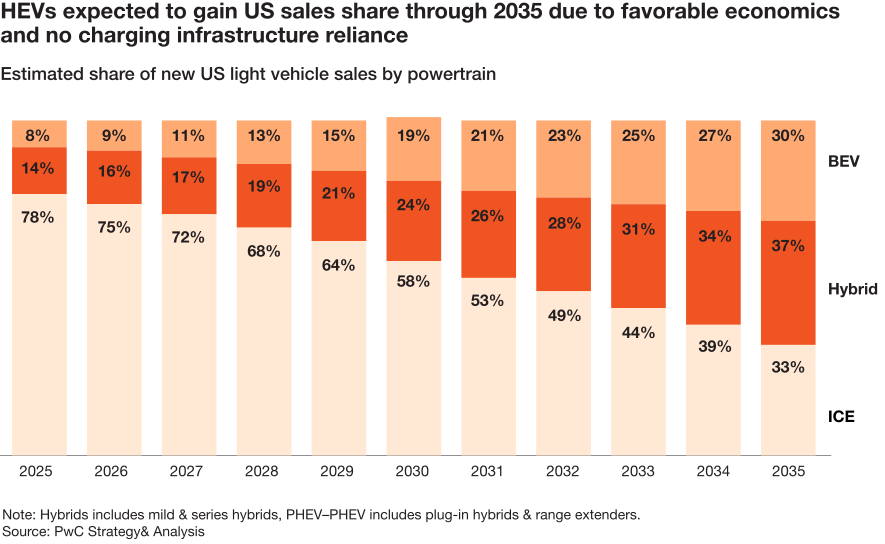
As a result of these dynamics, our projections show US adoption will rise to nearly 20% by 2030 and continue to gradually increase by 2035. China will continue its rapid BEV adoption throughout the next decade, surpassing 50% of vehicles sold by 2030. European forecasts are expected to change, reducing from previously projected +60% penetration by 2030 as a result of new regulations throughout the EU auto industry.
Given the current economics and infrastructure challenges facing BEVs in the US, hybrid electric vehicles have emerged as a crucial product. HEVs currently command a 5–10% price premium over equivalent ICE vehicles but benefit from better fuel efficiency and retain higher residual values. Our total cost of ownership (TCO) studies indicate that fuel savings fully compensate for the initial premium over a 40,000–80,000-mile vehicle life cycle.
This improved TCO, coupled with incremental consumer familiarity and relatively fewer infrastructure needs, has positioned HEVs favorably in many mature markets over the last few years. Automakers are rapidly expanding HEV offerings and, in some cases, using HEVs to fully replace their ICE product lineups entirely. This expansion in product offerings and resulting increase in consumer adoption has driven HEVs to become a more viable market until the challenges facing BEV adoption stabilize.
In this environment, it’s imperative that OEMs and suppliers maintain flexibility and balance in their powertrain investments. Prematurely abandoning ICE or hybrid platforms risks losing market share, while overcommitting to BEVs poses financial strain and inventory risk.
We recommend that suppliers, especially those historically centered on ICE components, continue to diversify portfolios across BEV and hybrid technologies. This enables responsiveness to rapid shifts in production and consumer demand, providing a hedge against policy or economic reversals affecting electrification timelines.
Globally, OEMs have seen year-over-year EBITDA decline from a peer average of nearly 11% in Q3 2024 to below 8% in Q3 2025. This contraction is attributed to stagnant vehicle volumes, elevated input costs (notably raw materials and semiconductors), and increased freight and tariff expenses.
Despite record transaction prices, margin pressures persist due to rising warranty provisions, recalls related to new powertrain technologies, and the scaling costs of new manufacturing processes. Additionally, OEMs bear costs of regulatory compliance, software development, and infrastructure partnerships that suppliers partially avoid.
Automotive suppliers have maintained relatively stable EBITDA margins by effectively passing increased costs upstream to OEMs. This pricing power, however, varies by commodity and product category.
Suppliers specializing in electronics, chemicals, and metals have experienced margin pressure due to cost volatility and commoditization. Conversely, exterior trim and powertrain suppliers enjoy stronger demand signals and more stable cost bases, cushioning them from margin erosion.
Supplier distress metrics indicate improvement, shifting from 31% of suppliers in distress in 2024 to 24% in 2025. This improvement is supported by operational cost control and pricing discipline. Still, suppliers remain vulnerable to shifts in OEM production volumes and tariff escalations, both of which are poised to quickly change distress levels if the balance between OEMs and suppliers shift.
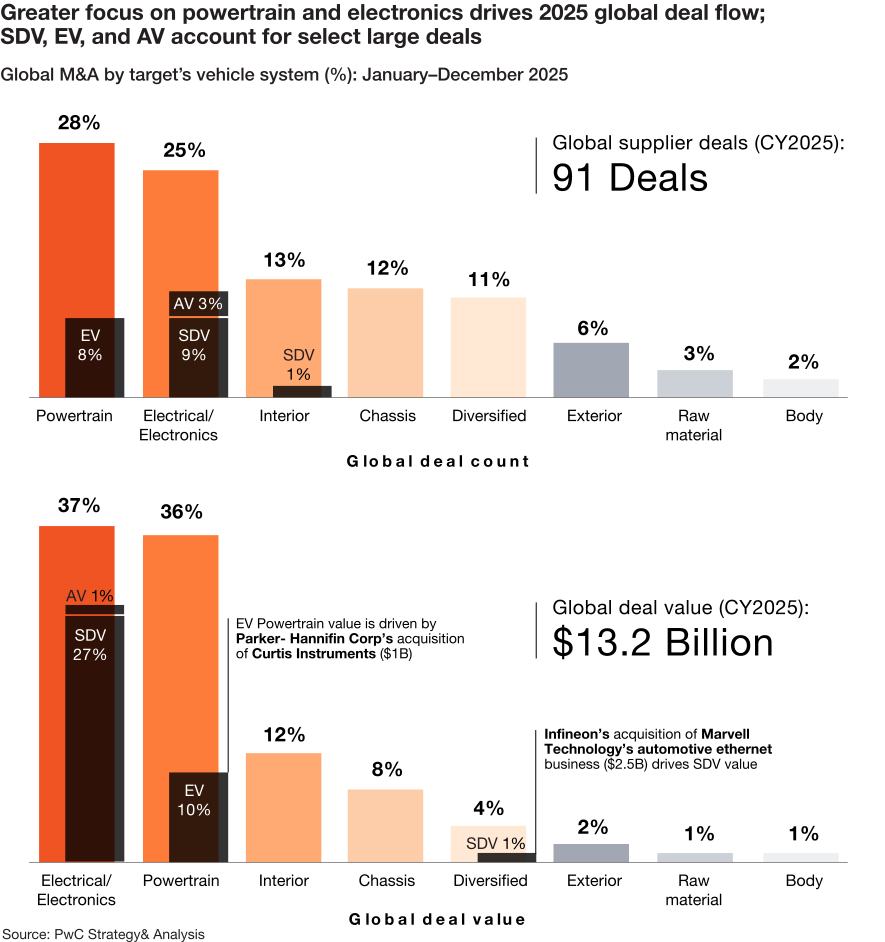
Following historic lows in 2024, M&A activity among automotive suppliers is recovering with increased deal volume and value reported through the end of 2025. Powertrain and electronics sectors dominate transactions, reflecting continued focus on strategic bets in software-defined vehicles, electrification, and autonomous driving capabilities.
Megadeals—those exceeding $1 billion—have accelerated, signaling renewed confidence among buyers and sellers despite lingering macroeconomic uncertainties.
Margin pressures caused by stagnant volumes and tariff costs are catalyzing consolidation as suppliers pursue scale, vertical integration, and portfolio focus. Divestitures of non-core businesses enable reinvestment into profitable growth segments.
Private equity interest remains robust but selective, with dry powder fueling acquisitions of distressed and non-core assets, particularly in mid-market tiers.
1 - Source: Andy Colthorpe, “Li-ion battery pack prices fell 8% since last year despite metals prices rising,” Energy Storage News, Dec. 10, 2025, accessed on Factiva on January 12, 2025.
{{item.text}}
{{item.text}}