











{{item.videoDuration}}
{{item.title}}
{{item.text}}

{{item.videoDuration}}
{{item.text}}
Medicare Advantage (MA) has long been a key component of payer growth strategies. Enrollment has more than doubled over the past decade and, in 2023, the program crossed a symbolic milestone: More than half of all Medicare beneficiaries choose MA plans over original Medicare.
Behind this story, however, is a nuanced financial picture. MA enrollment keeps rising, but profits haven’t followed. More than 70% of MA plans operate today at breakeven or below, and industry-wide profitability has been concentrated in just a handful of national players for decades. The attraction to and competition around MA has made it easy to overlook the fact that, for most plans, it’s been an ongoing challenge.
In recent years, the gap between myth and reality has only widened. Structural headwinds have converged, squeezing margins across the market. Even the top performers have not been immune. Plans that once built business models on management of high-acuity members, hyper-focus on appropriate coding of disease burden, and benefit innovation are finding themselves on the defensive.
Exhibit 1: Distribution of margins across MA plans (2015–2024, weighted by underwriting margin dollars)
Source: NAIC Statutory Filings, PwC Analysis
After a decade of growth, the MA market is in a clear period of margin compression. While some stabilization may come in the years ahead, the drivers of pressure—medical cost inflation, drug pipeline innovation, and regulatory recalibration—are here to stay. The next chapter of MA will not be written by those who chase scale alone, but by those who adapt with discipline by optimizing portfolios, managing costs with precision, and finding creative ways to achieve scale and capabilities.
For years, MA margins rode predictable tailwinds—coding gains, quality bonuses, and growth in membership creating scale. Now, those same forces have flipped into headwinds worth more than $90 per member per month in total impact. CMS’s new risk adjustment model has downshifted, Stars bonuses are dwindling, the rich benefits race has trapped plans in unsustainable designs, and pharmacy liabilities are exploding under the Inflation Reduction Act (CMS). With a sicker population and surging utilization, even the well-run plans are watching margins compress. For plan leaders, it’s not just about tightening costs—it’s about reinventing the fundamentals of how MA delivers value and profit.
Exhibit 2: Headwinds in MA plan profitability from 2023 to 2025 ($, per member per month)
Source: NAIC Statutory Filings, MedPAC Reports, CMS Medicare Enrollment Data, PwC Analysis
Risk adjustment has quietly underpinned the financial viability of the MA program for the past decade. With CMS’s 2017 risk coding model (v24), plans saw a positive step-change in revenue opportunity. Risk scores jumped 10–15% between 2012 and 2023 as plans invested in coding infrastructure and data-driven acuity capture (MedPAC). This was evidenced by a dramatic increase in rebate dollars, from roughly $80 per member per month in 2016 to nearly $200 per member per month by 2023-2024 (MedPAC).
But those economics were fragile. The recent launch of the next generation model (v28) reduced revenue for common diagnoses and put strict guardrails on coding intensity. As a result, even the most sophisticated coders now can only reach mid-single-digit gains. For plans serving sicker populations, the bottom-line hit is severe, with some seeing upwards of 10% revenue loss and 3.5% on average.
Exhibit 3: Average risk Score for MAPD vs. PDPs (2012–2023)
Source: MedPAC Report
Quality bonus payments through Stars have long been a steady, if modest, margin booster. However, CMS recalibrations (e.g., adjusted measure weightings, new measures, more stringent measure cut points) in 2023 made the system tougher. Fewer beneficiaries are now enrolled in 4+ star plans, reducing average bonus payments per member per year by nearly 10% (or $40) from 2023 to 2025. The competitive spread between plans that can consistently maintain 4+ star ratings versus those that fall short has widened, making Stars less of a safety net and more of a dividing line.
Exhibit 4: Distribution of MA enrollment by plan Star rating (2020–2026)
Source: CMS Medicare Enrollment Data, CMS Medicare Quality Data, PwC Analysis
As a result, health plans are under growing pressure to reassess their revenue strategies and operational priorities. With bonus dollars harder to secure, many are redirecting resources toward care management, member experience, and data analytics to regain or defend high ratings. The shift underscores how Stars performance now directly dictates financial flexibility and market positioning.
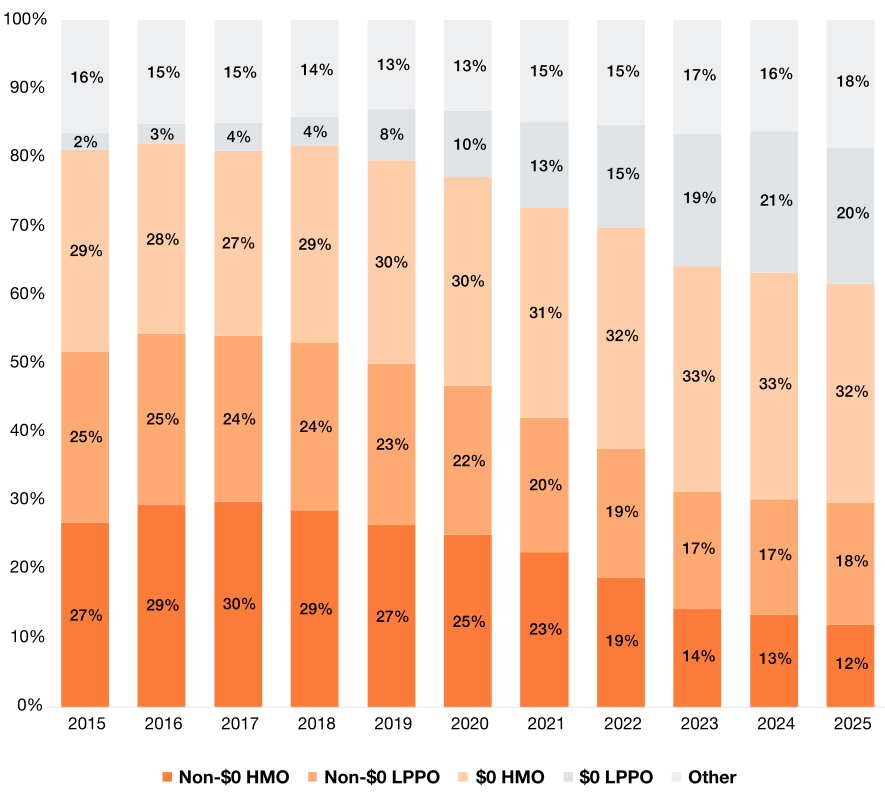
Historically, $0 premium plans existed but were mostly narrow-network HMOs with modest offerings. That changed when some insurers began to scale the $0 PPO, igniting a competitive explosion. By 2019, many of the major national and regional plans were in the game, layering richer benefits on top of broad-network products. Paradoxically, the cheapest plans became the richest – triggering a member migration that, when utilization spiked in 2023, broke the math. Plans suddenly found themselves trapped within unsustainable benefit structures. For many plans, recalibrating benefit design is not optional but urgent.
Exhibit 5: Distribution of MA plans by type and premium (2015–2025)
Source: CMS Medicare Enrollment Data, CMS Medicare Plan Benefit Package Data, PwC Analysis
Beyond product mix and growth of $0 premiums, this period also marked the start of an increase in the value of supplemental benefits through use of the MA plan’s remaining rebate dollars for non-Medicare covered services beyond the more common hearing, vision, and dental care benefits, such as fitness memberships, meal services, and transportation services. MA plans largely use these benefits to attract members to enroll but are often underutilized by members (Medicare Advocacy). That can make it challenging to prove the value of these services. While SNPs have a growing rebate dollar pool and can continue to fund a rich set of supplemental benefits, MA plans may need to rethink their supplemental benefit strategy for general enrollment as rebate dollars shrink over time.
Exhibit 6: Total Medicare rebate dollars and rebate dollars allocated to supplemental benefits (2014–2025, per member per month)
Source: MedPAC Report
The IRA’s redesign of Part D turned a historically shared-risk model for prescription drug spending into a largely plan-funded model. The donut hole vanished in 2025, and Part D plans’ share of brand and generic drug costs jumped from 20% to 60% (CMS). At the same time, the IRA capped annual growth of base beneficiary premiums to a 6% maximum—decoupling Part D bids from premiums and removing a key lever for plans to offset rising liability (Congress). As a result, national average Part D bids soared from roughly $30 per member per month in 2023 to $239 per member per month in 2026, while premiums remained below $40.
Exhibit 7: National average bid and base beneficiary premium (2014–2026, per member per month)
Source: CMS Medicare Plan Benefit Package Data, Medpac Reports, PwC Analysis
MAPD sponsors can partially buy down Part D liability through Part C rebate dollars, but standalone PDPs have no such lever and face the same margin pressure. As a reaction, some health plans may decide to integrate their PDPs with other plans or exit the market. CMS reported a 35% decrease in PDP offerings between 2024 and 2025 and another 22% decrease in 2026. Even for integrated plans, pharmacy spending in high-cost therapeutic areas such as oncology and obesity is expected to grow ~25% and ~100%, respectively, due to demand for novel and innovative therapies (IQVIA).
The bottom line is clear. The next margin battle in MA will be in pharmacy management, a function that many plans outsource today, where plans who fail to rebuild their Part D strategy will see erosion in their MA market position.
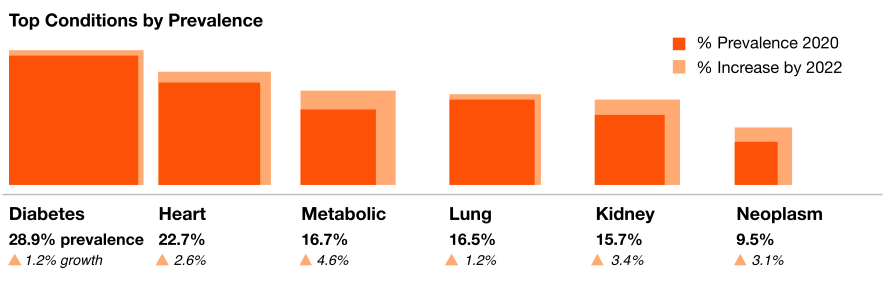
Elevated utilization is no longer a temporary post-pandemic blip—it’s structural. Since 2022, CMS showed a sustained annual 2–3% trend in inpatient spend and a 7-8% trend in outpatient hospital spend attributed directly to utilization and volume increases (CMS). Behind those numbers is a population living longer but with heavier disease burden. Diabetes now affects nearly one in three MA beneficiaries, and obesity rates have climbed roughly 4 percentage points over the past decade to 30% prevalence in seniors (CDC, CDC).
Exhibit 8: Change in condition prevalence among MA beneficiaries (2021–2023)
Source: Care Journey Medicare Claims Data, PwC Analysis
Providers, meanwhile, are responding to increased resource demand and margin pressures with a renewed focus on coding intensity and revenue cycle optimization. There have been notable increases in the share of Medicare Advantage claims with the highest-level complexity codes being used from 2023 to 2025 – with as high as a 7% increase in level 3 codes observed in excision / biopsy / incision and drainage procedures for example. Inpatient and outpatient unit costs in Medicare have also experienced sustained growth above inflation at 3-4% since 2022 (CMS). For payers, the compounding effect—more claims, more complex cases, and higher per-unit costs—translates into a sustained medical expense trend that shows no sign of easing.
Exhibit 9: Percentage of procedures / services by complexity level for Medicare Advantage (2023–2025)
Source: PurpleLab Claims Data
Looking ahead to 2026, plans should expect continued upward pressure on claims from aging cohorts and provider rate renegotiations. Medical cost management will be a key component of margin stabilization as MA plans look to stabilize in 2026 and beyond.
The story of MA is shifting. Eligibility will likely continue to rise, but the question is, who will be able to profitably serve those members? Payers that accept margin compression as a baseline and build resilience into their model are going to be better positioned to succeed in the future. Key elements of a successful strategy can include:
The MA market has entered a new phase. Enrollment growth remains a strategic prize, but the playbook that delivered margins in the past no longer suffices. The same payers that led on margin a decade ago still lead today, not because they escaped any headwinds but because they built organizations wired to anticipate and adapt to change faster than others. The winners in the future will likely be those that do not treat these capabilities as nice-to-have but as core strategic enablers. MA enrollment will continue to rise, yet sustainable profitability will be captured by organizations that see change early, act decisively, and execute consistently.
Kelly Tamburo and Billy Keim contributed to this article.
{{item.text}}
{{item.text}}