







{{item.videoDuration}}
{{item.title}}
{{item.text}}

{{item.videoDuration}}
{{item.text}}
The US healthcare system is poised for a fundamental transformation, with more than $1 trillion of annual spend expected to shift from today’s fragmented, infrastructure-heavy model toward digital-first, consumer-centered, and data-powered care. The next 12–24 months are a critical window for medtech companies to put the building blocks in place, modernizing commercial execution making data AI-ready, reshaping operating models for speed, launching ecosystem partnerships and actively reshaping portfolios. Those who embrace this new way of operating can create differentiated outcomes and free up the capacity to reallocate toward higher top-line growth — performance that investors will reward.
For decades, medtech companies thrived by delivering exceptional product innovation, generating strong growth, high margins and consistent market outperformance. But this performance often masked operational inefficiencies such as disconnected systems, fragmented teams and underdeveloped enterprise capabilities. That margin for error is gone.
Medtech leaders now face a far tougher environment. Investor scrutiny is rising, regulatory and reimbursement hurdles are intensifying, AI-native competitors are entering the market and customers are demanding more for less. In this climate, leaders should show they can create value beyond the product itself.
Medtech is being reshaped by powerful disruptions. The home is becoming the hub for diagnosis, intervention and recovery. Hospitals are evolving into modular care ports designed for short-stay procedures. Virtual teams, remote monitoring and AI-supported decision-making are extending care far beyond traditional facilities. At the same time, new entrants, digital platforms and data-native competitors are redrawing the lines of competition.
In this environment, breakthrough products alone are no longer enough. Profit pools are shifting toward product-enabled services, data-driven solutions and integrated care models where value is created over time. Medtech companies can serve as connectors across the healthcare industry and devices can become entry points into wrap-around offerings — analytics, digital monitoring and service pathways — that deliver measurable outcomes. Top performers will be defined by their ability to consistently execute across five foundations: data, operating model, ecosystems, portfolio and commercial excellence. The most successful medtech companies will be those that let go of legacy models and adopt this new playbook, positioning themselves to lead the future of health.
Even a future-ready portfolio cannot deliver its full potential without effective commercial execution. You can build the most innovative, synergistic portfolios in the market, but they may never realize the value without today’s version of commercial excellence.
Importantly, commercial excellence is not one-size-fits-all. Different parts of your portfolio demand different models. High-growth categories merit full sales coverage, digital engagement and AI-augmented account teams, while mature businesses may be sustained through leaner approaches such as AI agents and centralized account support. Reallocating your commercial spend this way can drive outsized top-line growth without equivalent downside risk, freeing up capital to reinvest in priority areas. This is the commercial/portfolio connection that separates leaders from laggards.
Many companies still run outdated go-to-market strategies to grow sales. But customers no longer buy in a straight line; marketing “reach” does not equal influence and long-standing sales processes have outlived their value.
Leaders are pivoting their commercial efforts to where decisions are made. They fund and activate the most critical call points, use influence maps to navigate complex buying journeys, design coverage for how buyers behave and segment by value and propensity to buy. Their marketing content focuses on the real drivers of adoption-clinical outcomes, workflow impact and economics. And they relentlessly measure the metrics that matter: share of wallet, market share and headroom, where they’re winning or losing by segment, and the mix of new versus existing customer contribution.
Commercial processes are being rebuilt to be AI native. Manual quoting, pricing, contracting and customer service are automated or moved to self-service. Frontline teams are amplified with customer insights, guided players and digital enablers to workflow.
Commercial excellence, done this way, is a force multiplier. It aligns efforts to influence, matches how stakeholders make decisions and uses AI to turn everyday interactions into faster, sustained adoption.
Medtech companies generate vast volumes of data across the value chain whether commercial, R&D, manufacturing, regulatory, quality or customer service and, increasingly, through connected devices as well. Too often, this data remains locked in silos, constrained by outdated governance and legacy IT systems, limiting visibility, slowing decisions and leaving value on the table.
That model no longer works. In an AI-driven world, leaders will treat data not as a passive asset but as a product that is discoverable, consumable and actively exchanged both internally and through a robust data marketplace accessible to partners across a continuum of care. When executed well, this approach makes data interoperable, AI-ready and directly linked to outcomes such as faster regulatory approvals, predictive quality, stronger compliance and better patient experiences. It also accelerates product development, improving success rates, performance and market impact.
This transformation is as much cultural as it is technical. Success requires new ownership models that empower your company to act on insights. It demands aligned incentives, modern capabilities and a shared data vision. Without this discipline, even the largest digital investments will underperform. With it, medtech leaders can turn data into a true growth engine — one that improves margins, accelerates innovation, and strengthens investor confidence.
The medtech sector cannot build the future in the image of the past. Legacy structures and rigid processes are incompatible with the speed, integration and intelligence the market demands. Despite heavy investment in digital transformation, many organizations still move slowly, fail to work effectively across functions and struggle to fully leverage disruptive technological innovations.
Future leaders will operate as intelligent enterprises that are outcome-oriented, data-enabled and built for agility at every level. This means breaking down silos, embedding analytics into everyday workflows and redesigning org structures and processes to empower a hybrid workforce of human and AI agents.
One proven accelerator is the creation of AI centers of excellence where business, technology and clinical teams co-design, test and launch solutions in rapid, iterative sprints. The concept of multifunctional teams working in sprints isn’t new. The critical difference is the industrialization of this process and commitment to make it a permanent fixture in the operating model.
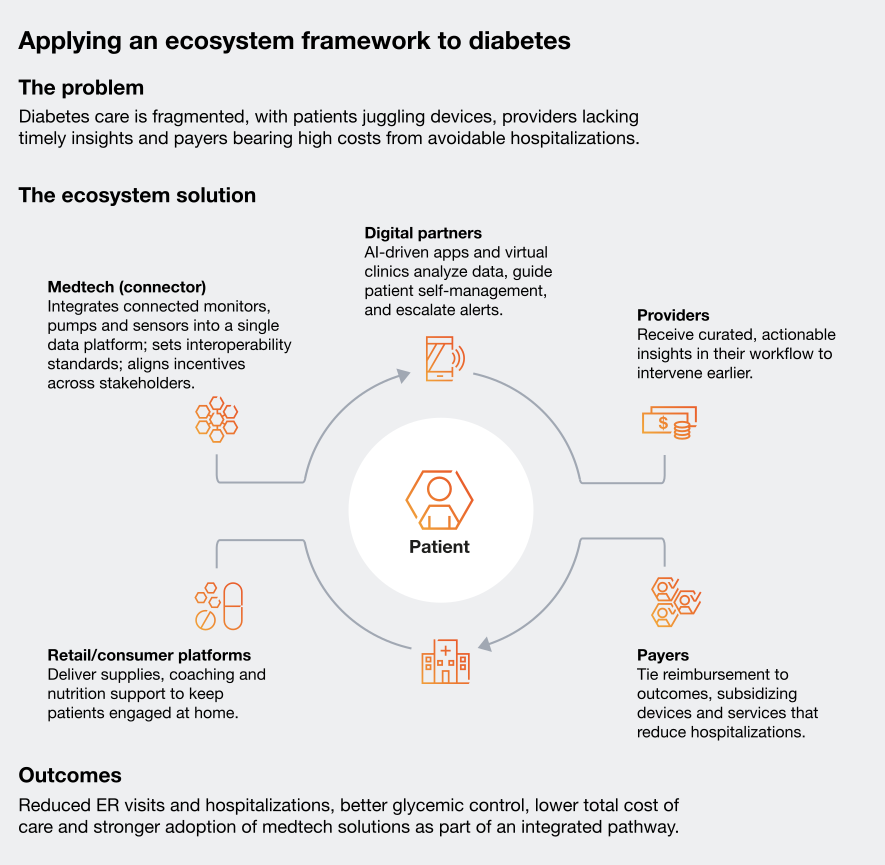
The next wave of medtech growth will come from reimagining the value proposition and the business models that deliver it. To lead, medtech companies should become orchestrators of care with diagnostics and therapeutics converging into one seamless, adaptive system. Medtech should evolve from stand-alone hardware to intelligent infrastructure.
Devices won’t just collect data, they will enable real-time diagnostics and insights that guide decision-making across the care continuum. Embedded intelligence will link devices directly to care teams, enabling timely interventions whether the patient is at home, in the hospital or on the move. The next wave of differentiation will come from brain-computer interfaces between patient and device, remote monitoring, robotics and neuromodulation as software and connectivity.
Leaders are making deliberate choices about where to compete, where to partner and how to share value — sometimes through joint ventures, sometimes through co-development partnerships and increasingly through collaborations with retailers, payers or digital platforms to create integrated care pathways that combine diagnostics, therapies and services.
But success requires internal readiness. Harmonized data, interoperable technology, flexible structures and outcome-based revenue models are essential for sustaining collaboration. Too many partnerships fail because incentives are misaligned, technology cannot scale or internal teams remain siloed. Companies that succeed apply the same clarity, accountability and discipline internally that they demand from their external partners. Early movers are already realizing benefits such as faster product uptake, stronger provider relationships and distinctive positioning in a crowded market.
Delivering leading shareholder returns in the medtech industry will require a strategy to achieve durable, industry-leading top line growth. Rapid technology shifts and new care models demand continuous portfolio shaping — balancing organic innovation with bold inorganic moves.
Leading medtech companies will focus on:
The most agile players will make disciplined, data-driven capital allocation decisions while also building the capabilities to capture value.
Source: PwC analysis of Capital IQ data on 297 transactions between December 31, 2011, and October 31, 2022
The next generation of medtech leaders will not be defined by products alone, but by how they rewire their businesses across five dimensions: commercial excellence, data, operating model, ecosystems and portfolio. Discipline is the differentiator. This is not only financial discipline but also operational clarity, decision-making speed and cultural accountability.
The opportunity is clear: Strengthen five foundations and create the discipline gap that separates leaders from laggards. Small differences in execution over the next 18 to 24 months will compound into lasting advantages in growth, competitiveness and investor returns.
If the answer to any of these is no, it’s time to make a change.
{{item.text}}
{{item.text}}