





{{item.videoDuration}}
{{item.title}}
{{item.text}}

{{item.videoDuration}}
{{item.text}}
Tariffs, drug pricing proposals and geopolitical headwinds are rewriting the rules of global trade. For pharmaceutical and life sciences executives, reacting isn’t enough. It’s time to rewire supply chain strategies for resilience. Traditional network models weren’t built for this pace of change. Now, agility and foresight must drive every decision — from sourcing active pharmaceutical ingredients (APIs) to optimizing production footprints.
Most pharma leaders (89%) say they will change their supply chain strategies as a result of US trade policies and almost as many (87%) say supplier and material costs will increase significantly in the next 12 months. If you’re ready to move from risk to advantage, you can take three decisive action steps today to strengthen your supply chains for what’s ahead.
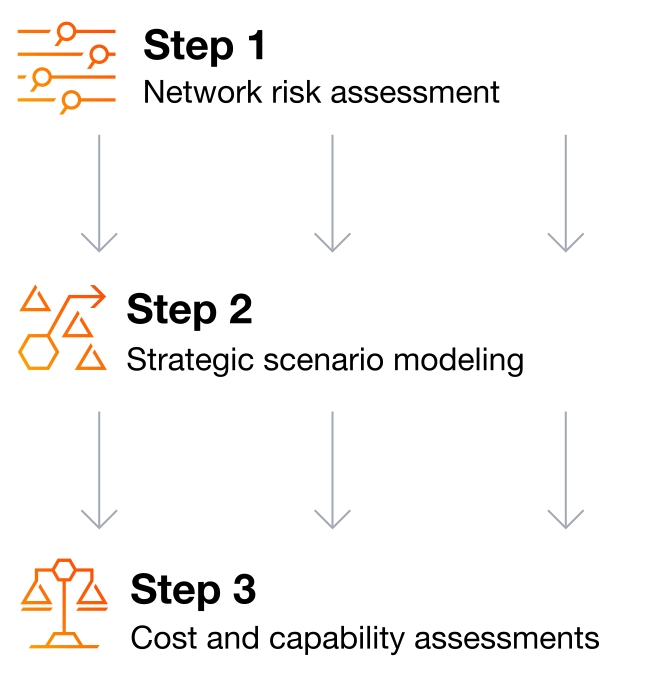

Start with a clear view of your vulnerabilities. Conduct an end-to-end risk assessment of your entire product supply chain — from raw materials and APIs to finished drug products, components and device releases. Map dependencies in high-risk regions like China and India. Flag where single-source suppliers expose you to potential tariff shocks or regulatory disruptions.
For instance, a dependency assessment of APIs or device components sourced from regions vulnerable to tariffs can guide decisions on diversification or dual sourcing. These assessments can take time, but they’re foundational to building a supply chain that can adapt under pressure. This isn’t just a diagnostic. It’s your blueprint for change. The earlier you act, the more room you’ll have to diversify suppliers, dual-source critical materials and stay ahead of global shifts.
With today’s digital tools — like AI-driven simulations and digital twins — you can explore how different scenarios affect cost, profitability and regulatory compliance. Simulate tariff hikes. Factor in pricing policy changes. Layer in competitive moves. Then make decisions grounded in data. For example, modeling the full financial impact of shifting oncology drug production from offshore to domestic facilities — while factoring in pricing, margin pressure and regulatory compliance — can reveal new opportunities to stay competitive.
Run a deep assessment across your internal and external networks. Where are the high-efficiency, high-automation sites and where are the gaps? A plant with exceptional overall equipment efficiency but limited geopolitical security may still be indispensable due to its unique knowledge and capabilities. Conversely, lower-performing sites requiring significant capital to meet modern automation standards should be addressed with a long-term network strategy in mind.
Conduct a thorough assessment of facility capabilities using automation solutions and AI-driven shop floor analytics. Evaluations should include technological infrastructure, manufacturing flexibility and facility-specific product qualification capabilities. Opportunities should be informed by rigorous cost-benefit analyses and return-on-investment metrics to balance resilience and operational efficiency.
Once your network scenario planning model is in place, it’s time to activate governance that drives impact.
Oversight, ownership and the ability to track change are essential in an uncertain policy environment. Position your network not just to withstand shocks, but also to grow through them.
{{item.text}}
{{item.text}}


