







{{item.videoDuration}}
{{item.title}}
{{item.text}}

{{item.videoDuration}}
{{item.text}}
Hospital care that goes unpaid can be a significant financial challenge for health systems today. Uncompensated care (UCC), which refers to hospital services provided to patients for which no payment is received, has been on a steady rise over the last several years. But with the right guidance and tools, financially strained providers can find reimbursement solutions for uncompensated care.
Hospitals across the United States accumulated over $36 billion per year in uncompensated care costs over the last three years according to the Federal Fiscal Year 2026 proposed rule published by the Centers for Medicare and Medicaid Services (CMS). As providers navigate UCC processes and changes in UCC payment pools, they have options for reimbursement opportunities:
Here are a few scenarios that illustrate the solutions that are available to providers seeking reimbursement for uncompensated care and the benefits, or drawbacks, of each. The scenarios show the compensation that providers can expect in a patient account with $100,000 in unpaid charges.
For patients who meet the specified criteria in a provider’s financial assistance, charity care or uninsured discount policies, their accounts can be written off from active accounts receivable and included for UCC reporting on Medicare Cost Report Worksheet S-10. Remember, however, that the reimbursement will not cover the actual charges. In this example, $50,000 ($100,0000 in unpaid charges multiplied by the 50% uninsured discount, as noted above) is written off to a financial assistance adjustment or uninsured discount. This translates to $12,500 ($50,000 write-off multiplied by 25% cost-to-charge ratio) of uncompensated costs, and the estimated reimbursement from the Medicare UCC pool would be $2,250, or approximately 18% of the uncompensated costs or 2.25% of unpaid charges. The 18% and 2.25% are not regulatory determined amounts but estimates based on UCC payment pools and years of experience. This reimbursement is distributed over three years of UCC payments, so collection may take time.
Presumptive charity care can be useful for reducing costs borne by providers and patients. While reimbursement for these accounts may still takes time, as it comes through the same UCC payments as mentioned in the first example, there is less risk that a portion of the unpaid charges will go unaccounted for if patients are eligible for a full presumptive charity discount. The costs in this example are $25,000 ($100,000 in unpaid charges multiplied by the 25% cost-to-charge ratio,) which produces estimated UCC reimbursement of $4,500 (approximately 18% of costs or 4.5% of unpaid charges). There are also potential cost savings. Since the account was presumed to be charity care, the cost of collection was removed as patient bills were not sent, collection agencies were not involved, and the labor cost for helping patients apply for financial assistance was eliminated. Additionally, supplemental state Medicaid payments may be available related to uninsured accounts that receive presumptive charity adjustments.
The difference between the 2.25% and 4.5% UCC reimbursement for unpaid charges is due to the 50% uninsured discount in Scenario A versus the 100% presumptive charity discount in Scenario B.
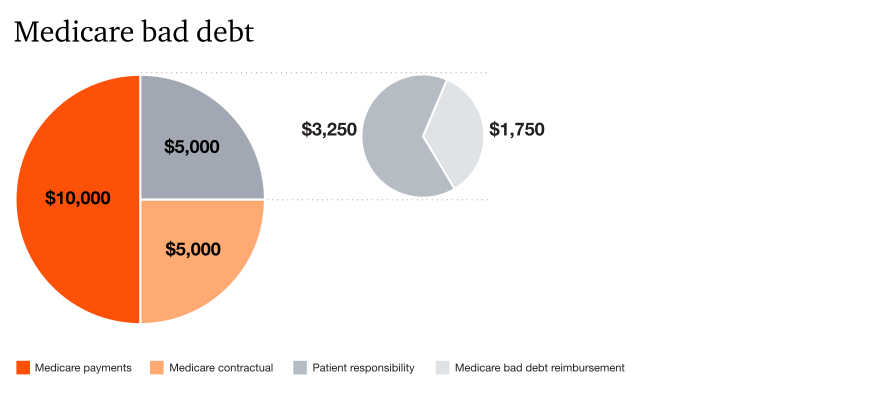
For Medicare accounts, Medicare bad debt is a preferred avenue of reimbursement as these are paid at 65% of charges, rather than the less than 20% of costs received for an insured charity care account reported on Worksheet S-10. Medicare bad debts are, however, subject to more stringent regulations. These include restricting claimed amounts to just the patient’s responsibility (Medicare deductible, coinsurance, copay) and the requirement that providers should wait at least 120 days from the date the patient is billed to consider an account uncollectible. The benefits here can be seen in both the reimbursement timing and amount. The estimated reimbursement in this example would be 65% of the $5,000 patient responsibility, or $3,250. This compares to just $900 ($5,000 multiplied by the 18% reimbursement estimate) if claimed as insured charity care on Worksheet S-10 and would be received through bi-monthly pass-through payments rather than three years of UCC payments.
While there are various other reimbursement opportunities for Medicare providers to explore, these examples highlight the importance of capturing and reporting accounts in the correct way.
Health systems can explore several strategies to improve the reimbursement they receive for uncompensated care.
Contact us to help you implement reimbursement strategies for your uncompensated care accounts.
Jeff Baird and Ben Taylor also contributed to this article.
{{item.text}}
{{item.text}}


