






PwC’s 2025 US Healthcare Consumer Insights Survey

The consumer-first era of health

Decorative image
  • Insight
  • 10 minute read
  • October 20, 2025

In 10 years, the US healthcare system could look radically different: preventive, personalized at scale, digital-first and accessible anywhere. The system faces mounting pressure to evolve as market dynamics, including rising costs and advancements in technology and biology are compounding to force a change. A groundswell from consumers is propelling this transformation into existence. What once felt like a distant vision is now within reach.

The sandwich generation wants to be empowered and is eager for solutions.

Millennials and Gen X, who care for both children and aging parents, want new innovations like smart health devices, robotic assistants and unified platforms to ease their caregiving burden.

68%

encounter a barrier when accessing healthcare (vs. 55% of all consumers).

61%

worry about affording care if they lose job/insurance (vs. 53%).

71%

are currently using or interested in using AI-assisted diagnosis, leveraged and reviewed by their doctor (vs. 56%).

73%

are using or interested in AI-powered care navigation tools that recommend the right provider or care setting (vs. 53%).

Gen Z is demanding and defining the change.

As the first digital-native generation, they see healthcare through a different lens and act on digital data sources.

57%

of Gen Z have trust in primary care physicians (vs 85% for Boomers).

~36%

of Gen Z and Millennials trust tech and retail companies for care (vs. 21% Gen X+).

79%

of Gen Z use health tech, such as wearables, telehealth, online prescription services, etc., on a monthly basis (vs. 70% of all consumers).

~20%

of Gen Z and Millennials are more likely to use insights from digital health and AI tools to guide their care.

Together, these generations are redefining healthcare on their own terms. They are signaling, funding and accelerating the shift toward a new system of health—one that organizations should serve if they want to remain relevant in the decade ahead.

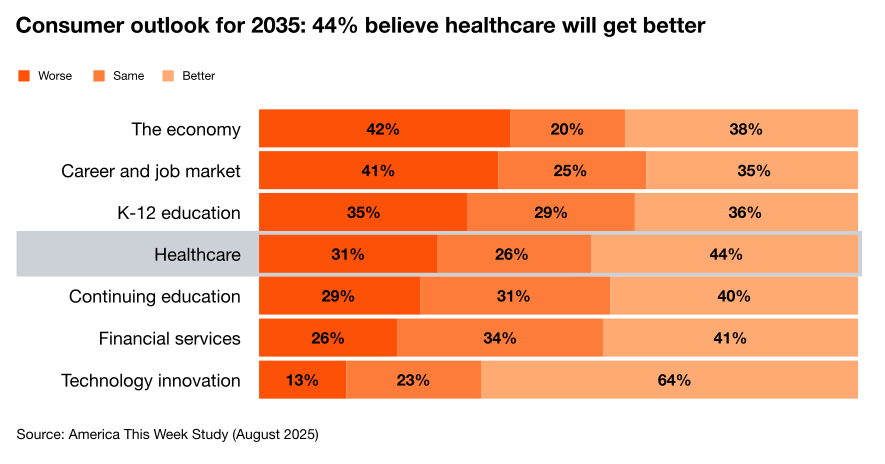
Consumers are optimistic about healthcare in 2035 driven by the potential of technology advancements.

Among the 44% who believe healthcare will improve in the next 10 years, optimism is fueled by:


Advancements in medical technology 
%
Early detection and prevention
%
AI integration
%
More personalized treatment
%
Better virtual access
%

Base: All Qualified Respondents (n=4,030); Optimistic About Healthcare (n=1,800)
Q30: In 2035, I expect the experience of receiving healthcare in the US will be... (Single Select)
Q31: You indicated healthcare experiences will improve by 2035. What makes you feel that way? (Select all that apply)
Source: PwC’s 2025 US Healthcare Consumer Insights Survey

The shift is already underway.

Consumers aren’t waiting for the healthcare system to evolve—they’re driving the change themselves. Their behaviors, expectations and willingness to invest are early signals of transformation underway. 

65% of consumers want a system built around prevention, not treatment. The mindset is shifting from “sick care” to proactive health investment.

Seven in ten consumers already use health technology monthly—from wearables to apps and portals—and expect to adopt emerging tools like AI-assisted personalized care plans and genomic screening within five years.

At least one in five consumers would pay more out of pocket for personalized treatment (28%), continuous monitoring (22%) or unified digital platforms (19%). The willingness is even higher among Gen Z and Millennials.

Consumers are most comfortable with AI handling administrative and triage tasks—freeing clinicians to focus on care—and ~13% say they would pay a premium for AI-orchestrated post-visit support.

High-income ‘super consumers’ lead on innovation: 75% of $100K+ household income earners using health tech monthly and 51% reporting they would like to receive or have received in the last 12 months at-home care — trends that will expand as costs fall and digital access becomes democratized.

Younger generations are redefining how, where and when care happens. Gen Z and Millennials are far more likely to seek care outside traditional settings—40% and 42% have used virtual visits in the last 12 months compared with Gen X (33%) and Boomers (20%).Many have used retail or urgent care clinics in the past year (44% Gen Z, 37% Millennials vs. 31% overall).

Despite current gaps, technologies such as genomic screening (54%), AI-assisted diagnosis (46%) and personalized medications (57%) show interest across income levels—signaling that transformation can scale equitably.

Each of these signals point to the same reality: transformation is already happening, one consumer decision at a time.

Barriers must be overcome.

Despite this consumer-led groundswell, persistent pain points threaten to stall progress.

Many believe the system is broken. Systemic dysfunction hits the most vulnerable the hardest.

51%

of consumers agree the healthcare system is fundamentally broken.

58%

agree access to healthcare in America depends on income or status and that number jumps to 71% among uninsured consumers.

53%

of uninsured consumers are living with a current healthcare need they’re not addressing because they can’t afford it compared to 31% of all consumers.

The universal affordability crisis. Cost anxiety transcends all demographics; even the insured and affluent fear healthcare affordability.

Top universal cost concerns: 


Cost not covered by insurance 
%
Long-term or chronic care costs
%
Out-of-pocket (copays and deductibles)
%
Cost of emergency care
%
High insurance premiums
%

Base: All Qualified Respondents (n=4,030)
Q12: What is your level of concern about the following healthcare costs? (% Somewhat / Very Concerned)
Q15: To what extent do you agree or disagree with the following statements? (% Somewhat / Strongly Agree)
Source: PwC’s 2025 US Healthcare Consumer Insights Survey

The healthcare access divide is wide and deep.

Anxiety about uncovered costs cuts across every demographic, not just the uninsured. And even those with “good” coverage aren’t immune.


All customers
Medicaid recipients
Uninsured

Negative care experiences (in the past 12 months)
%
%
%
Can't afford recommended care (% delayed/skipped appt., text, prescription - net)
%
%
%
Quality care gaps (% received an incorrect diagnosis)
%
%
%

Base: All Qualified Respondents (n=4,030); Received Care in P12M (n=3,509)
Q9: In the past 12 months, have any of the below negatively impacted the quality of healthcare you or a dependent received? (Select all that apply)
Q11: In the past 12 months, have you done any of the following for yourself or a dependent due to healthcare costs? (Select all that apply)
Source: PwC’s 2025 US Healthcare Consumer Insights Survey

Heavy caregiver burdens weigh on many. 32% of consumers identify as caregivers.

Provider stress experienced by consumers: Burnout and strain are visible to patients.

What consumers observe in their providers


Rushed or pressed for time 
%
Distracted or not fully present
%
Burned out or exhausted
%

Base: All Qualified Respondents (n=4,030); Received Care in P12M (n=3,509)
Q13: In your healthcare interactions over the past 12 months, how often have you felt that your healthcare provider appeared... (% Experienced)
Q15: To what extent do you agree or disagree with the following statements? (% Somewhat / Strongly Agree)
Source: PwC’s 2025 US Healthcare Consumer Insights Survey

Four strategic imperatives for healthcare leaders.

Leaders have a narrow window to harness consumer optimism and dismantle systemic barriers

The next two to three years represent a critical window for organizations to establish themselves before tech companies and retailers could take the lead. To fully capitalize on this consumer revolution, leaders should act on four strategic imperatives.

1. Unhook growth from real estate

Consumers are moving away from in-person visits toward virtual, at-home and retail models. Growth won’t come from square footage but from scalable, digital-first platforms. While 72% of consumers received care at a doctor’s office in the last 12 months, only 34% say they would ideally like to receive care at a doctor’s office in the future.

Actions for leaders
  • Shift capital from facility expansion to tech-enabled virtual delivery. 

  • Invest in virtual platforms, AI-driven tools and retail partnerships. 

  • Redesign business models around “care anywhere,” not “care onsite”.

2. Build the connected ecosystem

Fragmentation is the number one pain point for consumers. They want one system, not ten apps. A connected ecosystem is now table stakes for loyalty. Only 26% of consumers consider it very easy to see their medical records across providers or systems.

Actions for leaders

  • Prioritize building integrated, unified digital ecosystems like connected health records and coordinated care platforms
  • Push for adoption of open APIs, FHIR, and other interoperability frameworks. 
  • Partner with tech vendors and regulators so the data can flow securely across platforms and organizations. 


3. Target high-opportunity markets

Some groups are disproportionately strained — caregivers, those with chronic conditions and families juggling multiple generations. These groups represent a market which places higher value on innovative solutions such as smart health devices, robotic assistants and unified platforms that ease the strain of balancing their own and their family’s health. 

Actions for leaders
  • Design tailored offerings like AI care navigation for caregivers and smart health devices for chronic patients.
  • Prioritize affordability and convenience for these groups, as they represent both near-term adoption and long-term loyalty.
  • Pilot solutions with these segments to build proof points before broader launches.


4. Democratize access

Innovation should reach all income levels. Income gaps in healthcare technology already exist, with higher-income consumers far more likely to embrace virtual care, concierge models and premium digital services. Leaders who democratize access can define the next growth frontier in healthcare.

Actions for leaders
  • Scale advanced innovations like AI triage and personalized medicine with pricing models that broaden access. 

  • Build trust through transparency, education, and partnerships in underserved communities. 

  • Tie investments in innovation to affordability initiatives, not just premium offerings. 

Consumers are ready. Are you?

Consumers want preventive care, personalization and digital-first access. Organizations who respond now can unlock relevance and long-term growth and build a system ready to better serve the patients of the future.

The consumer-first era is here

Download PwC’s 2025 Healthcare Consumer Personas to understand who today’s healthcare consumers really are—and how to win their trust. 

About the survey

PwC conducted an online quantitative survey and captured insights from 4,030 US consumers on their attitudes and opinions towards the healthcare system. Consumer respondents in the online survey were adults 18 and older with demographic weighting to achieve US Census representation. Fieldwork was conducted between June 27 and July 9, 2025. PwC has exercised reasonable care in the collecting, processing, and reporting of this information but has not independently verified, validated, or audited the data to verify the accuracy or completeness of the information. PwC gives no express or implied warranties, including but not limited to any warranties of merchantability or fitness for a particular purpose or use and shall not be liable to any entity or person using this document, or have any liability with respect to this document.

The consumer-first era of health 

New consumer demands are reshaping healthcare. PwC’s 2025 US Healthcare Consumer Insights Survey reveals insights to drive growth, innovate, and optimize your business for the future.

Download the report

Contact us

Glenn Hunzinger

Glenn Hunzinger

Health Industries Leader, PwC US

Greg Rotz

Greg Rotz

Pharmaceutical & Life Sciences Advisory Leader, PwC US

Thom Bales

Thom Bales

Principal, Health Services Advisory Leader, PwC US

Keith Fengler

Keith Fengler

Principal, Customer Service and Channels Lead, PwC US

Phil Sclafani

Phil Sclafani

Principal, PwC US

Claire Love

Claire Love

Deals Strategy & Pharma and Life Sciences Principal, PwC US

Alena Taylor

Alena Taylor

Principal, PwC US

Follow us

Required fields are marked with an asterisk(*)

Your personal information will be handled in accordance with our Privacy Statement. You can update your communication preferences at any time by clicking the unsubscribe link in a PwC email or by submitting a request as outlined in our Privacy Statement.

Hide