





{{item.videoDuration}}
{{item.title}}
{{item.text}}

{{item.videoDuration}}
{{item.text}}
Artificial intelligence (AI) is already transforming how pharmaceutical and life sciences companies work. From R&D and manufacturing to finance and compliance, AI is helping reshape core enterprise functions across the value chain. Sixty percent of pharmaceutical executives have already launched generative AI (GenAI) pilots, according to a 2024 survey. Thirty-two percent are scaling them across functions like R&D, quality and regulatory. Nearly 70% believe AI will fundamentally reshape operating models within the next three years.1 And the market is following suit. Pharma investment in AI is expected to grow from around $2 billion USD in 2025 to more than $16 billion by 2034 — growing at nearly 27% a year.2
Computer system validation — the process by which companies confirm a software meets its intended purpose — remains one of the most fundamental functions in regulated pharmaceutical and life sciences. Traditional validation methods rely on thorough documentation, manual processes and deep specialist oversight. They’ve served their purpose, but they’re too slow, rigid and resource-heavy to match the speed and complexity of today’s digital landscape. Many leading companies are turning to AI to help close the gap and prepare for tomorrow’s greater demands. They are automating tasks like drafting documentation, assessing risks and accelerating submissions. That means shorter timelines and greater consistency — all while meeting regulatory requirements and enabling audit readiness.
Still, many organizations remain anchored in outdated approaches. The cost? Slower speed, reduced scalability and limited flexibility.
AI introduces a step change — moving validation from static, human-intensive workflows to adaptive, intelligence-driven systems. Increasingly, pharmaceutical companies are deploying AI to help interpret system changes, generate or update validation outputs in real time and support smarter, risk-based decision-making. This shift doesn’t just make validation faster. It can make it adaptable for the future without compromising rigor.
Regulators are evolving, too. The Food and Drug Administration’s (FDA) 2025 draft guidance outlines how to assess AI credibility in regulated use cases.3 Frameworks like ISPE’s GAMP 5 and global standards like ICH are now incorporating AI principles and automated manufacturing practices.4,5 What began as experimentation is now expanding into enterprise-scale transformation in the industry. 91% of pharmaceutical companies recognize AI as a significant opportunity, reflecting its growing impact on quality, compliance, and validation.
Pharma investment in AI is expected to grow from around $2 billion USD in 2025 to more than $16 billion by 2034 — growing at nearly 20% a year.
Compliance leaders should confirm validation stays traceable and ready for audit. Even as automation increases, trust in outputs — and in the process itself — cannot be sacrificed. AI-enabled validation should be grounded in strong controls and transparent processes that help maintain regulatory confidence.
We worked with more than 20 clients and ran focused workshops to analyze over 100 AI-enabled use cases across the validation life cycle. We assessed where large language models (LLMs), intelligent workflows and autonomous agents could meaningfully enhance or transform day-to-day activities. Our goal was to reimagine validation, shifting from document-heavy processes to dynamic systems that generate insights and outputs in real time. We wanted to see where automation could augment — rather than replace — professional judgment, without compromising on compliance or quality.
To do that, we broke validation down into three categories: core outputs, process-driven tasks and supporting operational activities. Then we worked with clients to build tailored implementation roadmaps that can fit their systems and their strategic goals.
In one instance, we developed a modernized approach to help assess reporting and analytics dashboards. Previously, this involved recreating scripts for each dashboard view by hand — capturing filters, navigation and data logic. It worked, but it was slow and inconsistent. In place of this manual process, a GPT-enabled solution helped generate baseline scripts automatically and fill in key elements like navigation path, dashboard links. Human reviewers can focus only on context-specific inputs. The results? A 40% reduction in drafting time and dramatically improved standardization across the lifecycle.
Early wins like that are just the beginning. As AI becomes embedded in how pharmaceutical and life sciences companies operate, validation leaders are being called to step up. This shift isn’t just about smarter tools. It demands new capabilities, stronger oversight and reimagined strategies for compliance.
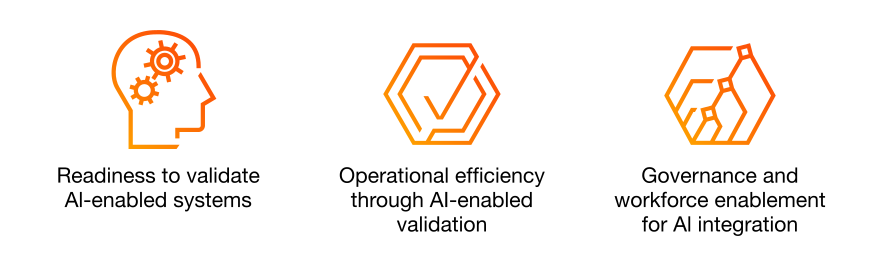
Based on our experience, three enterprise-level enablers are emerging:
Readiness to validate AI-enabled systems: Your organization should be ready to validate AI and machine learning-enabled systems. That means updating operating procedures, documentation and validation methods to account for explainability, algorithm behavior, life-cycle management and alignment with GxP compliance and global regulations. This readiness can help your company meet evolving regulatory expectations — from the FDA to GAMP 5 standards and ICH technical requirements — without scrambling at the last minute. When validation is built into design and life-cycle planning, it enables leaner, faster and more consistent delivery.
Operational efficiency through AI-enabled validation: Your company should evaluate opportunities to deliver efficiency through AI-enabled validation. Generative AI can now generate draft documents, simplify review cycles and speed up workflows. These gains shrink delivery timelines and help reduce the need for large-scale validation teams. That means your in-house specialists on staff can stay focused on high-impact strategic work. Human oversight should still play a role — but only where it’s needed to safeguard accuracy and maintain audit readiness.
Governance and workforce enablement for AI integration: Long-term adoption depends on building governance and skills. Your validation, quality and IT teams should be equipped to manage AI-based tools in regulated environments. That includes upskilling in-house specialists in AI concepts, revising processes and procedures to clearly define roles and embedding mechanisms that can support traceability, transparency and quality.
The opportunity is clear. Pharmaceutical and life sciences organizations now have the chance to go beyond incremental improvements — and build validation systems that are intelligent, agile and ready for tomorrow. The technology is here but lasting impact requires smart integration, trusted governance and skilled teams who know how to make it work. With the right strategy, AI can help you validate faster, scale smarter and stay compliant — laying the groundwork for what’s next in a digitally powered, innovation-driven world.
1 Tom Hughes, “The Growing Value of GenAI in Pharma,” Forbes.com, 2025
2 Deepa Pandy, Aditi Shivarkar, “AI in Pharmaceutical Market,” Precedence Research, 2025
3 “Considerations for the Use of Artificial Intelligence to Support Regulatory Decision-Making for Drug and Biological Products Guidance for Industry and Other Interested Parties,” FDA.com, 2025
4 Brandi Stockton, Eric Staib, Martin Heitmann, “New GAMP ® Guide Addresses Challenges Posed by AI-Enabled Computerized Systems,” ISPE.org, 2025
5 “Artificial Intelligence in Drug Manufacturing,” Food and Drug Administration, FDA.gov, 2023
{{item.text}}
{{item.text}}


