





{{item.videoDuration}}
{{item.title}}
{{item.text}}

{{item.videoDuration}}
{{item.text}}
With its proposed rule, the Department of Labor created a potential safe harbor for selecting designated investment alternatives in defined contribution (DC) plans, which could materially reduce the perceived fiduciary and litigation risk if adopted. The scale of the opportunity for alternative managers is significant. Even a modest 5% allocation to alternative investments across 401(k) and other tax-advantaged retirement vehicles could unlock over $1 trillion in new assets under management by 2030, according to a PwC analysis. At typical fee levels, that translates to about $7 billion to $19 billion in new annual revenue for the alternatives industry, with upside possible as DC adoption grows. It seems likely that retirement plans are the next growth market in alternative asset management as the age of Universal Asset Access comes into view.
Access to DC plans, however, will not be granted to private market assets solely because participants demand them or because of product innovation. Instead, it will be governed, explicitly, by the expectations of investment consultants, plan sponsors, fiduciary gatekeepers and regulators. In DC, success won’t come from being chosen. It will come from being embedded inside target-date funds, managed accounts, multistrategy products and model portfolios. To be embedded, consultants will assess the fiduciary readiness of any private market offering against five rigorous standards. These five standards will ultimately tie back to one central question: whether fiduciaries can reasonably expect a private market allocation to improve participants’ risk-adjusted, net-of-fee outcomes relative to available alternatives.
Five standards that will assess fiduciary readiness of alternative asset offerings are:
Let’s look at how alternative asset managers, DC product owners, and facilitators seeking to enter or scale in this market can get there, meeting the practical requirements of consultant-led distribution in a low-margin, high-scrutiny environment.
$1 trillion is the potential AUM value of a 5% private markets allocation within the US defined contribution system in 2030
Source:PwC Insights Factory analysisUnderstanding what consultants can ask for and what the DOL will expect starts with examining the ecosystem in which they operate. Capturing the private markets opportunity in DC requires navigating a highly intermediated ecosystem where participants rarely choose their own investments. Instead, asset flows are directed through professionally managed defaults, primarily target-date funds (TDFs) that must meet Employee Retirement Income Security Act (ERISA) standards and fit within standardized wrappers like collective investment trusts (CITs) or registered funds.
Decision-making authority in DC ultimately rests with plan fiduciaries, but in practice is shaped by consultants and constrained by recordkeeper platforms. As a result, distribution is not just a channel, it is the mechanism through which fiduciary decisions are implemented. In DC, that mechanism is the target-date fund (TDF). They control nearly two-thirds of 401(k) contributions today, according to Cerulli Associates, a figure that’s expected to reach about 70% by 2030. TDFs are the default engine powering retirement saving, making them the likeliest vehicle for introducing private markets into DC plans at scale.
The TDF-centric structure underpins our $1 trillion private markets AUM in 2030 estimate. Our modeling reflects age-based allocation changes as alternatives become mainstream, yet we projected that alts would be only a partial replacement for fixed income and equity allocations in an industry representative retirement investment glidepath. Our modeling shows that roughly half of future private market AUM would be concentrated in younger participants (aged 20-40). Participants who are 50 years of age and older represent the remaining AUM. Their participation in private markets is likely to be conservative, however there is potential for upside to our model. Private markets’ risk-adjusted alpha versus traditional markets may become more attractive to that demographic to reduce the risk of depleting assets as life spans lengthen. Consultant recommendation frameworks, however, will remain the binding constraint on any age cohort’s adoption of alternatives.
To succeed, asset managers should design offerings that integrate seamlessly into TDFs because in DC, if you’re not in the default, you’re not in the plan. The good news is that once you’re established, change can happen quickly as demonstrated by how quickly TDFs became a central part of DC contributions.
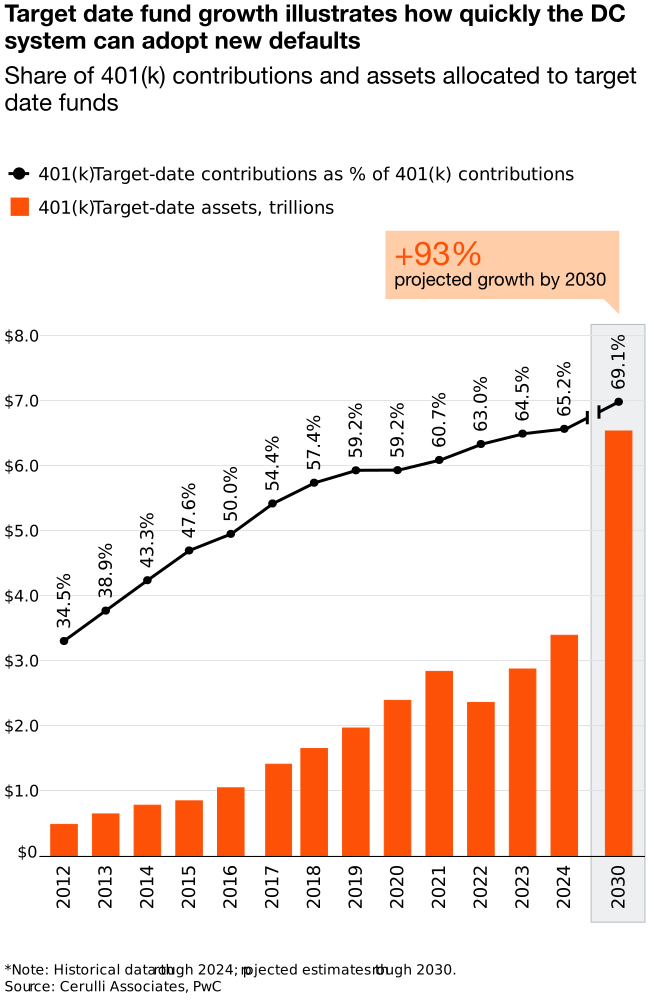
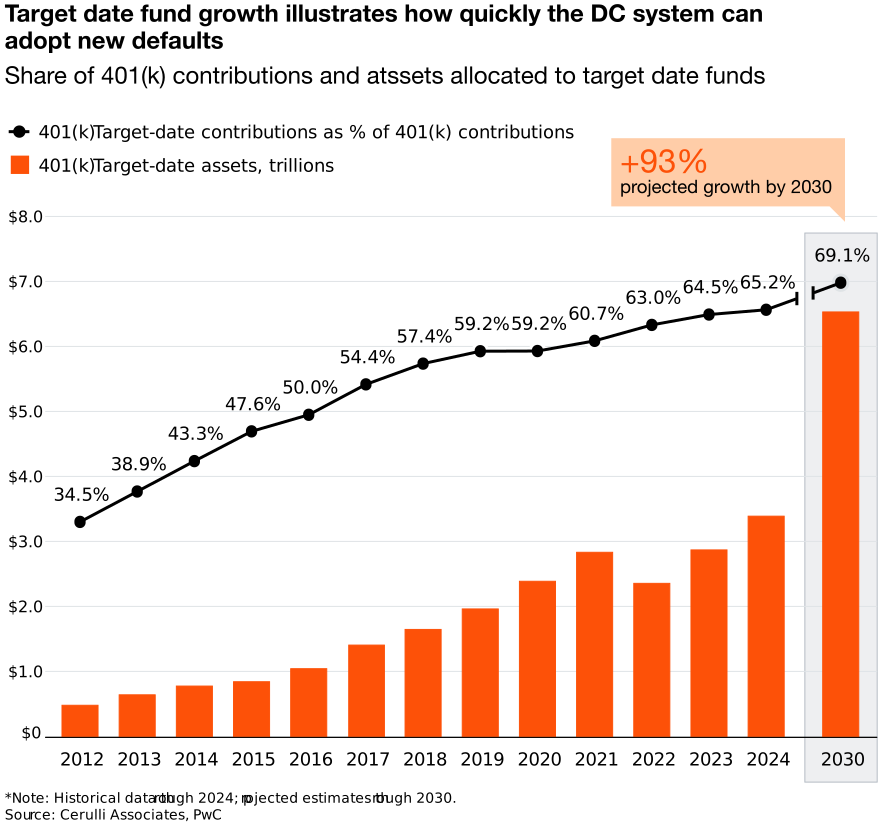
But fitting into that DC default is no small feat. DC platforms impose structurally tighter pricing, deeper disclosure requirements, and complex participant-level operational standards.
Consultants and sponsors will expect private market offerings to integrate smoothly across recordkeeping systems, liquidity windows, participant portals, and fiduciary frameworks. For many alternative managers, these demands will feel like a steep hill to climb. Yet it’s worth remembering that in DC, winning doesn’t mean being chosen, it means being embedded. And the prize is meaningful, perhaps as much as $19.2 billion in additional annual fees across the industry, according to a PwC Insights Factory analysis.
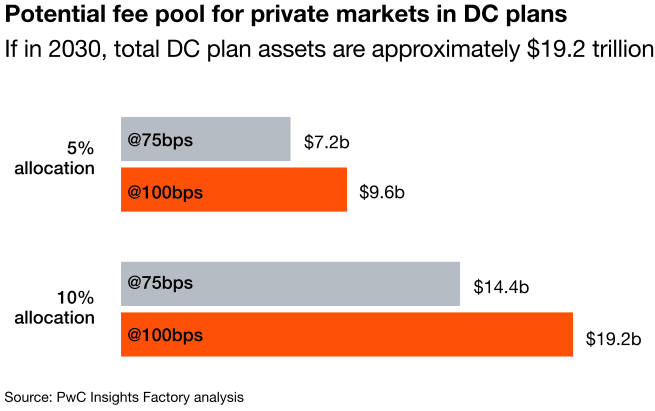
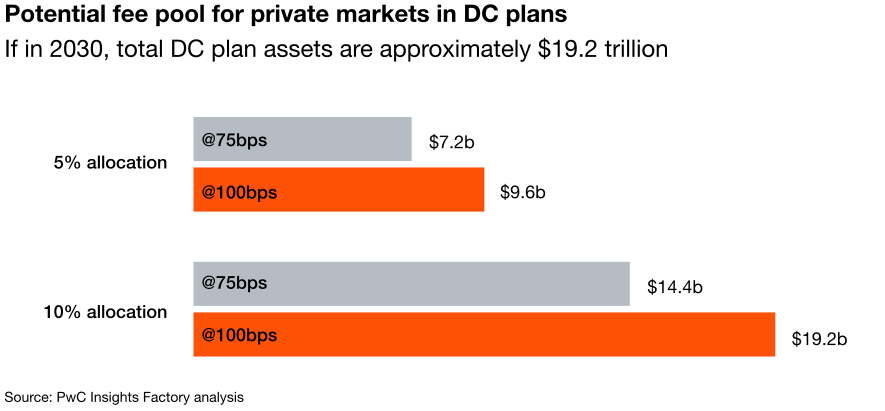
In defined contribution plans, winning does not mean being chosen—it means being embedded.
Let’s examine five critical issues that plan consultants and fiduciaries will likely ask about during a private markets product review and what executives should be focusing on.
Consultants and fiduciaries will expect private market valuations to follow institutional-grade policies and processes that are well-documented, consistently applied, and defensible under fiduciary scrutiny. Managers should be able to demonstrate that their pricing methodologies are reasonable, consistent and fit for use in participant-driven plans.
Managers should demonstrate that valuation approaches support fair participant transactions, enable meaningful comparison of risk and return, and can be clearly explained and documented within a fiduciary decision-making process.
What should you do to meet those expectations?
Consultants and fiduciaries are likely to expect private market structures with liquidity frameworks that function within DC plans. These platforms require immediate settlement of even modest cash flows. Liquidity design is a system requirement and consultants will evaluate whether contributions, withdrawals, loans, and rebalancing can be operationally supported without creating liquidity mismatches.
What should you do to meet those expectations?
DC systems operate at a different level of operational granularity than wealth platforms. They require daily, participant-level accounting, valuation, and transaction processing, which is structurally different from advisor-managed or pooled retail channels. Consultants and fiduciaries will assess whether recordkeepers, custodians, fund administrators, and asset managers can collectively support alternative assets without introducing unmanaged operational risk, including errors, delays, or reconciliation issues. Operational feasibility depends on standardized data feeds, defined tolerances, and repeatable workflows. Systems, data, and workflows will therefore need to be sufficiently robust, transparent, and repeatable to be understood, monitored, and defended within a fiduciary framework.
What should you do to meet those expectations?
Consultants and fiduciaries evaluate private market solutions along two distinct dimensions: first, whether the investment is appropriate within a prudent fiduciary framework, based on its expected contribution to participants’ risk-adjusted, net-of-fee outcomes relative to available alternatives; and second, whether it can be implemented in a participant-directed plan in a way that participants can reasonably understand and use.
Given the complexity of illiquid assets, delayed valuations, and non-traditional structures, behavioral science can be helpful. Providers should understand how trust, fear, and ambiguity shape engagement and what kinds of messaging reduce anxiety around concepts like “illiquid” or “privately valued” assets. Providers should therefore ensure that participant-facing elements, such as account balances, transaction timing, and disclosures, are clear, consistent, and aligned with how the product actually behaves.
What should you do to meet those expectations?
Against a backdrop of sustained fee compression in DC defaults, consultants are likely to ask for a clear explanation of the total fee stack, including any underlying fund fees or tax-related drag from blockers or structure choice. They will expect evidence that the benefit to participants justifies the incremental cost relative to public markets. Fee transparency must be reliable, repeatable, and aligned with recordkeeper disclosure systems to avoid participant surprise and fiduciary risk. The key test is not absolute cost, but whether fees are reasonable relative to the expected return, diversification, and other benefits provided, and how they compare to available alternatives.
Until consultant comfort and fiduciary benchmarks solidify over the next few years, asset managers are navigating fee decisions with incomplete information. Fee decisions today vary based on two underlying beliefs, how much pricing flexibility is required to gain DC access, and whether fiduciaries can ultimately reward long-term net-of-fee value over headline cost. Fee transparency must therefore enable fiduciaries to understand, compare, and document total costs and net-of-fee value, while ensuring participant-facing disclosures are clear, consistent, and aligned with plan systems.
Furthermore, tax-exempt 401(k) plans may have taxable product structures feeding into them from private market investments, including exposure to unrelated business taxable income (UBTI), unrelated debt-financed income (UDFI), and potential tax leakage from blocker structures.
What you should do to meet those expectations?
While these gate-keeper issues may seem insurmountable for new entrants, the reality is that managers who are already in the market and those seeking to enter should redesign their offerings to help bring private assets into 401(k) structures.
The leading DC firms today are there because the system rewards simplicity, scale, and operational reliability, but it also requires that complexity, fees, and liquidity trade-offs be clearly justified in terms of net participant benefit while complexity, rising fees, and fiduciary risk are frowned upon. Managers that can translate private market exposure into structures that are operationally sound, transparent, and fiduciary-ready will be best positioned for adoption.
The firms that invest now have the opportunity to help define the DC marketplace’s standards around private assets, helping them capture share in what may be one of the most significant long-term growth opportunities in the US retirement system.
{{item.text}}
{{item.text}}