





{{item.videoDuration}}
{{item.title}}
{{item.text}}

{{item.videoDuration}}
{{item.text}}
Banks have many reasons to become the leading financial services provider to small- and medium-sized businesses (SMBs). Small businesses are a leading engine of US economic growth, employing nearly half of America's private sector workforce and representing 44% of gross domestic product.1 And banks that want to win their business have a natural opening for starting a conversation: SMBs’ demand for outside financing is soaring as pandemic assistance fades. The share of firms applying for loans, lines of credit or cash advances was 40% in 2022 in a Federal Reserve survey, nearly doubling from 21% a year earlier.2
But the Federal Reserve survey also points out why SMBs are hesitant to turn to a bank for financing: a difficult application process and a potentially long wait for a credit decision. Online lenders can be more attractive to SMBs as they can make decisions more quickly than banks and are more likely to approve financing – highlighting some of the reasons why fintechs, neo-banks and other competitors are gaining SMB market share. However, lending is just one part of the multi-dimensional financial relationship SMBs are seeking.
Starling Bank, with PwC’s help, launched dozens of new products and services to specifically serve entrepreneurs, micro-businesses and small enterprises. That effort helped set the bank apart and contributed to the acquisition of more than 300,000 small-business customers.
1. US Small Business Administration, https://advocacy.sba.gov/, What’s new with small business?, March 2023
2. Source: Small Business Credit Survey, Federal Reserve Banks, March 2023
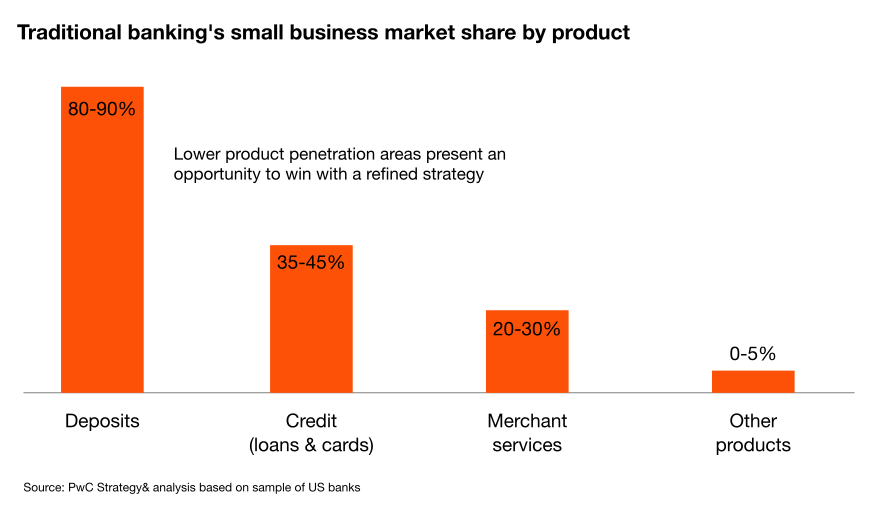
Banks are strong in their core competency of providing deposit and loan services, but they’re typically less well versed in the merchant services, credit card and software offerings that constitute the broad suite of financial services SMBs want as they look to simplify the day-to-day management of their business.
SMB financial services spending can be categorized into four areas:
Given those four areas help business owners manage cash flow, inventory and sales, it should be no surprise that SMBs are gravitating toward unified platforms that address their technology, payments and banking needs.
A unified platform is more than products cobbled together from bank, fintech and third-party suppliers. A unified platform is based on a common data model which can access the information that resides on the computer systems run by the bank and its fintech and third-party partners. When a SMB customer accesses the platform, they see a seamless integration of their operational, financial and balance sheet information that helps them run their business more efficiently and profitably.
Fintechs are taking SMB market share as their cloud-native operations can more easily create a unified platform. But their progress - slowed by funding issues - is an opening for banks to pursue their own unified platform. Competition isn't the only motivating factor: the deposit churn following 2023's bank failures show that durable, stable, long-lasting relationships are especially valuable during times of financial stress. Banks offering a diversified product suite that includes B2B payments and business-management software are aiming to increase customer retention and create stickier deposits.
Many traditional banks are leveraging third-party technology, such as PwC’s Industry Cloud for Banking, which provides services and accelerators that increase scalability, lower costs and enhance customer experience across channels. A flexible architecture lets banks launch our cloud-native, pre-built assets as a replacement to—or in parallel with—existing systems. This can reduce time, expense and regulatory risk and allow banks to fend off digitally-native fintechs.
Traditional banks possess a significant edge over fintech companies in acquiring SMB clients. This advantage stems from their extensive customer base, which includes a substantial segment of retail and private banking/high net worth (HNW) individuals who may also own SMBs. This existing customer base provides a valuable starting point for identifying potential SMB clients for cross-selling business products and attracting new private banking clients. Furthermore, the strength of these relationships can enhance the attractiveness of the SMB segment due to the potential for additional deposits on the retail side. PwC has assisted banking clients in capitalizing on this critical advantage using our Customer Link product offering. Customer Link enables banks using our rich data fabric to improve targeting and identify and prospect SMBs owned or operated by their retail and HNW clients, and vice versa, facilitating seamless cross-selling opportunities.
Fintech’s and neo-banks have typically focused on providing financial services to the under-served SMB marketplace, helping them develop a deep understanding of SMBs’ pain points. In contrast, the traditional bank model, built to serve large businesses, is too costly and complex to effectively serve SMBs. Twenty-one percent of SMBs told the Federal Reserve in a 2022 survey that they do not use large banks because they believe that banks “don’t work with” small businesses.
The root causes of the SMBs observation tie back to five common themes and challenges with the current large bank operating model:
While fintech’s may be winning with SMBs, the battle is not lost. There is no clear winner and the market serving SMBs continues to grow faster than the overall market, presenting an opportunity for traditional banks to capture a higher share. To do this, traditional banks can consider a transformation focused on three main areas:
The competition with fintechs and neo-banks is heating up, but the jury is still out on which model will ultimately be victorious. The winner is likely to be a partnership across traditional banks, fintech firms and software vendors.
PwC has witnessed the power of partnership firsthand when working with Starling Bank and its business marketplace partners to develop a new small business offering that addressed businesses’ unmet or underserved needs. PwC helped Starling Bank launch a suite of 47 new products and services designed specifically to serve entrepreneurs, sole traders, micro-businesses and small enterprises. Starling Bank has lent more than £1.8 billion to SMBs in the UK and acquired more than 300,000 small-business customers. A winner of multiple British Bank Awards in 2018, 2019 and 2020 – including Best British Bank for three years in a row – it has sparked new conversations across the industry about how to serve small businesses and inspired other banks to follow its lead.
Creating a suite of leading capabilities can provide an opportunity to turn competitors into allies, leverage collective brand equity and accelerate time to market. Only time will tell who will win by capturing the largest share of SMBs' wallets.
{{item.text}}
{{item.text}}


