





The end of SEO as we know it?

Agentic commerce and banking’s next digital frontier

  • 10 minute read
  • October 23, 2025

Consumers and businesses are increasingly relying on voice assistants, AI chatbots, and autonomous AI agents to find information and complete transactions, even in a complex space like banking. This means search engine optimization (SEO) is no longer sufficient. This is giving rise to new disciplines like answer engine optimization (AEO) and generative engine optimization (GEO) alongside SEO. At the same time, agentic commerce — where AI agents act on behalf of users to shop, recommend and transact — is poised to redefine how customers discover and purchase financial products.

These developments require a reimagining of a bank’s customer engagement model for both consumer and corporate clients. Organizations that evolve their digital marketing and customer experience to be ready for the new frontier of search will be best positioned to capture growth.

The shifting search landscape: From SEO to AEO to GEO

Search behavior is evolving rapidly. Where once a search led to a list of links, now users receive direct answers or AI-generated summaries without ever clicking a blue link to reach a website. Let’s clarify the key concepts and why this shift matters:

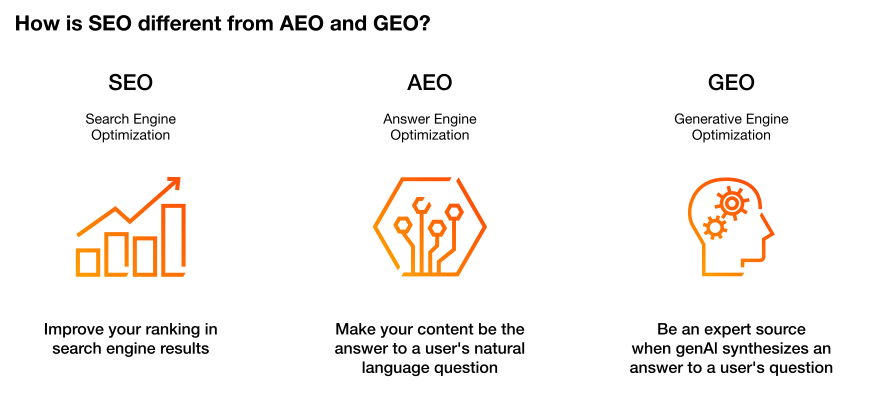
Search engine optimization: SEO focuses on improving visibility in organic search results. Climbing up in the rankings involves keyword strategy, meta tags, backlink building, technical site health and relevant content. SEO has been the cornerstone of digital marketing for banks aiming to reach people searching for specific financial products like “best savings account rates.”

Answer engine optimization: In a subtle shift from SEO, the idea behind AEO is to have the content be the answer itself, with the link being of secondary importance. In several cases this requires structuring content but also making the content conversational and concise so answer engines can address natural-language questions by easily extracting the answer. Instead of a generic page targeting “mortgage rates,” for example, a bank might create content that directly answers, “What are today’s 30-year mortgage rates for first-time buyers?”

Generative engine optimization: Often used interchangeably with AEO, GEO refers to restructuring content for AI-driven generative search results. With the emergence of generative AI (GenAI) in search, queries can return synthesized answers compiled from multiple sources rather than a list of links. The aim is to increase the probability of your information being included in those AI-generated summaries and recommendations.

Whether we call it AEO or GEO, the objective is to become the trusted source that AI platforms cite or recommend. If a user asks an AI assistant “What’s the best checking account in Dallas?”, the strategic goal is to have the AI answer include your bank’s account details (and hopefully cited), rather than being absent from the conversation.

Traditional SEO remains important, but its effectiveness is changing. Zero-click searches could mean customers are getting answers to their questions without visiting your site. As AI answers proliferate, individuals might not even see the source websites unless they check citations. For your bank, that could mean two very different outcomes. On one hand, being the snippet or AI-cited source confers authority and can yield traffic or leads (as users trust the AI’s recommendations). On the other hand, if your bank doesn’t appear in those results, you may be completely bypassed by a prospective customer. Consider if a prospect asks an AI engine, “What are the top 5 small business loan providers and their rates?” If your bank’s offering isn’t part of the answer, that prospect might never know about it — even if you had a great webpage that appeared in traditional search results.

What does it practically mean to optimize for answer engines and generative engines?

Key elements include:

For example, content that explicitly asks and answers, “How can I improve my credit score to get a loan?” or “What’s the difference between a HELOC and a home equity loan?” Banks should expand FAQ sections, knowledge bases and blog posts to cover these conversational queries holistically.

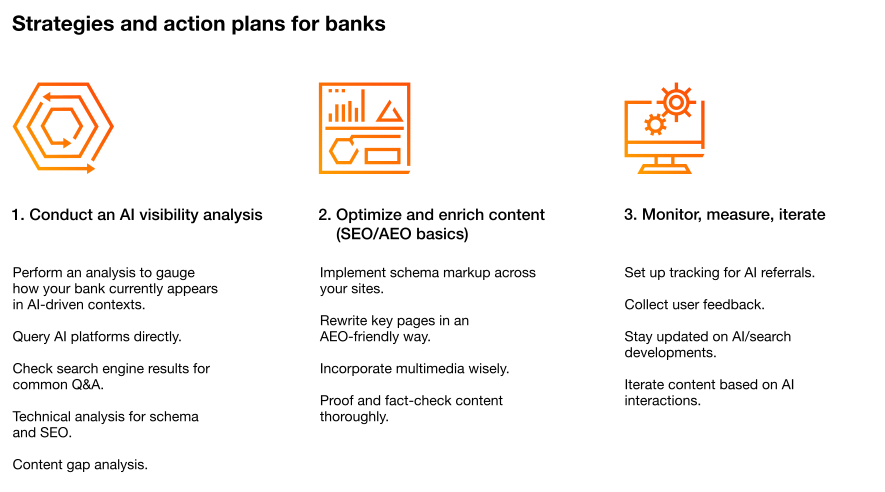
SEO isn’t going away — it’s important to speak “machine language” to AI in addition to natural language considerations. Implement schema markup (using JSON-LD or microdata) on your pages for things like FAQs, product details, rates, addresses, reviews, etc. For example, marking up your branch locations, contact info or interest rates with schema helps confirm that the AI assistant will retrieve the answer correctly if someone asks, “Where is the nearest ATM?” or “What’s Bank X’s CD rate today?”

Content optimized for GEO should be written to align with user intent and natural phrasing. For example, instead of “consumer deposit account.” use “savings account” if that’s what people say. Is your content tone answering likely questions in plain language? Does it cover the who, what, where, when, why that a user (or AI) might want?

There are now tools to track how your brand appears in AI answers and to measure brand performance on generative searches. Your bank should begin incorporating these into its analytics.

The rise of agentic commerce: AI as a customer assistant and personal shopper

Parallel to the transformation in search is an equally disruptive trend in commerce — the advent of agentic commerce. As defined in our recent retail disruption perspective:

“Agentic commerce refers to a new way of shopping powered by AI agents: software systems, usually powered by GenAI, designed to act on a user’s behalf. Unlike traditional chatbots, AI agents don’t just respond to prompts. They can browse, compare and even initiate purchases based on the user’s goals, preferences and constraints.”

Much of the agentic commerce discussion revolves around how retailers may be affected. However, banking is likely to be deeply impacted also.

Here’s why your marketers and strategists should pay attention:

If an AI agent stands between the customer and the bank, the bank’s traditional touchpoints diminish. Rather than visit a branch or website to inquire about a loan or open an account, someone might simply ask their AI agent, “Find me the best small business loan I qualify for and initiate the application.” The AI could interact with multiple banks’ systems (via APIs or by parsing sites) and potentially decide on one, perhaps even completing an application up to a point. The customer’s impression of the bank may be based solely on what the AI relays, meaning branding and value propositions may never be seen.

AI agents are likely to be less swayed by traditional marketing. For instance, a human might be drawn in by a mortgage ad, but an AI agent recommending a mortgage provider will analyze APRs, fees, product options and maybe user reviews. It will compare either objectively or based on the user’s preferences. This means banks should compete even more on product merits (rates, features, customer reviews) and make the data supporting that product transparent and accessible.

Agentic AI is not just for customers. Enterprises, including banks are redefining several of their activities as a result of this set of technologies. Many banks have deployed AI chatbots for customer service. The next step is making these chatbots more agentic by going beyond answering questions to executing tasks. We could see banks developing a “financial agent” for customers — an AI that proactively gives insights (“You’re spending more than usual on dining, want to move $100 from checking to cover your budget?”) and execute decisions (“Yes, move the money” or “Apply for the loan now”). It would help drive engagement and loyalty by providing a cutting-edge personal assistant aligned to your bank’s products.

Consider a small business using an AI agent to manage finances. The business could move surplus cash into a higher-yield account or shop around for the best merchant services provider when current fees get too high. Corporate treasurers might have an AI agent that automatically improves currency trades or credit line usage across multiple banks. Banks that want to retain B2B clients should prepare for an era where RFPs or treasury decisions might be influenced or even made by AI agents. This means providing thorough information (perhaps via whitepapers or developer-friendly documentation for fintech integrations, etc.) so that corporate-focused AI tools take your bank into consideration.

Implications for digital strategy: Retail banking

Agentic commerce and AI search will alter the steps consumers take to reach a financial decision. Banks should map out these emerging journeys and identify where to join the conversation or support customer information gathering. A few scenarios and strategic responses include:

AI-recommended products: A consumer asks their AI assistant, “Find me a good travel credit card with no annual fee and great rewards.” The AI assistant comes back with a recommendation, perhaps “I suggest the XYZ Bank Travel Rewards Card because it has no annual fee and 3% cashback on travel.” If your bank is XYZ in this case, great — you won because your card’s info was accessible and compelling to the AI. If you’re not, how can you get into that consideration set?

  • Strategy: Confirm your card’s unique selling points are clearly articulated online and consider creating or expanding SEO/AEO optimized content that targets comparison queries (such as “compare travel credit cards”) by highlighting key differentiators. It may also be worth creating tools or calculators on your site (e.g., reward calculators) — sometimes, AI agents might reference or even use such tools if publicly available.

Autonomous switching: Personal finance management (PFM) apps are increasingly agentic. Imagine an app that monitors a user’s accounts across banks and says, “You could earn $50 more in interest by moving your savings from bank A to bank B. Shall I move it for you?” If the user agrees, the agent uses open banking protocols to transfer funds or open a new account.

  • Strategy: Reconsider retention tactics in an agentic world. Loyalty programs or relational benefits might help by offering superior customer service or multi-product discounts.

Voice or chat-based account opening: A user tells their conversational AI assistant, “Open a new checking account at bank Y.”

  • Strategy: Work on enabling at least partial account opening via voice or chat interfaces. Even if regulations or practicalities require final steps with a human or a website form, starting the process via voice (“Sure, I can help with that. What’s your full name and address to begin?”) can be a differentiator. This is both a marketing and a user-experience improvement. It requires close work with product and IT teams, but marketing should advocate for it because it aligns with providing a seamless, omnichannel experience. If customers can shop and buy retail goods through agents, they’ll want to do the same with services like banking.

The retail customer journey is becoming less linear and more AI-influenced. Banks should keep their brand and products in that AI-influenced loop, either by feeding information AI needs or creating their own AI touchpoints for customers.

Implications for digital strategy: Commercial banking

While the dynamic is different for B2B segments, ranging from small businesses to large corporations and institutional clients, the core concepts of AI-driven search and agentic processes still apply. Businesses often have more complex needs and continue to rely on relationship managers, but digital discovery and automation are increasingly important in commercial finance.

Business decision-makers often search for insights and guidance, not just product keywords. Take “How to manage cash flow in a seasonal business” or “Treasury management best practices 2025.” An AI assistant might be asked about this by a CFO or a finance manager. If your bank produces high-quality thought leadership (whitepapers, articles, research) on these topics, it not only builds credibility but can position the content to be referenced in AI-generated answers.

Aim to have your bank’s professionals answer the big questions in your field. If you’re targeting SMBs, an article like “Top 5 ways to fund a growing small business” could attract queries and might be summarized by an AI answering a question on business financing. For larger corporate banking, content on “navigating interest rate volatility for corporate treasurers” could be picked up by the treasury staff’s AI assistants. Cite statistics, include real examples and consider publishing in places beyond your site like LinkedIn articles and trade journals. The key is that when an AI is compiling an answer about a financial strategy, your bank’s insight should be in the mix.

Banks often have webinars or PDF reports for businesses. Consider creating summary pages or Q&As around those, which AI can ingest more easily than a PDF. If you have an annual business outlook report, for example, create an HTML page with the top 10 findings as bullet points. This way, the AI might list a point from your bank’s research (with a citation) if someone asks “What’s the economic outlook for 2025 for small businesses?”

Corporate products (such as merchant services, corporate credit lines, trade finance) are harder to compare in a snippet than retail products, but you can still use schema where applicable (e.g., FAQ schema on “How does our payment API work?” page). If you have a developer portal for banking APIs (common in today’s open banking era), improve that for search as well. Developers or AI agents might use those docs.

Business buyers trust case studies and peer reviews. An AI that’s asked, “What’s the best bank for tech startups?” might reply with something like, “Many tech startups use Bank Z for its responsive service and understanding of the tech sector, according to reviews and case studies.” Make sure you have those case studies and sector-specific pages and encourage satisfied business clients to leave testimonials (on your site or a third-party site).

Larger companies might employ AI to parse RFP responses or even to generate the first draft of an RFP for banking services. You should confirm that you’re providing information in a structured, clear manner in your responses. (AI might be scoring those.) Your bank might even want to experiment with providing an AI-interactive RFP so a client’s AI can query your API or knowledge base for answers instead of reading a document.

Business banking products often involve a lot of documentation (terms, onboarding requirements, etc.). If an AI agent is helping a business gather info (“What does Bank X require to open a commercial line of credit?”), having that clearly enumerated on your site or via a chatbot will help. Consider providing quick reference guides or even AI chat access to your commercial onboarding team’s predefined Q&As.

Many banks are turning their products into banking-as-a-service components accessible via APIs. Even for direct clients, consider offering API access to certain functions like balance reporting, transaction initiation, loan drawdowns and so on. A corporate client that uses an AI agent for treasury might prefer banks that offer APIs that the agent can interface with. Marketing can highlight this in sales materials — “Our bank offers a full suite of APIs, allowing your systems or AI agents to seamlessly integrate for reporting and payments.” This positions your bank as tech-forward and agent-ready.

In commercial banking, the human touch will still matter. Agentic AI will likely handle more analysis and routine, while humans can focus on complex negotiations and trust-building. Marketers should position their bank as high-tech and high-touch. Emphasize that your bank uses AI to deliver fast, data-driven service while also professional advisors as needed. The goal is to reassure clients that AI isn’t making your service impersonal but instead making it more efficient so your people can spend a greater amount of time on what matters.

Adapting websites and apps: practical changes

Here are practical changes banks can implement on their websites and mobile apps to support SEO, AEO, GEO and agentic commerce readiness.

Confirm the site search can handle natural language queries. Customers are getting used to typing full questions. If your site search can interpret “I want to increase my credit limit” and direct to the right help page, that’s ideal. This also trains your content to align with those queries.

Incorporate FAQs and use clear subheadings to cover who the product is for, how it works, requirements, etc. Provide comparison info if you have multiple options (maybe an AI will pull a line saying “Bank X offers three checking accounts and waives fees if conditions are met on the premium one”). Embedding concise comparison tables is useful — not just for AI but for mobile users as well.

Implement text-to-speech for content on your site (some sites have a “listen to this article”). This not only aids accessibility for users but someday could allow voice assistants to directly play content from your site if a user wants more detail.

This is forward-looking, but consider exposing certain information in machine-readable formats beyond schema. For example, a simple public API endpoint for your current interest rates, or a chatbot API that external agents (with authorization) could query for info. If you offer that proactively (even just a data feed of your product list and terms), you might get integrated more readily. One simple step: Maintain a well-structured XML sitemap of your site content that AI crawlers can use to find information efficiently.

Embedding an AI-based financial coach inside your app can become a differentiator. One example is a GPT-powered feature that answers questions about spending or provides tips on budgeting based on the user’s data (with permission). This keeps users engaged in your ecosystem rather than asking an external AI that might suggest a competitor’s product. It’s both a retention tool and a data generator: You’ll learn what people are curious about.

If many users start coming via AI referrals (AI provides a link to “open account” which opens your app or site), confirm that the onboarding flow handles that smoothly. Implement referral codes for AI sources so you can track them and maybe customize the landing experience (“Referred by SmartAgent — welcome! Here’s a quick intro…”). It may be early for this, but having analytics in place now could alert you if, for example, a wave of traffic starts coming from a specific AI assistant.

Challenges and considerations in shifting strategies

Adopting AEO and GEO and preparing for agentic commerce is not without challenges. Banks should be mindful of these issues and plan steps to address them.

Misinformation in AI answers (quoting an outdated rate or an incorrect policy, for instance) can mislead customers and even pose compliance issues. One risk is that AI might pull data from an unofficial source. To address this, banks should publish clear, up-to-date info and perhaps use techniques like schema or data feeds that AI relies on. Additionally, monitor AI outputs about your bank. Just as companies do social listening, consider “AI listening” — periodically asking popular AI platforms questions about your bank or products. If inaccuracies are found, update your content accordingly.

Agentic commerce relies on sharing data and access with AI agents. But if users connect their bank accounts to a third-party AI tool, is it secure? What if the tool makes a wrong decision with their money? It’s important to develop a clear consent framework for any agent interactions. Perhaps you’ll require an extra verification step for an AI-initiated high-value transfer, etc. From a marketing standpoint, emphasize that your bank is innovating responsibly. Highlight security features of your digital services, use of encryption, fraud monitoring and the ability for customers to turn off AI access at any time. Consider whether you should obtain independent assurance over your AI systems. Build trust that as you enable convenience you haven’t sacrificed safeguards and security.

Implementing these changes requires collaboration between marketing, IT, product, compliance and so on. SEO/AEO might be led by marketing or digital teams, whereas enabling agentic functionality involves product development and perhaps partnerships (like integrating with voice platforms or agent startups). Breaking silos is essential. One idea is to create a cross-functional “AI in Banking” task force that meets regularly, aligning efforts on content, technology and policy. If your content and compliance teams know what the API team is enabling, they’ll have a leg up on marketing and documentation. Similarly, feedback from frontline staff (like what customers ask chatbots) should loop into content strategy.

Traditional metrics like website visits and click-through rates may become less straightforward in an AI answer world. If a customer gets their answer from an AI and then later directly types your homepage to apply, that success might not be attributed to the AI. New KPIs might be needed: share-of-voice in AI results, number of citations of your content in AI summaries and even conversions from voice interactions (for instance, “How many people used voice to do X”). Setting up analytics can be challenging but start with what you can. Monitor referral sources with query strings that indicate AI usage. Track usage of any voice skill or chatbot you deploy (how many queries, what intents).

AEO and GEO require a lot of content (answering many questions, etc.). But don’t turn your site into a content farm of thin Q&A just to target queries. Quality and accuracy matter more than ever. AI can detect and ignore low-value content. Invest in high-quality content creation — possibly leverage AI to help draft it but confirm human review and insight.

Many customers are still hesitant or concerned about AI. Marketing strategy should communicate that these new features are optional enhancements. Continue to provide and support traditional channels (web forms, phone support, in-branch) for those who prefer them. As AI proves to be convenient and powerful, more people will shift but always offer an easy off-ramp to a human.

Conclusion

The marketing paradigm for banks is broadening from “search engine optimization” to “search everywhere optimization.” Concurrently, the notion of “customer” is expanding to include AI agents acting on the customer’s behalf. This demands a dual focus — staying discoverable to human customers and AI intermediaries alike.

In practical terms, banks in both B2C and B2B spheres should:

  • Bolster their digital content and SEO fundamentals.
  • Embrace new digital channels and interfaces.
  • Adapt products and processes for agentic commerce.
  • Maintain the human touch and trust that banking is built on.

For banks, the shift to SEO, AEO, GEO and agentic commerce is both a challenge and an opening. It’s a chance for incumbents to modernize their approach and for forward-leaning institutions to capture early adopter customers. The cost of inaction, however, could be steep: reduced visibility, loss of customer engagement and being overshadowed by more tech-savvy rivals — or even tech companies encroaching on financial services.

Contact us

Roberto Hernandez

Roberto Hernandez

Front Office Consulting Partner, PwC US

George Korizis

George Korizis

Front Office Consulting Partner, PwC US

Follow us

Required fields are marked with an asterisk(*)

Your personal information will be handled in accordance with our Privacy Statement. You can update your communication preferences at any time by clicking the unsubscribe link in a PwC email or by submitting a request as outlined in our Privacy Statement.

Hide