







{{item.videoDuration}}
{{item.title}}
{{item.text}}

{{item.videoDuration}}
{{item.text}}
Mid- and small-cap investor-owned utilities (IOUs) find themselves at the center of a perfect storm, facing escalating capital expenditure needs, supply chain constraints, and heightened regulatory and customer expectations focused on affordability, reliability, and faster, more reliable interconnections. This pressure arises amid unprecedented transformation in the US power and utilities sector, where, after years of relatively flat electricity demand, rapid growth driven by AI, data centers, and broader electrification is dramatically reshaping consumption patterns.
In this environment, scale is no longer a luxury or a competitive differentiator. It’s a structural necessity. While strategies to manage these pressures vary, mergers, acquisitions, and strategic relationships stand apart as the most holistic way for mid- and small-cap IOUs to build the scale, delivery capability, and financial resilience needed to meet soaring demand while safeguarding customers and credit profiles.
The last decade’s flat demand environment allowed many smaller and mid-size IOUs to operate as standalones, relying on modest capital plans and the ability to anticipate and manage costs. That environment has changed.
Affordability constraints
Data from the Energy Information Administration (EIA) indicates that retail electric prices have outpaced general inflation since 2022, and they’re projected to keep rising through 2026. Notably, regions with already higher prices have experienced larger percentage hikes, squeezing the available “rate headroom” for further growth. For many IOUs, particularly smaller ones, the ability to raise rates without triggering credit metric deterioration or regulatory pushback is tightly constrained.
Affordability has shifted from an outcome to a fundamental gating constraint. Where demand grows, regulators and customers alike expect bills to remain manageable, even as utilities face intensifying capital needs to modernize grids and onboard new large loads. When affordability limits growth and investment, utilities risk eroding political and regulatory support jeopardizing long-term sustainability.
For small- and mid-cap IOUs, the critical starting point in strategic planning is understanding where their states fall on the spectrum of load growth and affordability pressures. Because the story varies markedly across regions, boards should frame each potential path, including mergers and acquisitions, against a fundamental hypothetical question:
“In our states, are we in a growth-and-affordability position we can manage alone, or do we need a larger balance sheet and delivery platform to keep bills tolerable while we build?”
Structural load growth: After nearly two decades of relatively flat demand, US electricity consumption grew again in 2024 and is projected to rise by roughly 2%–3% per year in 2025–2026.1
State-level divergence for smaller IOUs: Many states served by mid- and small-cap IOUs are seeing modest or highly localized load growth, often anchored by a limited number of data-center or manufacturing projects rather than broad-based demand.
1 Source: U.S. Energy Information Administration (EIA), Short-Term Energy Outlook (electricity section), 2024–2025 editions
Affordability pressure is rising, and often faster in high-price regions: EIA figures show that retail electricity prices have risen faster than general inflation since 2022 and they’re expected to continue increasing through 2026. Higher-price regions have, on average, experienced larger percentage increases in electricity prices than low-price regions, compressing headroom for further rate increases.
PwC’s analysis of state-level sales, retail price trends and known large-load projects segments smaller IOUs into distinct quadrants.
All this underscores why scale and financial resilience—often achieved through M&A—are no longer optional for many mid- and small-cap IOUs. Understanding your position in this matrix helps clarify the urgency and form of action required to balance growth ambitions with affordability and regulatory expectations.
Accelerating and complex load growth driven by AI and data centers
After years of modest or declining consumption, electricity demand is now surging anew, propelled by data centers, AI workloads, and electrification initiatives. Unlike traditional incremental growth, these new loads often arrive in large “lumps.” And while these anchor multi-year infrastructure investments, they still demand far faster interconnection timelines than utilities have historically delivered.
Time-to-power has become a key battleground. Large customers expect clear, executable interconnection paths, prompt and trustworthy construction delivery, and rate structures that shield existing customers from cross-subsidization. Failure to deliver can result in lost projects, untapped load growth, and reputational damage.
Increasingly complex regulatory and policy landscape
Recent shifts in the federal policy environment, including the One Big Beautiful Bill Act (OBBBA), modifications to renewable investment tax credits, and heightened domestic content requirements, have compounded project and financing complexity. Investor appetite is tilting toward assets and utilities that demonstrate clear regulatory frameworks, capital efficiency, and operational scale.
Simultaneously, long lead times for critical grid equipment have been exacerbated by global supply chain disruptions. Utilities with smaller procurement footprints are at a disadvantage, unable to secure favorable pricing or priority equipment allocations.
In addition, regulators are sharpening their focus on the ability of utilities to transform capital plans into delivered projects while safeguarding affordability and reliability guardrails. The viability of standalone growth plans is increasingly questioned.
Risks of inaction: a costly proposition
Smaller and mid-cap IOUs that delay decisive action risk losing key large-load customers to better-equipped competitors and face escalating rate pressures that undermine affordability while attracting increased regulatory challenges. They’re also vulnerable to supply chain pinch points as larger buyers secure scarce equipment through multi-year contracts, further constraining their ability to deliver.
Additionally, such utilities may suffer a decline in investor confidence, resulting in increased financing costs. Ultimately, by not acting swiftly, utilities risk being left behind in the ongoing consolidation wave and losing access to attractive partners essential for future growth and competitiveness.
Scale safeguards affordability through three principal mechanisms:
1. Spreading fixed costs over a larger customer base:
Fixed operating expenses, infrastructure maintenance, and capital costs become less burdensome on a per-customer basis as the size of the customer base grows, reducing the need for steep rate increases.
2. Realizing merger synergies that reduce costs:
Merger-driven cost reductions, through elimination of duplication, streamlined corporate functions, integrated IT systems, and optimized operations, can be significant. When utilities commit merger savings to customers via bill credits, rate caps, or verified savings-sharing, these synergies directly offset upward rate pressure from escalating capital spending.
3. Improved procurement leverage over constrained supply chains:
The global shortage of long-lead equipment (transformers, cables, network components, etc.) favors buyers with negotiating power to secure multi-year volume contracts with OEMs at favorable pricing. Larger utilities can standardize specifications, pool demand, and negotiate frame agreements that smaller IOUs simply cannot access, reducing cost and schedule risk.
Together, these levers compound to generate materially greater affordability and financial flexibility than smaller utilities can achieve alone.
Capital formation and credit strength accelerate reinvestment capacity
Mid- and small-cap utilities often carry higher weighted average costs of capital (WACC) and less diversified balance sheets. Scale achieved through M&A can strengthen credit profiles and lower financing costs, unlocking additional borrowing capacity. This is critical when planning to invest upwards of $1 trillion over the 2025–2029 period to support grid modernization and large industrial loads.
Enhanced capital formation capacity enables utilities to fund transformative infrastructure investments without jeopardizing credit metrics or risking downgrades—factors that could adversely impact long-term financing access and cost.
Industrializing large-load onboarding capabilities
Fragmented interconnection procedures are costly and slow, especially for large-load customers running multiple projects simultaneously. Larger utilities can stand up dedicated onboarding teams that standardize milestones, tariffs, engineering requirements, and project management across service territories—compressing cycle times and making the process legible to customers.
These improvements reduce rework, lower schedule risk, and improve asset utilization—all of which facilitate reliability and affordability, enabling utilities to compete robustly for new large-load projects.
Building a technology-enabled smart grid at scale
Scale is also critical to deploying AI and digital tools to optimize operations, planning, and customer service. Consolidated utilities can spread technology investment costs over broader platforms, extract efficiencies, automate back-office functions, and deliver better grid reliability and customer outcomes.
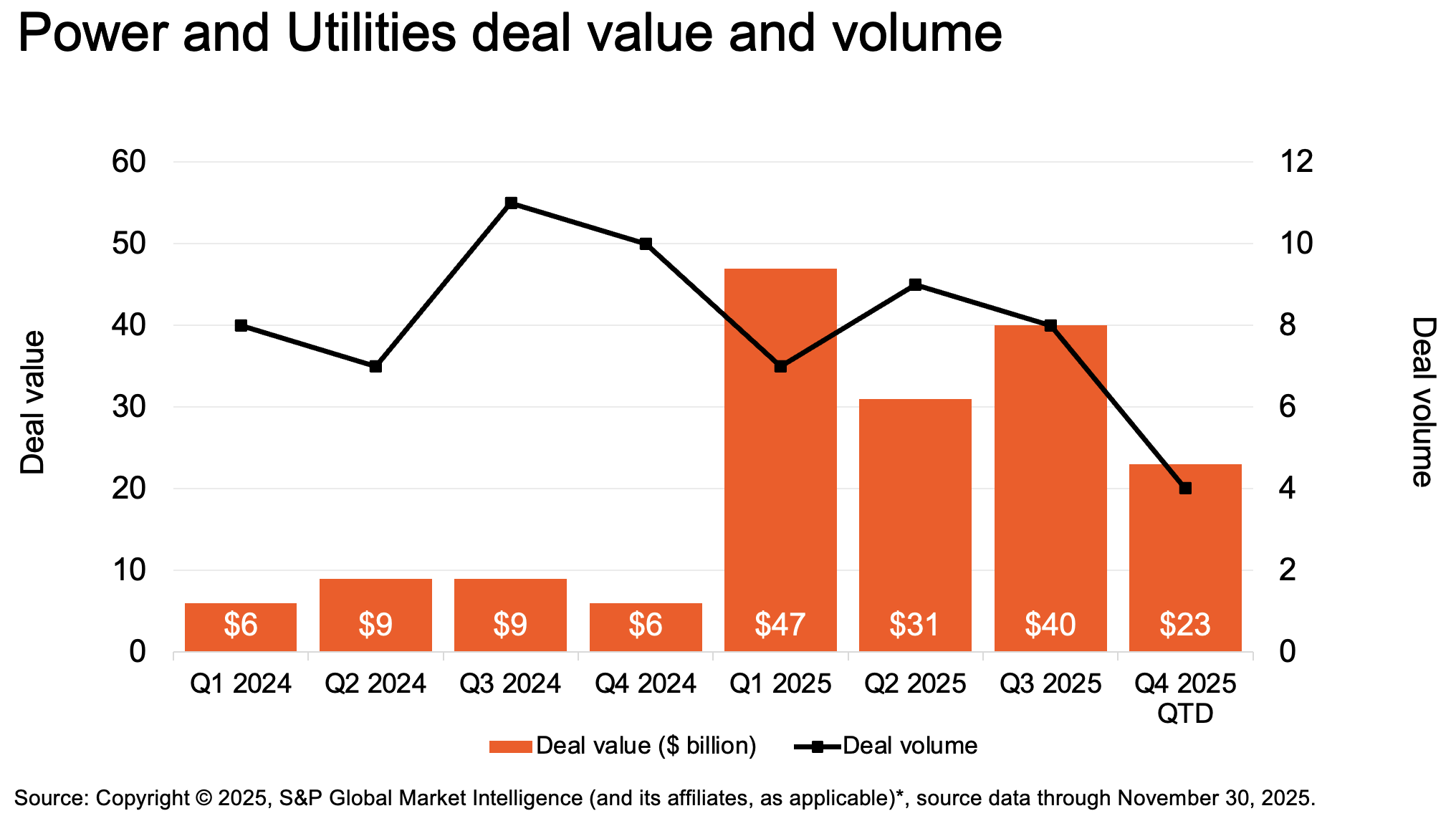
The power and utilities sector has seen a surge of M&A activity driven fundamentally by the same structural dynamics outlined above. From November 2024 to November 2025, total power and utilities announced deal value reached $141.9 billion across 35 transactions, a considerable increase from the prior year’s total of $30 billion. The rationale is clear. The utilities that emerge at scale can win the next wave of load growth, investor confidence, and regulatory support.
US consolidations have routinely produced concretely demonstrated synergy, delivered through operational simplification, shared services, digital integration, and supply-chain optimization. Synergies of 5-9% and 2-4% on planned capex have been realized and partially committed back to customers, per proprietary PwC data. This scale and savings enable utilities to better manage rate pressures and maintain or expand infrastructure investment to meet demand.
Regulatory bodies increasingly support transactions with credible affordability commitments (bill credits, savings sharing, caps on O&M growth) and strong community engagement plans that align local benefits with investment sequencing and rate protections. This has set a precedent and a roadmap for smaller IOUs considering M&A.
Conversely, smaller utilities that hesitate face real risks of losing prospective large-load customers to better-equipped competitors, facing costlier financing and supply constraints, and ultimately risking erosion of franchise value.
Recognizing the complexities and stakes, midsize and smaller IOUs should quickly and rigorously assess whether their current standalone strategies suffice or if consolidation offers the better path.
Here’s a six-step framework.
The power and utilities sector is undergoing a fundamental shift driven by historic demand growth, capital intensity, and regulatory rigor. For mid- and small-cap IOUs, scale has moved from a strategic advantage to a structural necessity to achieve affordability, speed of delivery, and credit durability. While alternative strategies provide some partial relief, mergers, acquisitions, and strategic relationships offer the most complete, credible, and durable path forward.
Boards and executives should promptly evaluate their risk and opportunity profile, quantify synergy potential with a customer commitment lens, and build robust regulatory and community engagement strategies. Failing to act decisively risks marginalization in a sector where scale, speed, and affordability are the new gatekeepers of sustainable growth.
{{item.text}}
{{item.text}}