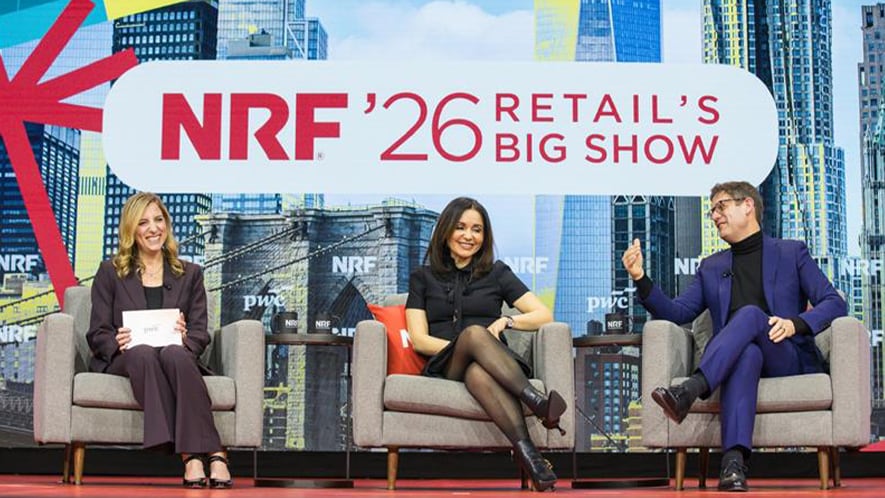
On a chilly Sunday morning in January, Google’s CEO Sundar Pichai stood before thousands of retail executives inside the Javits Center’s main theater to announce the Universal Commerce Protocol (UCP), an open-source language that would connect AI agents to merchants worldwide. The protocol enables what Google calls an “invisible shelf,” facilitating native checkout directions within search, producing a standardizing framework for retailers to scale their presence across the Google ecosystem. That announcement probably garnered the most headlines from the NRF’s Big Show. But it was the next afternoon, in that same space, when Emma Grede, co-founder and CEO of Good American and founding partner of SKIMS, made the implications of agentic commerce real, by making them personal.
“What I feel is that we’re in the midst of a really seismic change,” Grede told the packed theater when asked about the next era of retail during a panel discussion with Shopify’s president. Both of her companies were among the first retailers on earth to go live on new agent platforms. “Our customers are already there,” she said. “They’re playing with AI. They’re using it in their everyday lives. It’s informing their purchase decisions. And so for me, it’s an easy yes. You have to be in it, and you have to learn early.”

If you were among the nearly 40,000 attendees at the NRF’s Big Show, you likely rethought at least one assumption you had about retail's future. The most common revelation: The future isn't about AI replacing humans, but about redefining what each does best.
Grede crystallized this idea by explaining what she called her “second executive brain” framework. “I think the question that I ask myself most is,” she said, “is this something I should be doing? Is this something my team should be doing? Or should AI be doing it?” Her conclusion was both practical and profound: “AI can do certain things at the speed that no human would ever find manageable. So for me, it’s not about taking anything human out of what we do. It’s actually leaving ourselves the time to do the stuff that only we can do.”
“I think that being really true to who you are and to your customers and being steadfast in your vision, resisting the urge to do everything, that’s what has our companies in a really healthy, but also in a really kind of aspirational place.”
The mood shift: Everyone’s learning together
From the sprawling expo halls to the many keynotes with CEOs in the main theater at Javits, the energy was contagious at the year’s biggest retail conference. Most leaders didn't express concern about change, and they were candid about their experiences using AI. They shared learnings, expressed vulnerability, humility, and empathy. Again and again, executives noted keeping customers and employees at the front and center of their efforts to grow, even the tech-led initiatives.
“Luxury is all about human connection,” said Gonzague de Pirey, chief omnichannel and data officer at LVMH, during an engaging panel discussion on day one of the NRF three-day event. “If we are able, thanks to AI, to increase the desire of people for our brands, that would be the absolute key for success,” he said. But to do that, he explained that LVMH prides itself on the concept of “quiet tech,” which means AI is so seamlessly integrated that it amplifies rather than announces itself.
"If we want to develop successful technology, the technology needs to be everywhere, but visible nowhere."
Ali Furman, PwC’s U.S. consumer markets industry leader, who moderated the LVMH panel, said that in earlier years, conversations about AI focused on "efficiency, productivity gains, automation, and cost takeout." But now, more people are “talking about humanity, about how designers, artisans, and clients are really at the center—and how the purpose of technology isn’t to replace anything that they were doing, but to retain the magic of what they were doing.” Agreeing with that sentiment, Soumia Hadjali, global SVP of client development, digital and omnichannel, at Louis Vuitton, described using AI to help designers explore deeper and faster while ensuring “the signature remains really human and distinctive.”
This human-centric approach extended to how brands are reimagining agentic commerce itself. Rather than treating AI agents as sophisticated search tools, forward-thinking retailers are creating entire ecosystems. Hadjali described orchestrating that entire ecosystem around one single client—from product recommendations to restaurant reservations to exhibition access. “It's really about being a part of our client’s life and not just another transaction,” she said.

The big picture: Five signals from the show
As executives moved between the large keynote speeches at Javits and PwC's more intimate working sessions, the conference's real insight crystallized: The agents have arrived, but their job isn't to replace people. It’s to give us back the time to do what only humans can: create desire, build loyalty, and turn transactions into relationships. Five key themes emerged across this year’s NRF conference:
- Agentic commerce is operational, not experimental. With the announcement of Google's Universal Commerce Protocol enabling "discounts, bundling, subscriptions, merchandising, shipping, fulfillment," the infrastructure is live. In these early days, the priority is efficiency and frictionless buying. Over the next year we’ll see evolution in UX, emotion, loyalty and diverse payment methods.
- AI creates time for uniquely human work. Leaders emphasized using AI to eliminate tasks "no human would ever find manageable," freeing teams for creative and strategic thinking.
- Quiet tech is becoming the new standard. The most sophisticated implementations make technology invisible while making experiences more personal. Retail remains a people business.
- Gen Z is the generation to watch and learn from. Panels on tomorrow's workforce revealed that younger consumers (who are also the retail industry’s emerging leaders) expect AI integration as baseline, not innovation.
- Scale can require restraint. Both Grede and LVMH executives emphasized saying no—resisting the urge to do everything—as key to maintaining brand identity while embracing AI. Also as a means to build trust with employees and customers.
These takeaways extend beyond customer interactions to the workforce itself. During a PwC-hosted panel on the future of talent, retail leaders revealed that Gen Z employees, who will comprise 30% of the workforce by 2030, don't just expect AI integration; they demand it. “They're asking for AI tools on day one,” one executive noted, describing how younger workers view AI capabilities as table stakes for employment, not innovation. These digital natives bring a fundamentally different perspective: they see AI as a creative partner rather than a threat, using it to amplify their human contributions.
And that means the infrastructure enabling this industry-wide shift for many retailers relies on unprecedented collaboration between tech giants and commerce platforms. It’s fundamentally about enterprise AI—not consumer chatbots, but sophisticated systems that reshape how businesses discover demand, manage operations, and complete transactions at scale. For retailers navigating this shift, the path forward requires more than technology; it demands a partner who understands both the commercial implications and the technical architecture. During a small roundtable discussion, executives detailed how alliance partners are building the rails for agentic commerce. As new protocols connect with payment processors and commerce platforms, the technical barriers to agent-driven transactions are dissolving quickly—making the “quiet tech” revolution not just possible, but inevitable.
PwC brings together deep retail expertise with enterprise AI capabilities and strategic alliances to help retailers build agentic commerce strategies that work across B2B, B2C, and marketplace channels. As one executive noted during the conference, “The winners will be those who treat agentic commerce not as an experiment, but as their next major channel.” The infrastructure is ready. The agents have arrived. The only question now is who will lead this next era of agentic commerce.
Discover how we’re helping companies lead the next era of agentic commerce
Contact us