
Consumer spending was strong, but it also signaled a new pattern of demand: less frequent, more intentional, and increasingly influenced by AI, generational differences, and income.
The receipts are in, and consumer spending rose 6.4% year over year (YoY). But that headline number obscures a more nuanced story about who spent and how they shopped. Based on the signals we saw in late 2025, consumer decision-making is likely to be increasingly segmented by income and generational divides, and shaped by algorithmic forces in 2026.
Income divergence
Over the holidays, based on PwC analysis of household receipt data from Numerator, consumer spending was concentrated at the top, with high-income households driving nearly all growth, pointing to a “Pac-Man-shaped economy,” as noted by PwC economist Alexis Crow. Compared to the idea of a K-shaped economy, Crow writes: “The economic fates of the lower parts have flatlined in recent years rather than outright tumbled. Pac-Man’s narrow mouth shows that more clearly.”
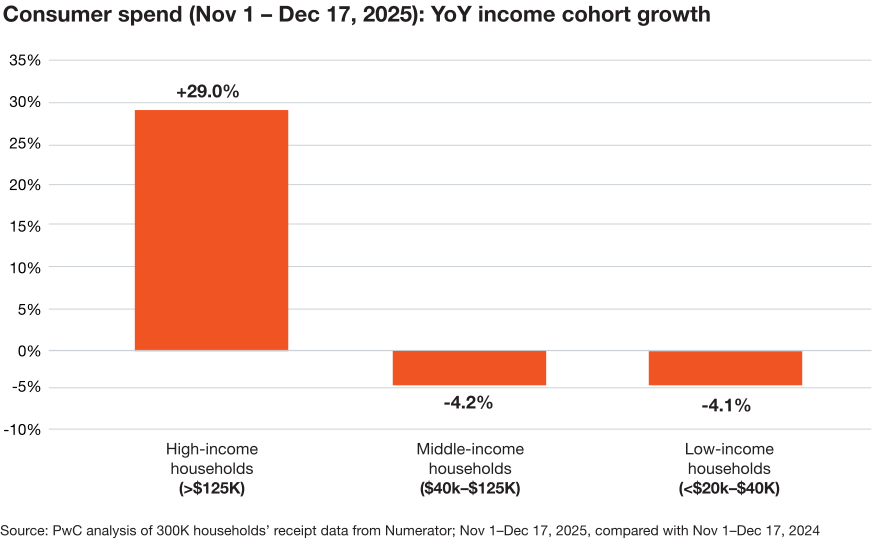
Similarly, high-income households’ share of spend jumped nearly seven points from 31.7% of total holiday spend in 2024 to 38.5% in 2025. At the same time, middle-income households’ share fell from 49.2% to 44.3%, and low-income share dropped from 19.1% to 17.2%.

Gen Z defies expectations
In the fall, PwC conducted its annual Holiday Outlook survey, in which Gen Z respondents expected to pull back on holiday spending. But our recent analysis of household receipt data found Gen Z actually spent nearly 21% more than last year during the holiday season. This say vs. do gap is common among Gen Z, but the receipt data also reflects more than specific gift spend. During the season, Gen Z probably spent on products related to their shifting life-stage needs. We also saw trends pointing to a rise in self-gifting and the resale market.

Gen Z clearly took advantage of promotions during the “five-day frenzy,” the period between Black Friday and Cyber Monday, likely to purchase things they felt they needed, as well as gifts, and to capture deeper discounts at mass retailers.

The total spending picture also puts Gen Z’s high YoY spend growth into perspective. Gen X still holds the largest share of spend at 34.4%, followed closely by baby boomers at 33.7%. Millennials account for 26.3%, while Gen Z represents just 5.6% of total holiday spend. The takeaway: An increase in spending across all generations shows a value-conscious consumer who is still shopping, and who will likely continue spending in 2026. And while older generations still hold the dollars, younger generations have rising influence and are critical trend setters to watch, particularly when it comes to digital commerce, social commerce, and adoption of AI shopping tools.

Behind the basket: What grew and why
Consumers across generations shopped less often this holiday season, consolidating trips due to price sensitivity, convenience, or both, but they spent more when they did shop. Trip frequency fell 5.7%, while spend per trip rose 11.1%, according to PwC analysis of Numerator data. Timing also mattered: People shopped earlier than in past years, leveraged promotions between Black Friday and Cyber Monday, and invested in meaningful experiences as well as wish-list items.
The basket tells a clear story: higher prices inflated parts of the topline, but where consumers chose to spend still reflected intent. Shoppers prioritized categories that offered a mix of utility, emotional value, and flexibility—especially while navigating food inflation and tightening discretionary budgets.
Apparel, electronics, and beauty grew 6—8%, aligning broadly with overall holiday spending, while books, home furnishings, and baby/toys surged higher. This spike points to two interesting dynamics. First, retailers in apparel and beauty—categories not historically known for deep discounting—offered more aggressive promotions, creating a pull toward self-gifting and multi-step regimens. Second, the rise of outcomes-based buying and wellness-minded behavior, tied in part to the growing adoption of GLP-1 medications, probably drove interest in health-tracking wearables. Consumers didn’t just seek savings; they looked for purchases that supported longer-term goals and self-improvement outcomes.

Food led holiday growth with a $5 billion year-over-year increase—driven by both elevated prices and steady demand. Food also played a dual role as a necessity and a treat. Premium groceries, wine, and specialty items became easy tradeoff choices—emotionally resonant, socially acceptable to gift, and easy to purchase at the last minute.
Where consumers shopped
Online shopping was the star this season, with spending growing three times faster than in-store. Consumers were likely driven by deal-hunting, the ability to compare prices across retailers, and new discovery paths, with AI referral traffic rising nearly 700% this season, according to Adobe.

Of course, consumers are still shopping in stores, at least in part driven by food purchases, but digital continues to gain ground in many categories. Heading into 2026, winning online will increasingly depend on where and how retailers show up in AI-driven discovery.

Merchandising, SEO, paid media, and even assortment mix will need to be re-anchored around how algorithms and AI agents, not just people, interact with brands.
Payment trends signal both innovation and strain
Credit card delinquency is fundamentally an income story. In the lowest-income ZIP codes, both 30-day and 90+-day delinquency rates exceed 20–23%, versus a national average near 3%, signaling highly concentrated financial stress (according to the St. Louis Fed). That pressure is compounded by age: borrowers under 30 are approaching 10% long-term delinquency, well above older cohorts, while baby boomers remain the lowest-risk group (according to Prodigal).
For retailers, this means greater demand volatility and price sensitivity among younger and lower-income shoppers, even as older, higher-income consumers continue to anchor spending. Against that backdrop, Buy Now, Pay Later (BNPL) reached a record $20 billion this season, according to Adobe, indicating that some consumers are looking for more payment flexibility amid rising financial pressure.
The generational picture for delinquency is also getting worse, with the same generations that are driving spending growth also showing the most financial strain. After pandemic-era lows in 2021, delinquency rates have climbed steadily across all generations, but Gen Z and millennials are pulling away from the pack. Gen Z delinquency rates are estimated to hit roughly 11% in 2025, up from around 8% in 2019. Boomers remain the most stable at about 7%.

Day-by-day spending
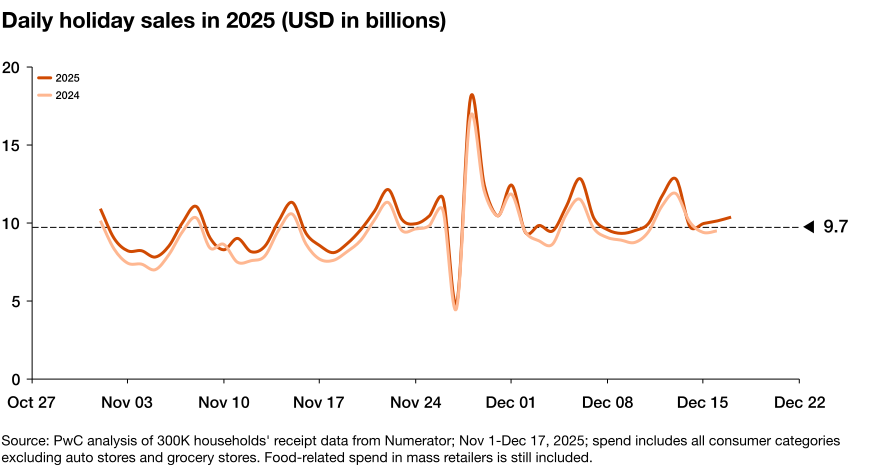
The holiday spend trends in 2025 tracked closely with 2024, with consumers spending just a bit more at each peak. Once again, the season’s spending topped at Black Friday, hitting nearly $20 billion in daily sales. The weekly rhythm otherwise shows weekend spikes and weekday dips with a gradual trailing off after mid-December.
Takeaway for retail leaders
Consumers spent more this holiday season, but they’re still feeling squeezed. This is what explains some of the “say versus do” gap between sentiment and actual spend, as particularly evidenced with Gen Z. Growth came disproportionately from high-income households and younger generations, while middle- and lower-income consumers pulled back. The same cohorts driving spending gains are also showing rising financial stress, with delinquency rates climbing fastest among Gen Z and in lower-income zip codes. Heading into 2026, we see three forces reshaping retail:
- Overall consumer health: High-income households are driving overall growth, but emotional relevance still dictates how and where people choose to spend. Increasing credit card delinquency could be a signal of future spend implications; certainly, it’s something to continue watching.
- Influence of younger generations: While they may not hold the majority of spending power yet, Gen Z is moving at the speed of culture, spending significant time online and influencing trends for all other generations.
- Acceleration of agentic commerce: Algorithms are collapsing the funnel, rapidly changing how consumers can discover, compare, and purchase products.
In several ways, this could be a preview of what's coming next: The headline numbers are looking good, but the details reveal the need for precision. Relevance now depends on knowing who you’re targeting, how they discover, and what gets them to convert.
The question for 2026 isn’t whether shoppers will spend. It’s who, when, and what will make them say yes. Relevance is the new retail battleground.
Contact us